
AFTER THE HURRICANE, THE ROAD BACK IN TAKES LONGEST
Tropical cyclones are getting stronger with climate change, and so are their costs. Most research on how people respond has focused on evacuation: who leaves before the storm. What happens afterwards, as communities get moving again, has been studied far less — usually for a single storm in a single city. The authors frame it as a question of fairness: not only who can leave, but who is left waiting.
Two storms, thirteen days apart
The 2024 Atlantic season offered an unusual comparison. Hurricane Helene made landfall on 26 September 2024 and Hurricane Milton on 9 October, just 13 days later, both in the southeastern United States. Helene’s damage reached far inland, including floods in southern Appalachia, across largely rural areas. Milton struck coastal, urban Florida.
Angelina Liu, of Scarsdale High School in New York, worked with Mengqiu Cao of University College London and Sen Pei and Qing Yao of Columbia University. They took every county within 100 miles of each storm’s track: 487 for Helene, 34 for Milton, home to 42.9 million people.
Reading recovery in phone traces
Their data are daily counts of visits to shops, offices, clinics, schools and other places, recorded from mobile devices by a commercial provider. The team sorted them into six activities — travel, work, health, education, retail and leisure, government — and three kinds of movement:
- local: trips that start and end inside the area;
- inflow: visits coming from outside the affected region;
- outflow: trips leaving it.
For each flow, a statistical model predicted what traffic would have been without a storm, based on 2023 and on the weeks before. Recovery time is when the observed visits climb back to that expected level.
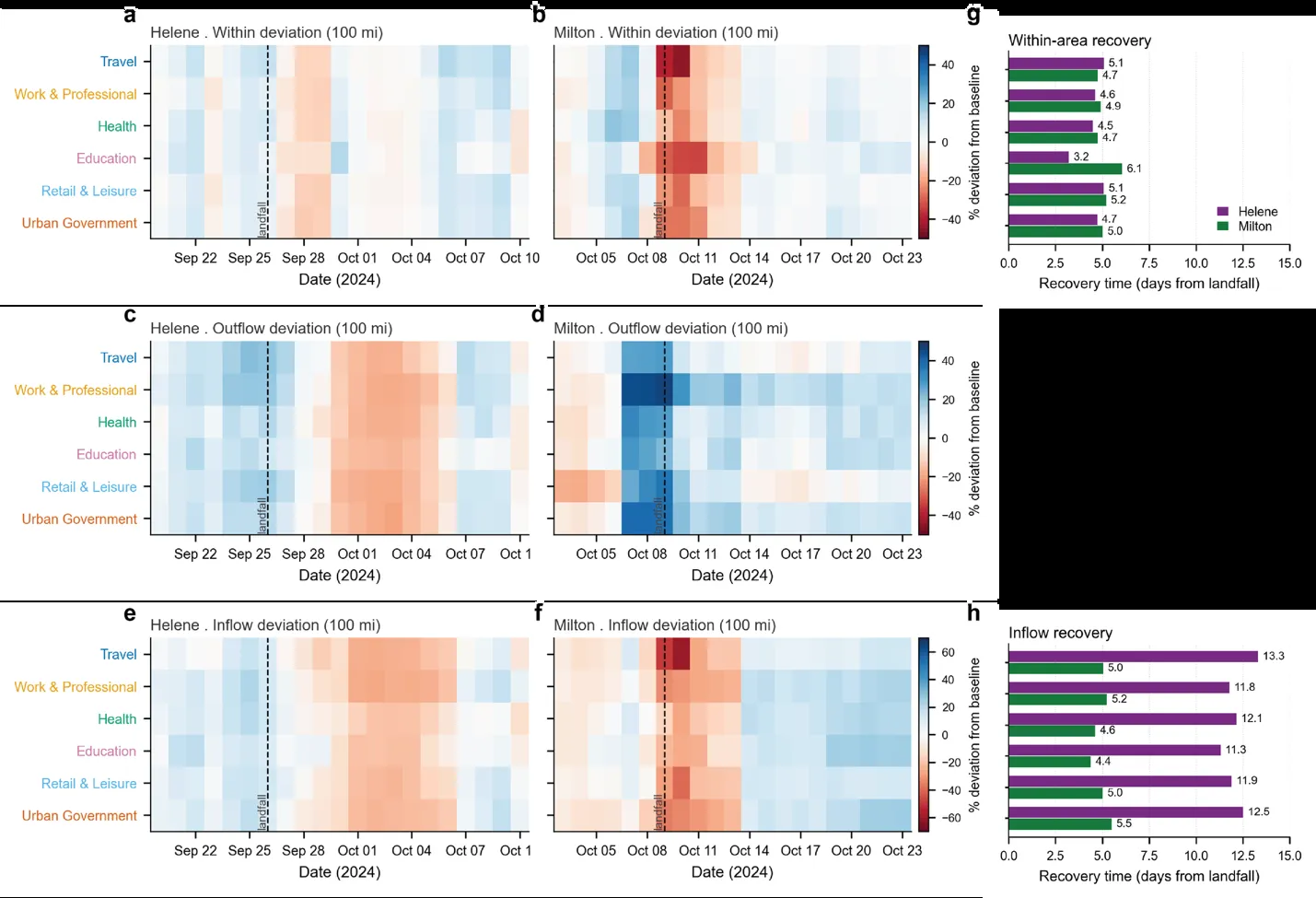
Daily deviation from expected mobility for six activities, for local trips, departures and arrivals (a–f), and recovery times (g, h): local recovery is similar, but arrivals take far longer after Helene (purple) than after Milton (green). — Figure 1, Liu, Cao, Pei & Yao (2026), arXiv:2610.17550.
The deeper shock recovered faster
Milton hit harder, in every category. Local movement fell by 24 to 45% under Milton, against 8 to 13% under Helene. Visits from outside fell by up to 60%. Departures surged two days before Milton’s landfall.
Yet local life came back at the same pace after both storms: a median of 4.4 days after Helene and 4.5 days after Milton, with no significant difference.
The gap was in reconnection. Visits from outside took 11.3 to 13.3 days to recover after Helene, in all six categories, against 4.4 to 5.5 days after Milton. Incoming health visits, for example, took 12.1 days after Helene and 4.6 after Milton. At the local scale, inflow recovery took a median of 11.1 days after Helene and 5.1 after Milton — more than twice as long.
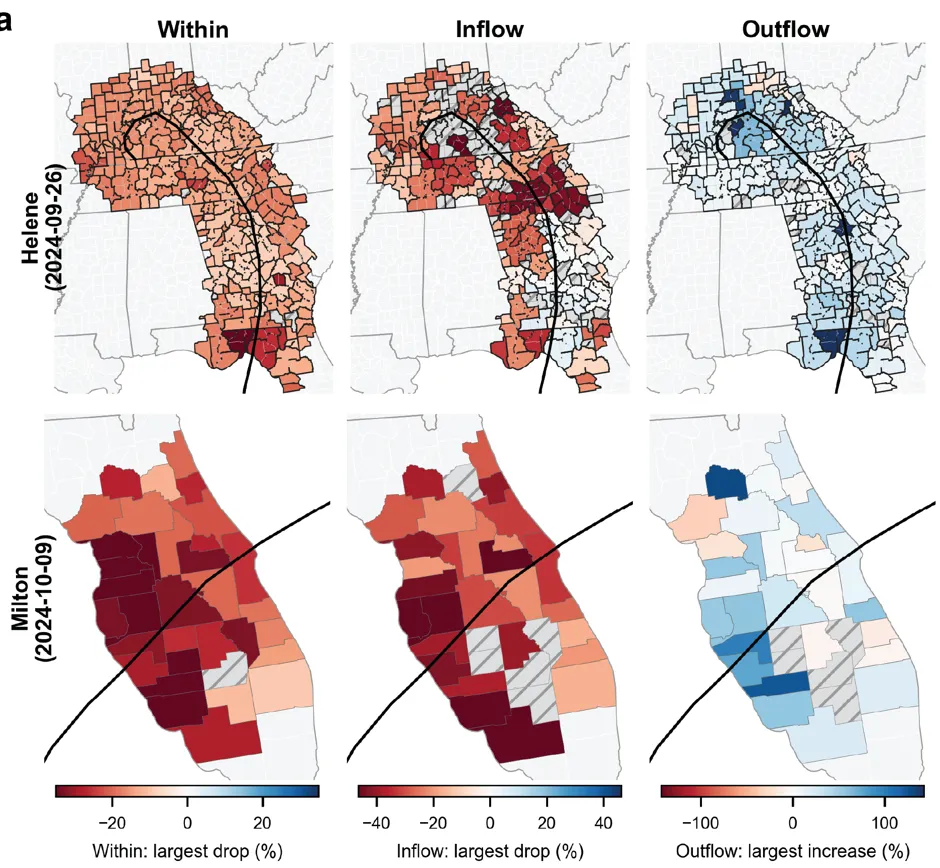
Where mobility fell most: under Helene (top), the deepest drops in arrivals lay far inland. — Figure 2a, Liu, Cao, Pei & Yao (2026), arXiv:2610.17550.
Who was hit, and why
Under Helene, heavier rain went with larger drops in arrivals, and coastal areas saw deeper local declines. A higher share of White residents was also linked to deeper drops in arrivals — but that link vanished once broad geographic patterns were accounted for, which suggests geography and population composition are hard to tell apart here. For Milton, the sample was too small for any clear association.
Watch who comes back
The authors’ message for emergency planners: the depth of the first drop is a poor guide to who recovers slowly. A community can look busy again while its links with the wider region remain cut. Tracking how fast visitors return could flag places where transport and access to essential services deserve a check — in their summary, rural isolation is what planners should target.
They list the limits themselves. Two storms cannot reveal which difference — weather, terrain or settlement — caused Helene’s slow reconnection. Device data do not say why people travel and may undercount rural, older and low-income residents. And visits returning to normal does not prove that essential services are back.