TWO CLOCKS, TWO COUNTRIES, ONE BEAT
Optical atomic clocks now reach fractional uncertainties of 10⁻¹⁸ and below — the equivalent of one second lost in thirty billion years. They outperform by more than a hundredfold the caesium microwave clocks that define the second today, and a redefinition of the second based on optical clocks is expected. Before choosing a new standard, though, clocks must be checked against each other.
Why two identical clocks
Comparing clocks that use the same atomic transition — the jump between two energy levels of the atom, whose light frequency the clock counts — gives a clear test: their frequency ratio must be exactly one. Such agreement had been shown below 10⁻¹⁷ almost only between systems built inside a single institute. A previous European campaign between the very same two clocks fell short of the 5 × 10⁻¹⁸ target set ahead of the redefinition, for lack of data. And comparisons between other independently built clocks have revealed disagreements far beyond their stated uncertainties — a sign of effects nobody had accounted for.
One ion, two labs
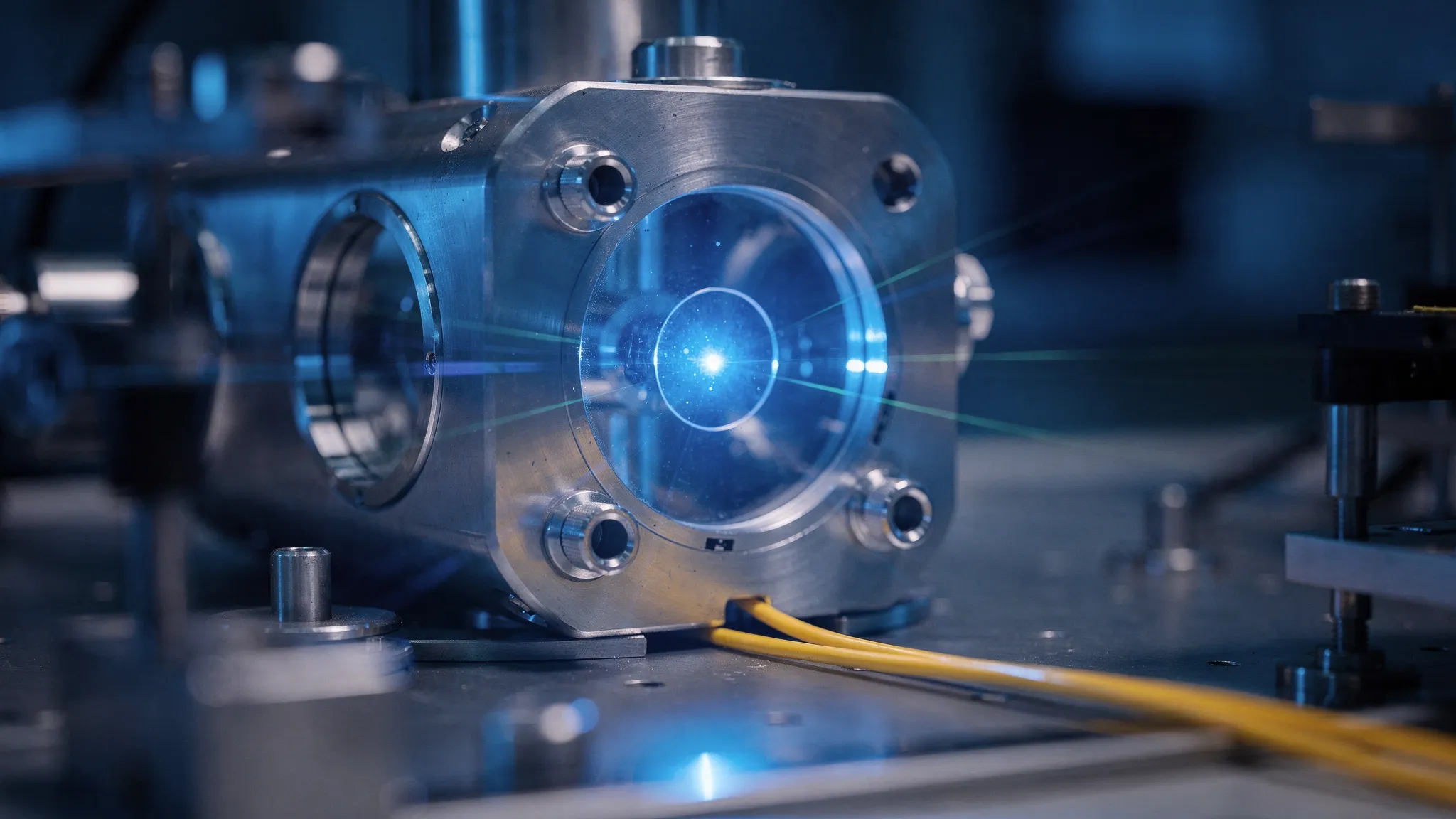
Both clocks trap a single ytterbium-171 ion and probe an extremely narrow transition, an “electric octupole” whose excited state lives for years. One clock, NPL-E3Yb+3, is at the National Physical Laboratory in Teddington, United Kingdom. The other, PTB-Yb1E3, is at the Physikalisch-Technische Bundesanstalt in Braunschweig, Germany. They differ in their trap design, their stabilised lasers and the way they cancel the shift caused by the probing light itself.
They were linked through the European network of optical fibres, stabilised so that they add almost no drift of their own: 2,220 km, via three relay stations in France — the Laboratoire de Physique des Lasers in Villetaneuse, the Laboratoire Temps Espace at the Paris Observatory, and the University of Strasbourg. Between 18 March and 12 April 2025, the team collected 12.6 days of usable data; both clocks and the link were running together 51% of the time.
The result
The ratio of the two frequencies came out at 1.000 000 000 000 000 001 0, with an uncertainty of 48 in the last digits: a difference of 1.0 × 10⁻¹⁸ ± 4.8 × 10⁻¹⁸, compatible with zero. To the authors’ knowledge, this is the first international clock comparison below 5 × 10⁻¹⁸.
The error budget, in units of 10⁻¹⁸ (independent errors partly cancel: they combine as the square root of the sum of their squares, which is why they total 4.8 and not 8.8):
- the clocks themselves: 2.8, the largest effect being heat radiated by their room-temperature surroundings;
- the international fibre link: 0.9;
- the statistics: 1.6;
- the relativistic redshift between the two sites — the higher a clock sits in Earth’s gravity field, the faster it ticks, by about 1 × 10⁻¹⁸ per centimetre —, including the changing pull of the tides: 3.5 — the largest single term.
That last correction depends on each clock’s position in Earth’s gravity potential. Its uncertainty is equivalent to just over 3 centimetres of height difference between the two clocks.
A test of relativity on the side
The two sites are far apart, and Earth’s rotation keeps turning the line between them. If the speed of light depended on direction — a violation of what physicists call Lorentz invariance — the frequency ratio would wobble with each sidereal day — one turn of Earth relative to the stars, 23 h 56 min. No such signal appeared. The parameter that measures that dependence on direction is constrained about five times more tightly than before. Without the tidal correction, by the way, a false wobble showed up, strong enough to pass for a hint of a signal (2.6 standard deviations).
The data also revealed that the fibre adds noise: the scatter was 24% wider in daytime than at night, consistent with environmental disturbances along the link.
Centimetres now matter
Because gravity dominated the error, the authors write that even better comparisons will require better knowledge of the gravity potential at each site — or a clock that can be transported to the other site without losing its performance.