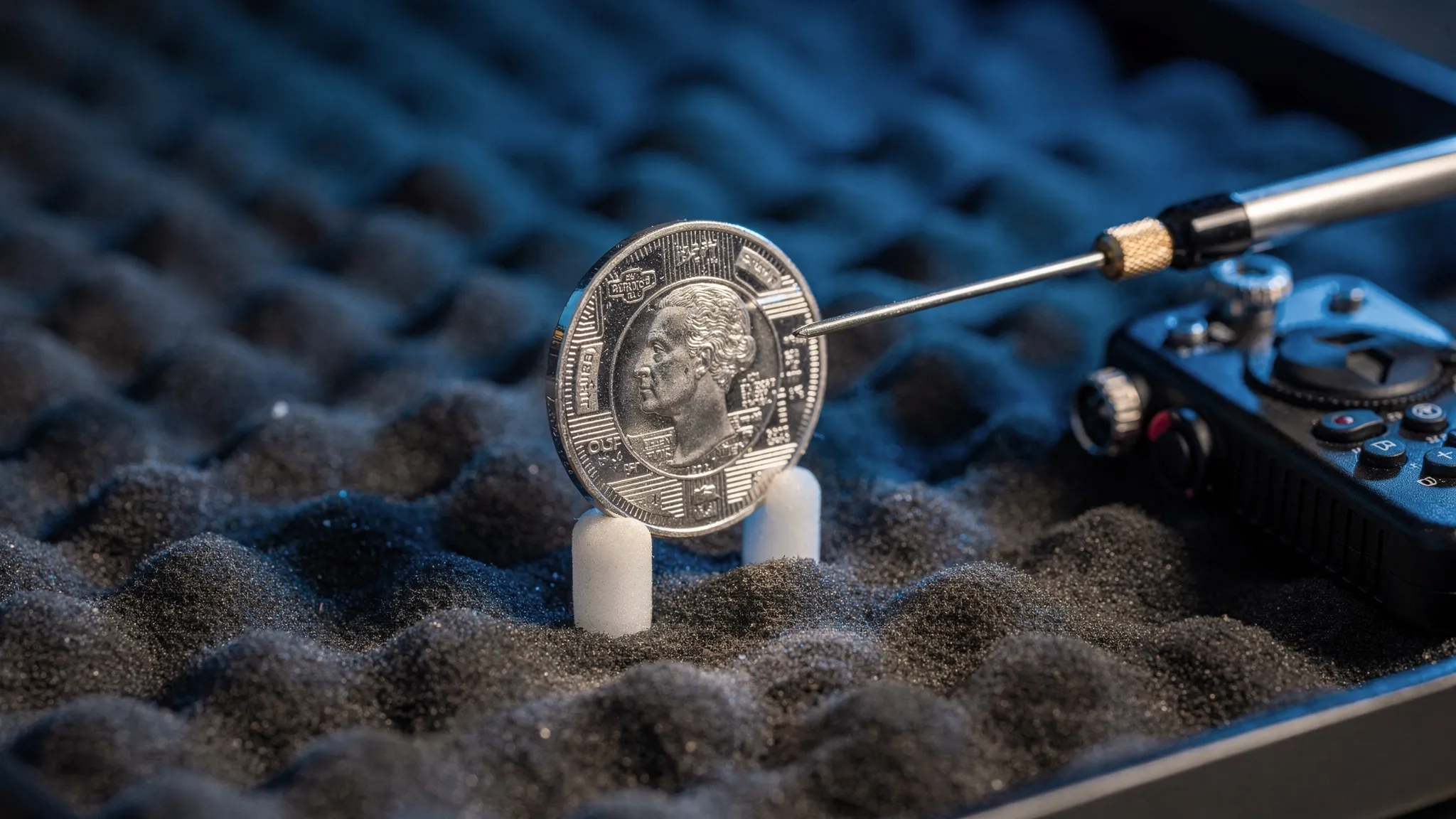
TAP A COIN, HEAR WHAT IT IS MADE OF
Silver bullion is a tempting target for counterfeiters, because its value lies almost entirely in the metal. A convincing fake only has to match a coin’s diameter, thickness, mass and look — all published, all easy to copy in cheaper metal.
Every common test stops somewhere. A magnet catches fakes with an iron core, but not others. Density is informative, yet a core chosen to match gold or silver passes, and “a correctly sized tungsten core passes it”. X-ray fluorescence — shining X-rays on the coin and reading the light it sends back — reads the composition only at the surface, so a thick plating hides the inside. Ultrasound probes the bulk but needs a contact probe, gel and a dedicated instrument.
A ring is not a property of silver
Tapping a coin and listening — the “ping test” — is already used. Apps compare the coin’s ringing frequency with frequencies recorded for the same coin type. The most developed one covered 23 silver coins when the authors last checked, and its vendor notes that privately minted rounds — coin-shaped bullion pieces not issued by a state — are tested less reliably.
The authors spell out the problem: “A frequency is not a property of silver — it is a property of this piece of silver, at this diameter and this thickness.” Change the size and the note changes, so every coin type needs its own reference.
Sylvia Dong, a student at Lynbrook High School in San José, California, and Takyiu Liu, of West Valley College in Saratoga, set out to remove the library. From the ring, the radius and the volume, they compute the plate wave speed — how fast bending waves run through a sheet of that metal —, a constant of the material that depends on its stiffness (Young’s modulus), its density and its Poisson’s ratio (how much it bulges sideways when squeezed).
Two obstacles
Coins are too thick for the textbook formula. The classic theory of thin vibrating plates fails at coin proportions. Calibrating on five machined aluminium discs, the authors measured a correction factor that cut the worst error from 8.9% to 0.75%.
A struck coin is not a flat disc. Its relief removes metal, so callipers overstate the thickness that actually vibrates. Their key idea is a fill factor: the coin’s true volume, measured by weighing it suspended in water, divided by the volume of the plain cylinder. Struck coins came out between 0.70 and 0.91. Multiplying the calliper thickness by this factor gives the effective thickness of metal that actually vibrates.
The set-up is modest: a box lined with acoustic foam, a 3D-printed stand holding the coin at its centre, a portable audio recorder, a 31-gram metal striker used by hand, and a balance. Of 2,163 taps, 1,937 were kept. The ringing frequency repeated to 0.15% from one session to another.
What the metal says
- On six struck copper rounds that played no part in the calibration, the method recovered a Young’s modulus of 119.1 ± 6.7 GPa (gigapascals, the unit of stiffness), at the centre of copper’s accepted range of 110 to 128 GPa.
- Wave speeds grouped by material: fine silver about 2,870 m/s, sterling silver about 3,040 m/s, copper about 3,880 m/s, aluminium 5,410 m/s.
- Five rounds bought because their authenticity was in doubt: four reacted to a magnet and had a density and wave speed consistent with plain carbon steel; the fifth, with brass. None passed as silver.
- The overtones are not musical harmonics: 83.7% of 1,970 peaks matched the vibration modes of a free plate, only 10.4% a whole multiple of the fundamental. “A tapped disc is not a string.”
A surprise came from the error budget. It predicted that a better microphone would change nothing and a finer balance everything. Weighing to 0.1 milligram instead of 0.1 gram cut the uncertainty per coin from 1.6–30% to 0.5–2.6%, and shrank an apparent 11% bias on one deeply embossed silver design to a few per cent.
The fake it could not hear
Why measure elasticity at all? Because a fake can copy density but not stiffness. Gold and tungsten differ by only 0.3% in density, yet their plate wave speeds are 2,240 and 4,810 m/s — a factor of 2.1.
In this study, the decision rule set in advance — non-magnetic and a density above 9,000 kg/m³ — passes any dense metal as silver: a tungsten disc clears it. The acoustic method should reject it, but neither of two tungsten samples produced a detectable ring. So that rejection remains predicted, not demonstrated.
The authors list other limits: the classification has not been tested blind, the result depends on an assumed Poisson’s ratio (about ±3%), and the compositions of the doubtful rounds were never confirmed by chemical analysis. Next steps: a tungsten sample that rings, and a blind trial.