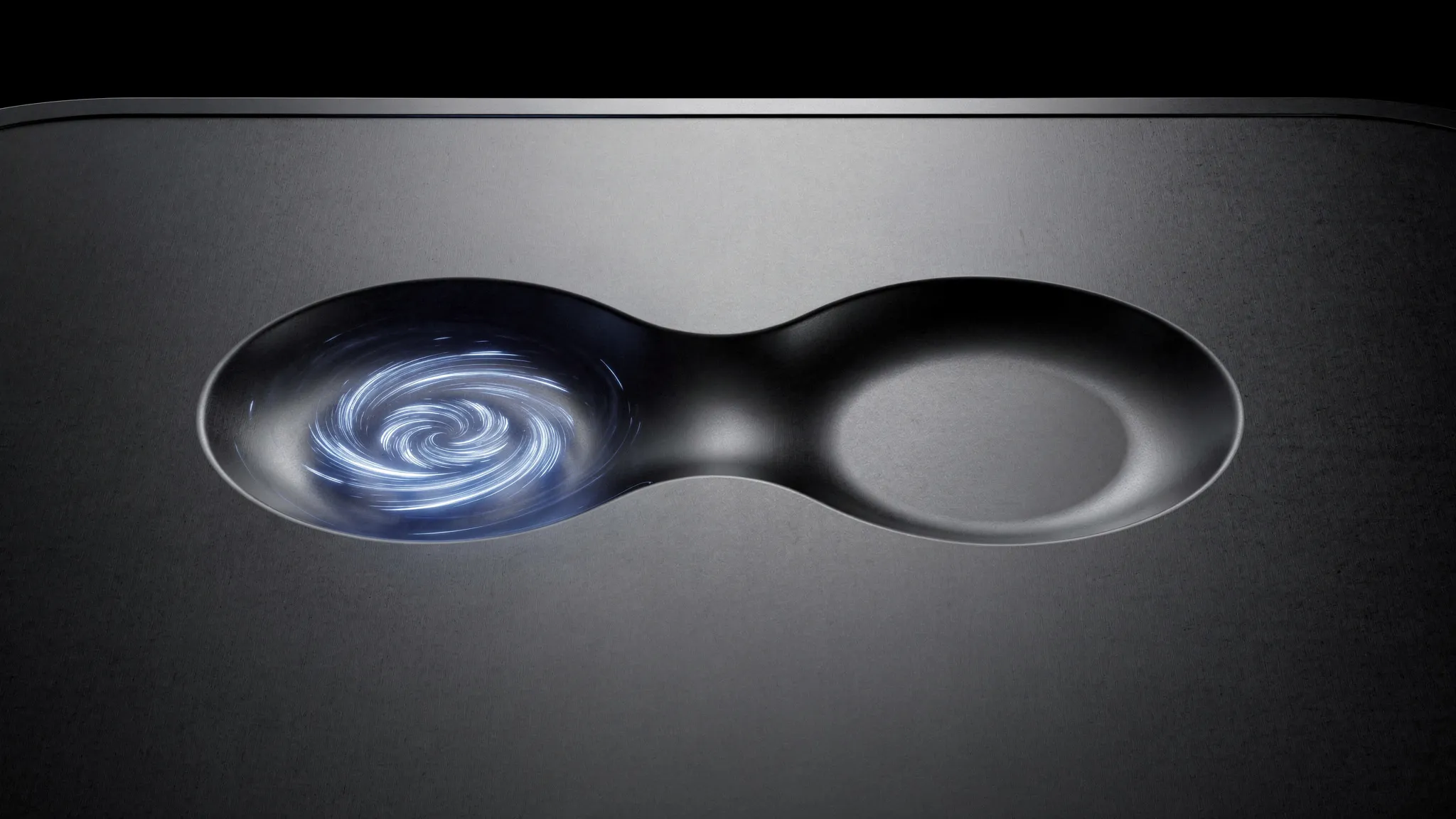
A MEMORY BIT MADE OF ONE SUPERCONDUCTING WHIRL
In 1961, Landauer linked information to heat: irreversibly erasing one bit of memory must release at least a certain amount of heat, k_B T ln 2, where T is the temperature and k_B is Boltzmann’s constant, a fixed number of physics: the cost depends only on temperature. The limit has been approached before with microscopic beads moved by optical tweezers, with large superconducting circuits and with single-molecule magnets.
A bit can also be stored in the position of a superconducting vortex — a tiny whirl inside a superconductor that a magnetic probe sees as a minute spot of magnetic field. Such bits are candidates for very frugal memories that could work in the deep cold where today’s quantum computers run. But how much energy does it cost to move one vortex a few nanometres? Earlier experiments saw single vortices dissipate energy without ever putting a number on it, and no thermometer is sensitive enough to catch so little heat.
Weighing a whisper without a thermometer
Nofar Fridman, Hadar Steinberg, Yonathan Anahory and colleagues at the Hebrew University of Jerusalem, with partners in the United States, Switzerland and Germany, took another route. They patterned a niobium film 55 nanometres thick into a strip 10 micrometres wide and cooled it to 4.2 kelvin. A scanning microscope carrying a superconducting sensor on its tip (a “SQUID-on-tip”, with a loop about 250 nanometres across) hovered 300 nanometres above, mapping the magnetic field until it found a single isolated vortex.
An oscillating current then pushed the vortex back and forth with forces counted in femtonewtons (a millionth of a billionth of a newton), from 4 to over 100 — a current of half a milliampere gives about 65. The microscope tracked the motion with a sensitivity of about 0.3 nanometres. The key is timing: the part of the motion that lags behind the push measures the work done on the vortex in each cycle, and therefore the energy it dissipates. No temperature reading needed.
Two hollows, one bit
The film offers a landscape of hollows where a vortex gets stuck (“pinned”). In a single hollow, the vortex wastes too little energy to detect. The interesting places are double wells: two resting spots side by side, separated by a small energy barrier. Left or right — that is a bit. The team found such spots by gently tilting the landscape with a steady current, and confirmed them by a tell-tale signal: when left alone, the vortex flickered randomly between two positions.
Below a critical force, the pushed vortex stays in its hollow and no work shows up. Near that force, it starts hopping now and then to the other side, and the work shoots up. Far above it, the vortex crosses the barrier every half-cycle and the work levels off. Depending on the double well, that cost varied widely — down to four times Landauer’s limit for one full back-and-forth cycle.
In two double wells with very low barriers, heat alone made the vortex hop, about 7,000 and 3,000 times a second when it was not being pushed. The rates measured from that flickering matched the ones fitted from the driven motion, and a computer model of a vortex hopping over a barrier reproduced the measurements.
Below the limit — and why that is allowed
At low driving frequencies, the measured work per cycle fell below Landauer’s limit. The authors explain why no law is broken. Landauer’s limit concerns erasing a bit whose value is unknown: half the time it is already in the target state. A steady back-and-forth is different: each push starts from a well-defined position.
So they simulated a true erasure: the vortex starts at random in either hollow, and the landscape is tilted once, over a quarter of a cycle, averaged over 1,000 runs. At high frequency, this costs four times less than a full back-and-forth cycle: a cycle makes two jumps where an erasure makes one, and half the time an erasure needs no jump at all. At low frequency, the true erasure stays above the limit, as Landauer requires. The steady rocking dips below because the disorder (entropy) given off as heat when the bit is set is taken back by the vortex when heat scrambles it again — a give-and-take the authors compare to the way a gas cools when it expands. But a vortex that hops on its own that often cannot hold a bit anyway.
The bottom line for a usable bit, according to their simulation: about five times Landauer’s limit at 150 kilohertz, the fastest the instrument could drive — a frequency at which the same double well costs more per cycle than at low frequency.
How fast could it go?
The researchers estimate that a vortex takes about 4 nanoseconds to switch hollows, enough for 250 million operations per second, at a cost of roughly ten times Landauer’s limit. Other materials and engineered pinning sites could go faster still. They see vortex bits as classical memory sitting right next to quantum processors, and further out, as a tool for quantum computing schemes based on moving vortices around.
One step remains: their measurement relies on a steady oscillation, so it cannot yet clock the cost of a single, true erasure directly — that figure still rests on the simulation.