HUNTING HIDDEN NUKES AMONG STARLINK SATELLITES
On 9 July 1962, during the Starfish Prime test, a 1.4-megaton thermonuclear device exploded 400 kilometres above the Earth. It created a belt of trapped electrons, and at least eight of the 24 satellites in orbit at the time, or launched in the following weeks, were damaged. Five years later, the Outer Space Treaty of 1967 committed its parties “not to place in orbit around the Earth any objects carrying nuclear weapons.” But it contains no verification clause: at the time, there was no technology to inspect in space, and inspections on the ground clashed with secret spy-satellite programmes.
Patrick Huber, a physicist at the Center for Neutrino Physics of Virginia Tech, argues that the question is back. Orbit now holds 16,946 payloads among 44,964 catalogued objects. Large constellations of cheap satellites shrug off a missile that destroys a single satellite, but remain vulnerable to a nuclear explosion. The paper recalls that Russia vetoed a United Nations Security Council resolution reaffirming the ban, with China abstaining. The scenario studied: a warhead hidden inside, or disguised as, one satellite of a huge constellation — and how to convince everyone that none is there.
Starlink as a test case
The study takes the largest constellation in orbit as its real-world example: SpaceX’s Starlink, with 7,852 satellites in steady operation in the catalogue of 25 March 2026. The author stresses that such inspections could only happen within a negotiated, cooperative agreement.
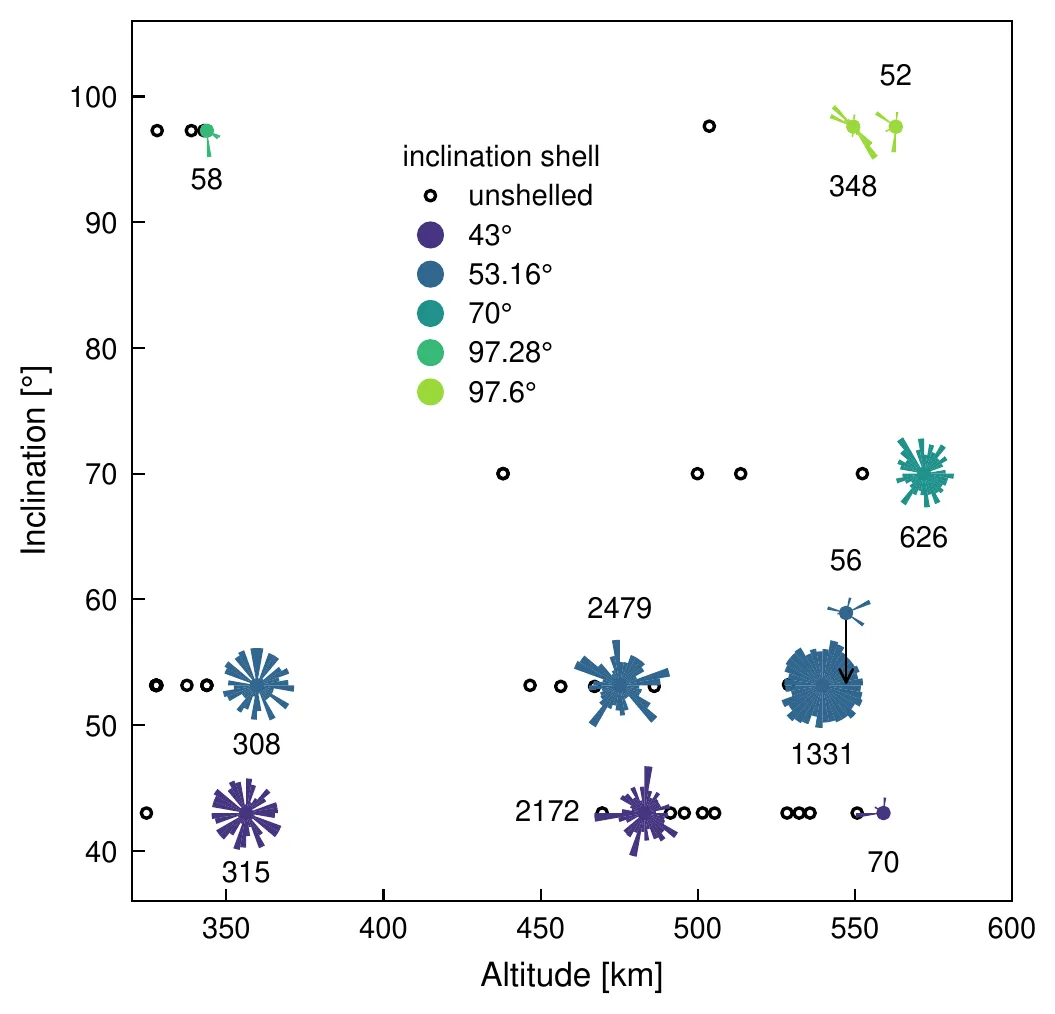
The 7,852 steady Starlink satellites of the 25 March 2026 catalogue, by altitude and inclination; each disc is a shell, labelled with its number of satellites. — Figure 6, Huber (2026), arXiv:2610.04016.
A beam that makes nuclear fuel speak
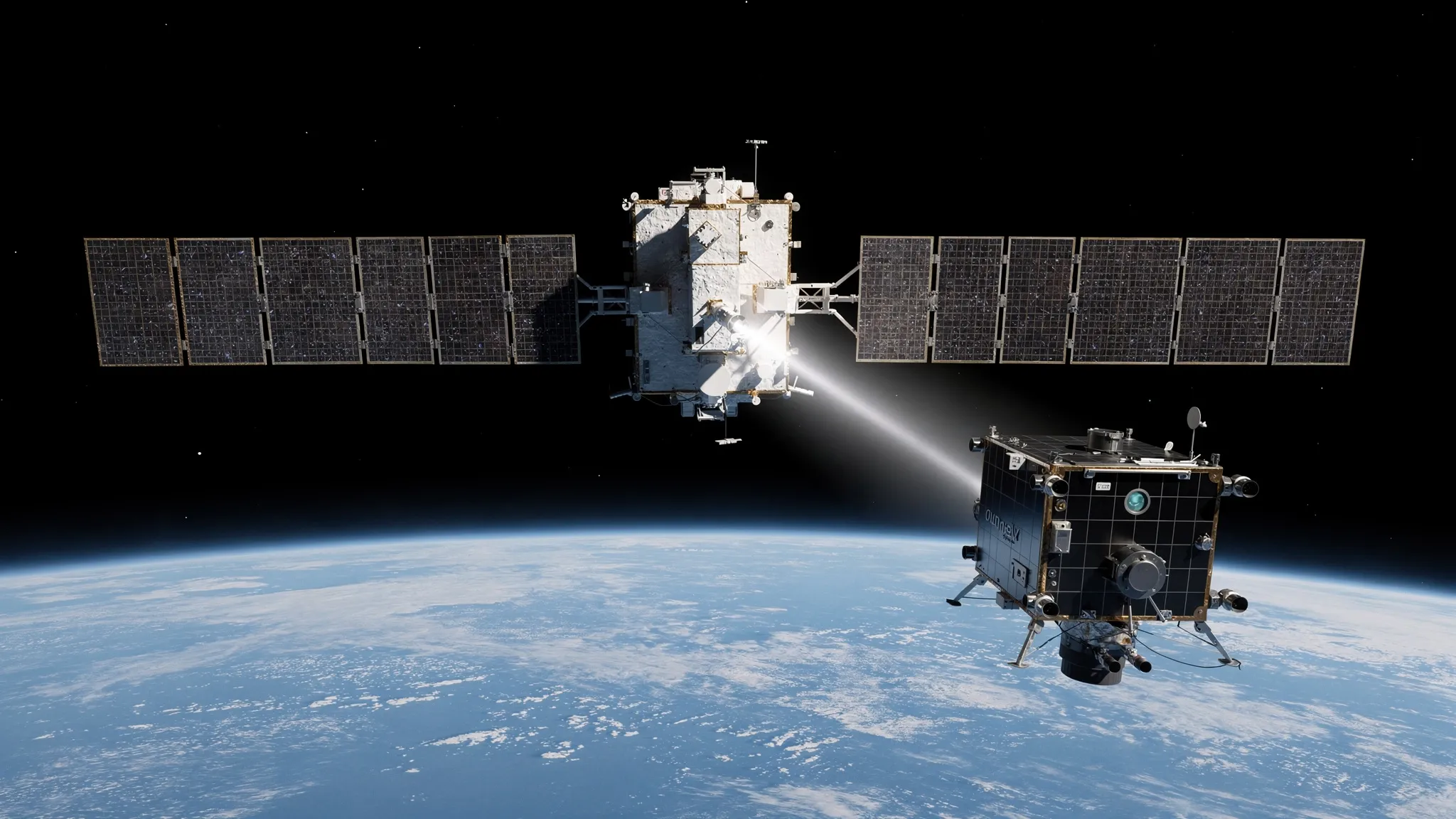
The method is called active interrogation: shine radiation on an object and listen to its answer. Here, an inspector satellite fires a very narrow beam of 16-megaelectronvolt photons — high-energy light — at the target. If fissile material is inside, some of its nuclei split, releasing neutrons and gamma rays that a detector on the inspector picks up.
The beam would come from a technology developed for particle physics: a laser-plasma accelerator that pushes electrons to about one gigaelectronvolt over some ten centimetres, then bounces laser light off them to turn it into energetic photons. Average power needs are only a few watts; short peaks are within reach of car batteries, according to the paper. The detector, a segmented plastic scintillator laced with lithium-6, borrows from recent neutrino detectors.
A real warhead gives itself away in two ways in the simulations: neutrons slowed by the material around the core, and a gamma glow that lasts about a millisecond as fissions multiply — whereas a simple lump of depleted uranium falls silent after about ten microseconds.
The satellites are not harmed: each receives at most 0.25 gray, under 1 percent of what the natural radiation of space delivers to it over five years.
How many inspectors?
The author simulated the nuclear physics, the space background radiation and the actual orbits, including the slow wobble of orbital planes caused by the Earth’s flattened shape — which inspectors can use to drift from plane to plane on little fuel. The study defines three kinds of inspector, from one that flies alongside its target for minutes to one that simply passes by at about 9.4 kilometres per second, for a fraction of a second. Required for detection: a 90 percent chance of spotting a single warhead, with one false alarm in a thousand.
- Every satellite in five years: 69 “shadowing” inspectors, each checking a median of 141 satellites — or 4 passive fly-by platforms covering 97 percent of the constellation, plus 16 inspectors for the rest.
- A random tenth of the constellation: a single fly-by inspector covers 783 of 785 targets. A cheater who had hidden 5 warheads would then face a 37 percent risk of being caught — the kind of deterrence on which existing nuclear inspection regimes already rely, the paper notes.
Some orbits, such as sun-synchronous ones whose planes barely drift relative to each other, are very costly to reach; the author suggests checking those satellites by other means, for example on the ground before launch.
What a treaty would need
The required distances — 0.55 to 2.9 kilometres — are closer than earlier studies assumed. The author argues that what matters is the real collision risk, which on-board position sensors make negligible, not a “politically acceptable” distance. Any agreement would need an inspection quota, rules for approaches and aborts, permitted doses, and a procedure for second checks. The key missing piece of hardware is a space-qualified, multi-joule fiber laser. The paper is a single-author simulation study, funded by the US National Nuclear Security Administration, and its author states that AI assistants were used for code, literature search and manuscript preparation, while the physics choices and conclusions are the author’s own.