
SEVEN MILLION HUMAN CHOICES, ONE SMALL MODEL OF THE MIND
For more than a century, psychology has produced principles of how the mind works. We know that associations grow stronger when things happen together, that learning is driven by prediction errors — the gap between what we expect and what happens — and that the brain organises information in layers, from simple to abstract. But each principle was developed in isolation, usually for one kind of experiment. How much of human behaviour do they explain together? That had never been measured.
Marcel Binz and Eric Schulz, of the Institute for Human-Centered AI at Helmholtz Munich and the Max Planck Institute for Biological Cybernetics in Tübingen, built a model to find out.
A mind made of memory
Their model, CORE (for COntextual Retrieval and Encoding), reads the full transcript of an experiment — instructions, what was shown, the feedback, the participant’s earlier answers — and predicts which key the person presses next.
It contains nothing but a handful of established ingredients:
- the text is turned into phonemes, the sounds of speech;
- these are written into an associative memory, following a classic learning rule;
- what gets written, how strongly, and what gets forgotten all depend on the current context;
- the memory stores prediction errors, not raw inputs — only what it did not already know;
- six such memories are stacked in layers.
The whole model has 452,608 parameters and trained in about 24 hours on a single graphics card.
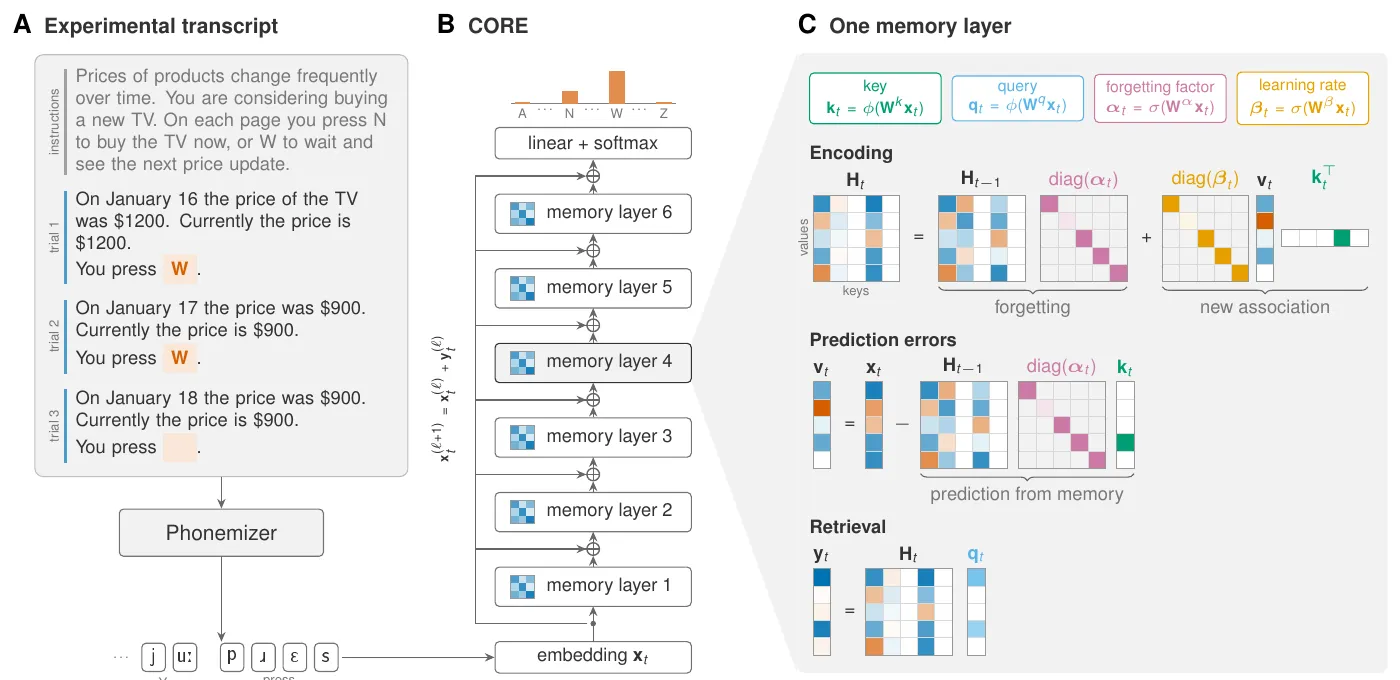
How CORE works: a transcript (A) feeds a stack of memory layers (B); each layer writes, forgets and retrieves associations depending on context (C). — Figure 1, Binz & Schulz (2026), arXiv:2610.13603.
Tested against seven million choices
They fitted CORE to Psych-201, a large collection of psychology experiments: 137 experiments from 62 studies, covering learning from rewards, decisions under risk, category learning, social judgement and more — 7,036,442 choices in 80,452 sessions for training, with other sessions set aside for testing.
- On sessions it had never seen, CORE predicted choices better than a standard AI architecture of the same size (a Transformer) in all 62 studies.
- It also did better overall than Centaur, a large language model fine-tuned on human behaviour that has five orders of magnitude more parameters — winning in 47 of the 62 studies.
- Removing any single ingredient made it worse. The layers mattered most, then forgetting, then the phonemes, then the prediction errors.
Like a virtual participant
Fitting data is not enough: a model of the mind should also behave like people. The authors simulated CORE as a participant in the original experiments and checked whether the published effects reappeared. It reproduced 50 of 67 effects (75%).
It did best in exploration (11 of 11) and learning from rewards (10 of 11), worst in language and social judgement (7 of 12). The authors explain the misses: many of those tasks rely on knowledge people pick up outside the lab, about words, numbers and the world — and CORE has only ever seen transcripts of experiments. It also struggles with planning ahead, for which it has no mechanism. Some effects it missed turned out to be fragile in the human data too.
Its internal settings also look psychological. Within a game, its learning rate drops as evidence accumulates, as Bayesian theories of learning predict. And its memory span grows during a game then collapses at the boundary with the next one — a signature of how people cut experience into events.
Conflict of interest. The data pipeline relied on AI: each experiment was turned into a transcript by DeepSeek-V4-Flash and verified by Claude Fable 5.1, from Anthropic; the simulators used to test the effects were also built by an automated AI pipeline. This article is written by Claude. In addition, the Centaur model used as a competitor and the Psych-201 collection are both earlier work led by the first author. The authors declare no competing interests.
Toward a shared model of the mind
The authors describe CORE as a step between classic cognitive models and black boxes: its principles are readable, but the details it learns are not. It has no long-term memory, since the experiments last under an hour. Their aim is broader than one model: to test theories of the mind against the whole experimental record of psychology at once, so that the field becomes “more than the sum of its experiments”.