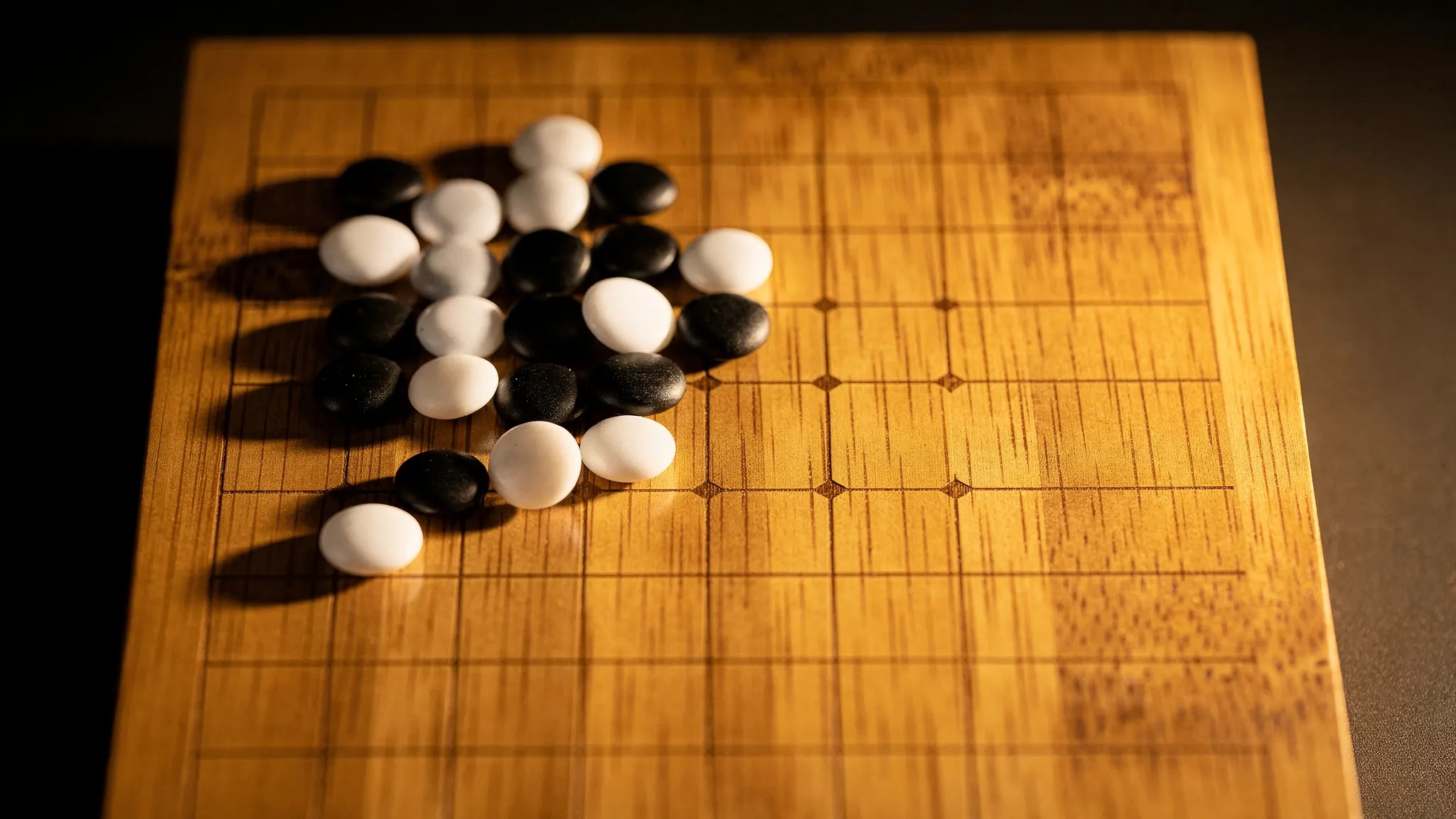
THE GO RULE THAT CHANGES THE ANSWER
Solving a game means knowing its outcome when both sides play perfectly. On a go board, that outcome is a value: the number of points by which Black wins under perfect play — 28 on a 4×7 board means Black owns all 28 intersections. Checkers was solved in 2007, and so was Hex on small boards. For go, computer proofs exist for many boards of up to 30 intersections, mostly from a program called MIGOS (2003 and 2009).
There is a catch. Those classic results use a simplified rule for repeated positions — a basic “ko” rule — a player may not immediately recapture a single stone that has just captured one of theirs, which would loop the same two moves forever — plus special conventions: a pass lifts a ko ban, a game stops at a repeated position, and so on. These conventions were designed so that a position’s value would not depend on how it was reached.
The rule people actually play
The Chinese rules as written, and computer go, use positional superko: no move may recreate any whole-board position that has already occurred in the game. Solving under this rule is much harder, because a move’s legality now depends on the entire history of the game. It breaks three tools that make solving feasible:
- reusing results from the same position reached by another path — the two paths may forbid different moves;
- recognising safe groups and territory without search, which assumes the owner can always capture intruders — under superko, such a capture can be forbidden;
- pruning moves that never help, such as filling one’s own eye — one of the empty points a group needs in order to stay alive — under superko, such a move can become decisive.
The cost was huge: with a variant of superko, MIGOS needed 1.1 hours for the 4×4 board, against 3.3 seconds under basic ko. The first superko solution of 5×5, in 2024, took 5.25 hours on six processes. Beyond 5×5, no board with at least two rows had been solved under superko.
A shortcut that stays sound
Sami Kharma and Florian Schintke, of the Zuse Institute Berlin, built Sanko. Its core is a simple proof-transfer theorem: a stored proof that one player wins stays valid on a new path unless a board that the winner must create has already appeared. Only the winner’s boards matter — if the loser can no longer recreate a position, the loser just loses an option. Checking this takes time proportional to the length of the path, not the size of the proof. On the 3×7 board, this shortcut alone cuts the work from 664 billion steps to 112 million.
They also adapted the classic recognition of safe groups so that it remains correct under superko, and pruned only the moves of the side whose win they were trying to prove, so that a failed search is reported as unknown, never as a win for the other side.
New values
- 5×5 in 15.7 minutes on six threads — about 20 times faster than before, partly thanks to better hardware; on a single thread, 4×4 is solved 58 times faster. On one 192-thread machine, 5×5 takes about a minute and a half.
- The first superko values of 23 more boards; 11 of them had never been solved under any rules. 3×10 is worth 8 points to Black — MIGOS had only proven at least 6, and two months of search had found no upper bound.
- On one-row boards, the values from 1×9 to 1×15 repeat 0, 1, 2, 2 — but 1×16 breaks the pattern, worth 1 instead of 2.
The 4×7 surprise
Under the old rules, 4×7 is a full-board win: Black captures everything, 28–0. Under superko it is worth 12. The authors replayed the 31-move optimal line published for MIGOS: every move is legal, and Black still takes the whole board. Solving the line backwards, they found the break just after move 25: in the position after move 25, played by Black, White should play G2 (or C1) instead of A2.
What follows is a strange ko. White captures; Black’s recapture would recreate an earlier board — forbidden. Every other Black move puts its own group in danger. Black has to pass, White passes, and the game ends with White’s group alive: what the MIGOS authors had already called “moonshine life”. Under the old rules, the pass would lift the ban and Black would retake and win everything. Under superko, Black’s best in this line is a shared life (seki) worth only 3 points, so perfect play leaves the published line earlier — and the best Black can secure from the empty board is 12.
Neither search was wrong. The difference comes from rules that only matter at the very end of a game. The authors’ advice: values computed under conventions that make repetition harmless should not be quoted as values of superko go without checking.
Checkable by anyone
Every value rests on two independent proofs, and the solver passed tens of thousands of cross-checks without a mismatch. Unlike earlier solutions of empty go boards, the solver’s source code and the exact command behind every result are public; the 4×7 chain of proofs replays in under twenty seconds. The proofs are not yet certificates that an outsider can verify independently, and 6×6 remains out of reach — by the authors’ extrapolation, about 50 days on one of their machines, or more.