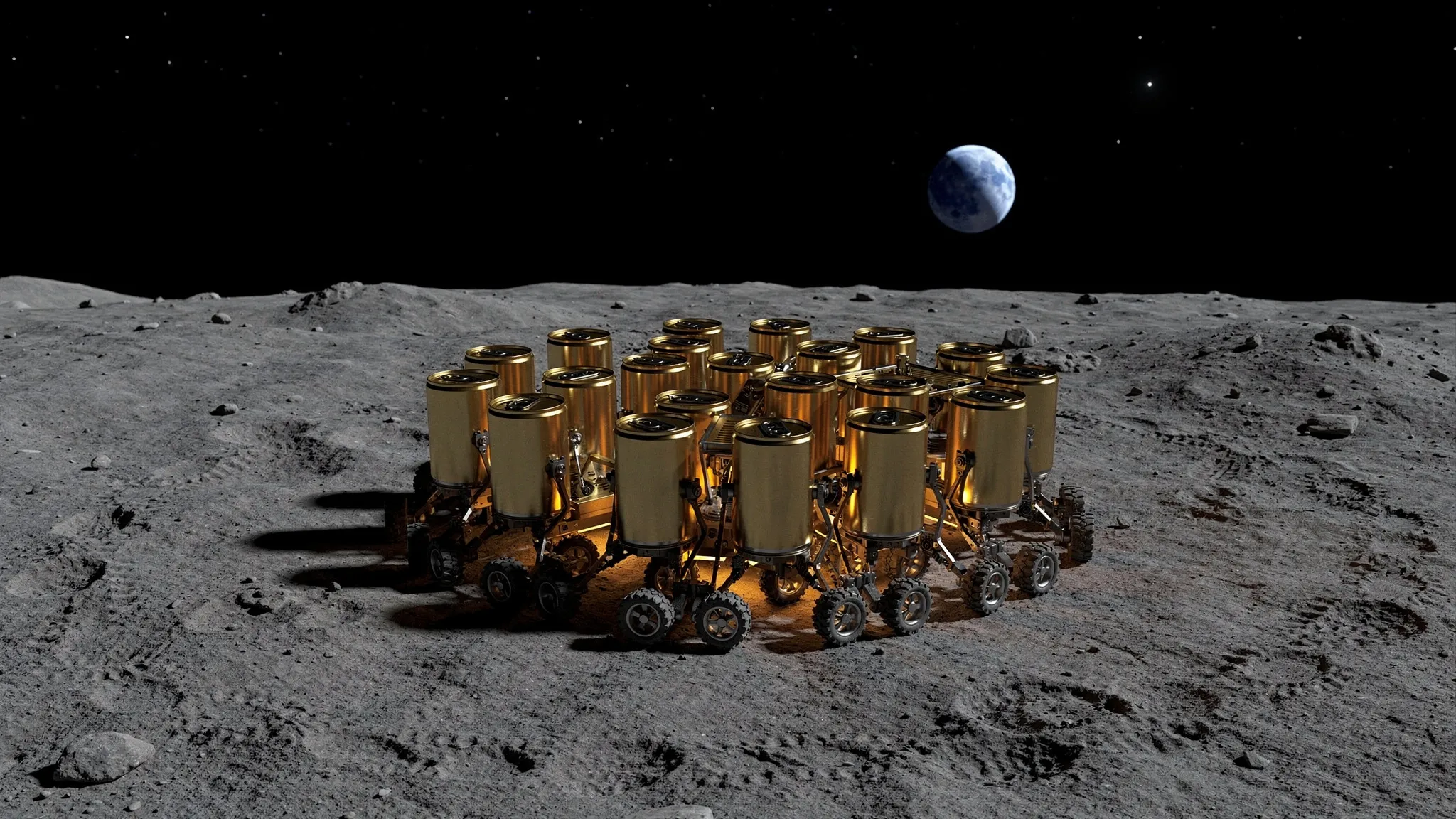
ROBOTS THAT HUDDLE LIKE PENGUINS TO SURVIVE THE LUNAR NIGHT
Swarms of small robots are an attractive way to explore lunar caves and lava tubes: if one is lost, the mission does not necessarily fail. NASA’s CADRE mission, for example, will fly three small cooperating rovers to map the Moon together — but only by day. They are designed for a single lunar day and will not survive the night.
A night of 354 hours
That night lasts about 354 hours, and the surface cools towards 95 kelvin, about −178 °C. Some rovers have come through it: Yutu-2 relies on radioisotope-assisted thermal control and has resumed work after lunar nights, while Pragyan, designed for one lunar day, did not resume communication. Radioisotope heaters, however, do not scale to a swarm. Holding a 2-watt heater takes about 5 grams of plutonium dioxide per robot, and the US production target of roughly 1.5 kilograms a year is sized for flagship radioisotope systems, not for expendable robots.
Anaïs Jeger, of MIT’s Center for Bits and Atoms and the European Space Agency’s Advanced Concepts Team, with Harry Holt of the same team and Lennart Puck of ESA’s Planetary Robotics Laboratory, asked a different question: could the robots use each other’s bodies as a heat shield?
One score, given at dawn
In their simulation, twenty robots spend a full lunar night together. Each one keeps itself at 0 °C with a heater as long as its stored energy lasts; after that it cools, and below −40 °C it counts as dead. How fast it loses heat depends on its sky exposure: how much of the open sky it sees, from 1 for an isolated robot to 0 for one ringed by neighbours. Alone, a robot radiates 1.92 watts away.
All twenty robots run the same small neural network. Each sees only local information — its own temperature, energy and exposure, where its neighbours are and how they are faring — and outputs a direction to drive in. The network was trained with “evolution strategies”: try many slightly altered copies, then nudge the shared settings towards the ones that score best, and repeat.
The score is deliberately sparse. It arrives once, at the end of the night: the average temperature of the five coldest robots. Nothing in it mentions position, spacing, exposure or movement.
Penguins, without being told
Two behaviours appeared anyway. From a scattered start, the swarm gathers within about five hours. Then it never settles: robots keep cycling between the sheltered core and the exposed rim. The authors point out that this is the same pair of behaviours with which emperor penguins survive the Antarctic winter — they huddle, and they keep exchanging places between the cold outside and the sheltered centre. The penguins inspired the question; the robots were never rewarded for copying them.
The circulation is what makes the difference. A hand-coded rule that only makes robots lean inward, never driving them back out, forms the same huddle, but the edge stays colder than the core all night, and in one test run nine of the twenty robots were lost. Over the course of training, the worst-placed robot’s time-averaged exposure fell from about 0.71 to 0.26, close to the swarm average of 0.23 — although exposure is not part of the score.
The robots are not rushing about, either: they cover 4.3 metres per hour on average, whereas driving nonstop at their set speed would cover 54: they mostly sit still and reposition in short bursts, and their net drift over the whole night is under a metre.
How little energy is enough
The authors measured the survival threshold: the smallest stored energy per robot at which every robot is still alive at sunrise, across ten starting layouts never seen during training. They express it in a unit they call the pcm-h, worth 7.2 kilojoules — what a 2-watt heater uses in an hour.
- Robots left scattered: 328.5 pcm-h.
- A huddle that stays still: 246.0 pcm-h.
- The learned swarm, pooled over ten training runs: 155.6 ± 1.3 pcm-h.
That is 37% less than the motionless huddle, and only 12.7% above a lower bound set by physics alone (138.1 pcm-h): the energy needed if all twenty robots shared the exposure of the densest possible packing equally. At 163 pcm-h, a still huddle loses six robots; the circulating swarm keeps all twenty.
Another simple hand-written rule did almost exactly as well, at 154.5 pcm-h: every robot leans gently inward, and whichever robot holds the least energy among those it touches burrows towards the core at full force.
Fewer requirements than expected
The behaviour holds up when pieces are removed. Without a shared landmark to steer by, the threshold barely moves: it stays between 154.3 and 156.7 pcm-h depending on the starting layout, against 155.4 to 155.7 with it, although the robots move more. A network without memory costs about 3% more energy. Trained on twenty robots, the same networks run swarms of thirty and forty without retraining, needing 5.0% and 8.0% less energy per robot — against 5.5% and 10.7% for the physical bound.
The robots do not even need to touch. Forced to keep 25 millimetres apart, they still all get through the night with the same networks, for about 13% more stored energy, because the shield now has gaps.
Wheels on lunar soil
Everything here happens in simulation. The robots keep shuffling all night, which means 354 hours of wheels working against lunar regolith (the loose dust and rock covering the surface). The model includes no wear and no drift in friction or contact. Whether wheels and bodies hold up through a full night of that grinding, which the authors single out as the main open question, is still untested.