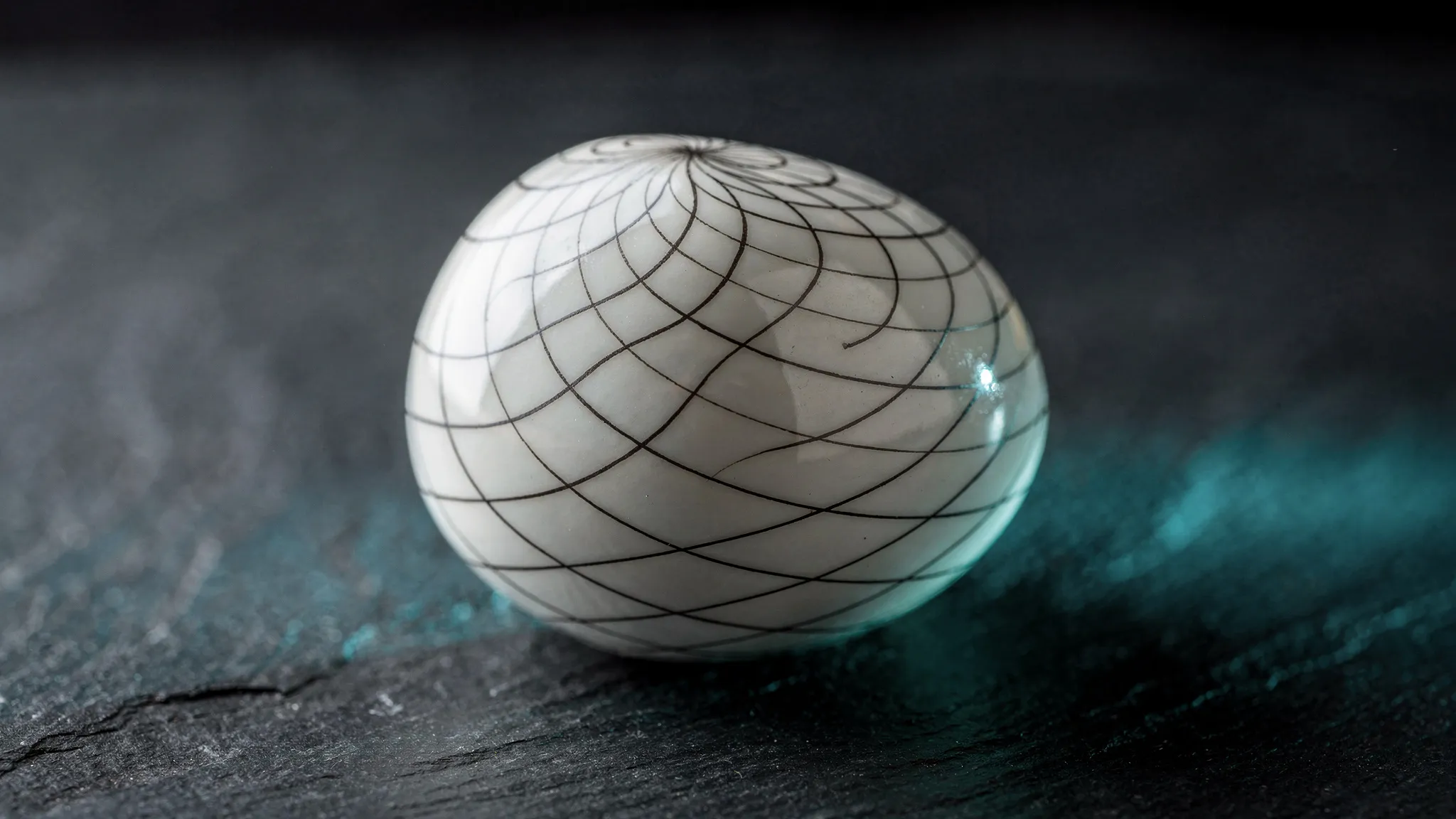
A SMOOTH BALL THAT IS ROUND AT ONLY ONE POINT
A ball curves the same way in every direction. The side of a rugby ball does not: it bends sharply around its girth and only gently along its length. At each point of a surface, geometers note the strongest and the weakest bending, whose directions always lie at right angles to each other; these are the two principal curvatures. A point where they are equal, where the surface bends the same way in all directions, is called an umbilic. On a perfect ball, every point is one.
Counting turns around an umbilic
Away from umbilics, the directions of strongest and weakest bending draw two families of lines across the surface, crossing at right angles everywhere. Walk once around an isolated umbilic along a small loop and follow one of these lines: it rotates. The number of turns it makes is the index of the umbilic. Because a line has no arrow, it can come back onto itself after half a turn, so the index can be a half-integer such as 3/2.
Two conjectures, as the paper states them:
- Loewner’s conjecture: the index of an isolated umbilic is at most 1.
- Carathéodory’s conjecture: a closed convex regular surface (a smooth surface with no edge that bulges outward everywhere, like an egg) in ordinary three-dimensional space has at least two umbilics.
The two are linked. On a closed convex surface whose umbilics are isolated, the indices always add up to 2. If none could exceed 1, at least two umbilics would be needed: Loewner’s conjecture would imply Carathéodory’s. A lone umbilic would have to carry the whole 2 by itself, and break both.
Announced in August, rebuilt from sines
The first counterexamples did not come from this paper. According to its introduction, L. Alpöge announced counterexamples to both conjectures for smooth surfaces, “developed with the aid of AI”, in a post on X dated 19 August 2026. Alpöge’s local construction already reaches an index of 1 + k/2 for every positive whole number k, and Alpöge reports a closed, strictly convex surface with exactly one umbilic, of index 2.
Naoya Ando, of Kumamoto University, and Masaaki Umehara, of the Institute of Science Tokyo, set out to give “a simpler construction through a variant of Alpöge’s construction”. Alpöge’s starting function combines three cosines with coefficients −1/4, 3/10 and −1/32, inside functions involving constants such as 10¹⁰ and 100. Their “seed” is:
F(x, y) = a(x) − a(y) + sin x sin y, with a(t) = sin⁴t + 3 sin²t
Picture a function of two variables as a landscape of bumps and hollows. The seed needs one property: nowhere may this landscape bend the same way in all directions. In technical terms, its trace-free Hessian, the table of second derivatives stripped of its “same in every direction” part, never vanishes. For this seed, the check takes three lines. The property is packed into one complex number — a pair of ordinary numbers, a “real” and an “imaginary” part, that is zero only if both are: 12 − 16(sin⁴x + sin⁴y) + 2i cos x cos y. Its imaginary part vanishes only where a cosine does; there a sine equals ±1, so its real part is at most −4. So it is never zero.
The authors state that they used ChatGPT to help search for candidate functions and to revise the text, and that they verified every argument themselves.
Folding an endless pattern into a point
The seed repeats forever across the plane. The authors squeeze all of it into a tiny disc: H_k(z) = exp(−|z|^(−k/4)) F(z^(−k/2)), where z is a point of the plane written as a single complex number and k a positive whole number the authors are free to choose. The substitution sends the far reaches of the plane towards the centre, so the sine pattern piles up in ever tighter rings around it. The exponential factor crushes everything: at the centre, the function and all its derivatives are zero. Mathematicians call such a function flat.
Around that centre, the directions of strongest bending of this landscape turn 1 + k/2 times: 3/2 for k = 1, 2 for k = 2, 5/2 for k = 3, with no upper limit (Theorem 1.3). With Fujiyama, the same two authors had earlier reached arbitrarily large indices with examples that are only C¹, once differentiable, at the umbilic; these new ones are smooth.
To turn a landscape into a surface, the authors use a support function: for each direction, it gives the distance from a centre to the flat plane touching the surface on that side, like a ruler pressed against a pebble. A constant support function describes a sphere. Adding a small multiple of the landscape to that constant gives a surface whose umbilics and indices match the landscape’s. This is a classical correspondence; the paper proves only the part it needs for the closed surface and cites the rest. Result: small pieces of smooth surface carrying umbilics of index 1 + k/2 for every k, so the index has no ceiling. The same holds for a class of surfaces in Lorentz–Minkowski space, where, in Pythagoras’s formula for distance, the square of one of the three coordinate differences is subtracted instead of added.
The only umbilic sits at the north pole
For the closed surface, the endless plane of the seed is wrapped around a sphere, like a map projection run backwards: it covers every point except the north pole, where all its far reaches converge. The seed is damped another way, so that it fades faster than any power of the distance from the centre of that plane, and a small multiple ε of it is added to the support function of the sphere. For ε small enough, the result is a closed, nearly round, strictly convex surface: it bulges outward everywhere. At every point but one, the property of the seed rules out an umbilic. The exception is the north pole, N = (0, 0, 1): there, the support function matches the sphere’s in every derivative, so N is an umbilic, and the only one (Theorem 2.2). Since the indices must add up to 2, its index is 2. One umbilic: Carathéodory’s conjecture fails. Index 2, more than 1: so does Loewner’s.
Smooth, but not analytic
Every surface in the paper is infinitely differentiable, or “smooth”. The authors specify that their surfaces in ordinary space are not real analytic, a stricter kind of smoothness in which, near each point, the shape is given exactly by an infinite sum of powers. The paper says nothing about whether analytic surfaces can have a single umbilic. It describes itself as self-contained for the index-2 umbilic and the counterexample to Carathéodory’s conjecture. And it contains no picture of the surface: the two constants that shape it, δ and ε, are only required to be “sufficiently small”, and no value is given.