
WINNING THE MATCH WITH FEWER POINTS
In a speech to graduating students at Dartmouth College in June 2024, Roger Federer gave two numbers: almost 80% of 1,526 career singles matches won, but only 54% of the points. The lesson drawn in the speech was about resilience — even the best lose almost every second point. The numbers also show a basic property of tennis scoring. Points make games, games make sets, sets make the match, and a small advantage on points is magnified at every level.
Andrés Martín, Johann H. Martínez and Javier M. Buldú, of the Complex Systems Group at King Juan Carlos University in Madrid, took that property apart, then tested it on 35 years of men’s professional tennis.
The length of the match does the work
Suppose a player wins every point with the same probability p. How likely is a match win? The team computed it exactly for tennis, badminton, volleyball and table tennis. At p = 50%, everyone is at 50%. Around that point, the curve is steep:
- a player who wins 52.5% of the points wins 80% of five-set tennis matches;
- in table tennis, best of five games, it takes 54.6% of the points to reach the same rate.
The steepness — how many percentage points of matches one extra percentage point of points buys, near 50% — follows a simple rule: it grows as the square root of the number of points in a match, about √(2N/π) for N points. A single point decides a contest only when the others are split evenly, and that becomes rarer as matches get longer. The whole hierarchy of games and sets changes this by only a few per cent.
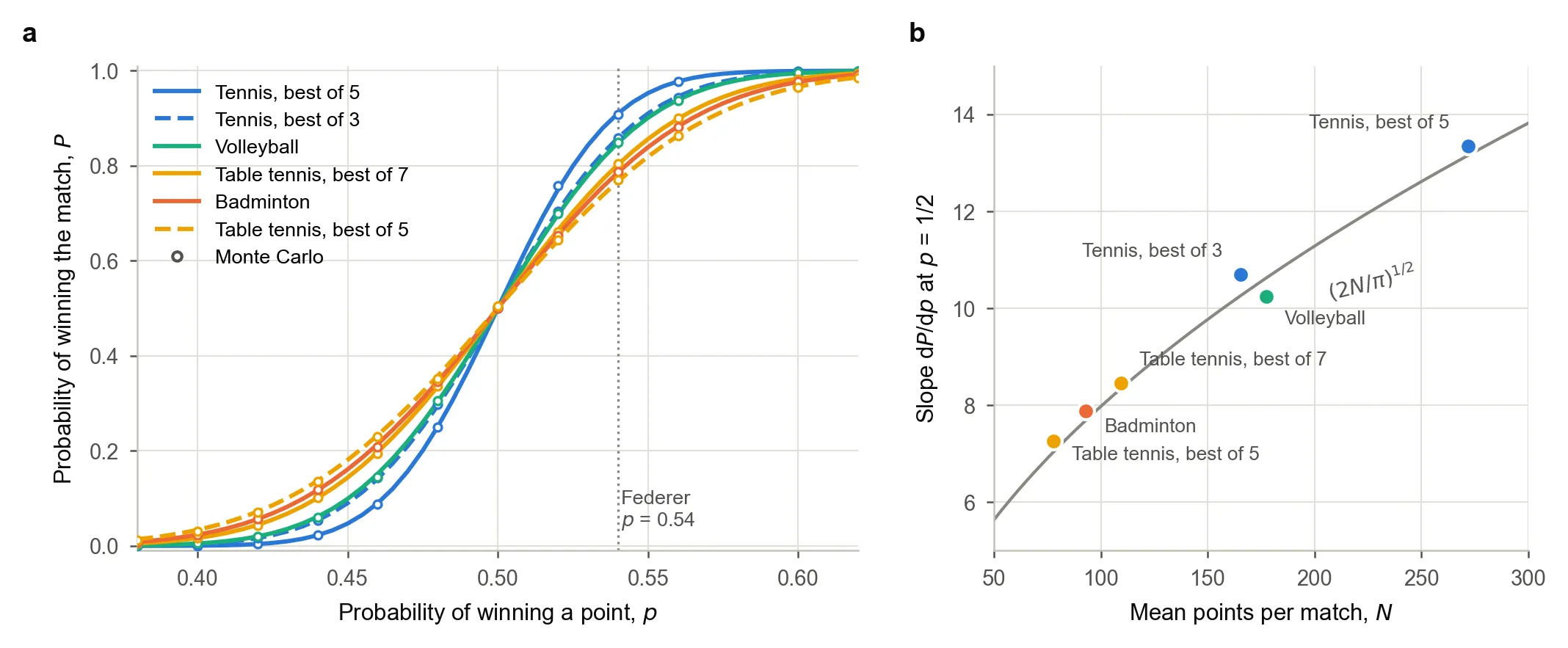
From points to matches: the longer the match, the steeper the curve (left); the slope at 50% follows the square root of the number of points (right). — Figure 1, Martín, Martínez & Buldú (2026), arXiv:2611.03702.
At 54% of the points, this model predicts 86% of three-set wins and 91% of five-set wins — more than the 82% Federer actually won (1,251 victories, which the speech rounded to almost 80%). The authors explain why: 54% is an average over very different opponents, and averaging along a curve that bends this way gives a lower result than reading the curve at the average.
Points that weigh more
Not all points are equal, though. The team split them in two: ordinary points, won with probability p₁, and crucial points — any point whose winner, whoever it is, closes a game, a set or the match — won with probability p₂.
There is always a narrow zone where a player wins most matches while winning fewer than half of the points. It exists because crucial points carry more weight on the outcome than their share of points, and it exists in all four sports. But on a chart of ordinary points won against crucial points won, it is a thin wedge with its tip at 50%–50%, opening at only 0.3 to 1.6 degrees. In tennis, a player who wins 49% of ordinary points must win about 52.4% of game points to get there. Game points are so frequent, about 29% of all points, that winning more of them quickly raises the overall share. Set and match points are rare, so they only tip the match with a large edge, around 70%.
Thirty-five years of matches
Between 1991 and 2025, 4,530 of 96,826 men’s ATP matches (4.68%) were won by the player who won fewer points. If each point were won independently, at the share of points each player actually took in that match, 3,892 would be expected: the real number is 16% higher, and still 5% higher once the serve is taken into account. In 166 Grand Slam matches won with fewer points, the winners took 49.1% of ordinary points, but 51.1% of set points and 61.9% of match points. A player’s composure on break points (points where the receiver can win the game against serve), measured in other seasons, also predicts results: one percentage point better than the opponent multiplies the odds of winning by about 1.08, at the same share of points.
The Federer paradox, recounted
Federer holds a strange record: 36 matches lost after winning more points than the opponent, more than anyone. But Federer won more points than the opponent so often that there were far more chances to lose such a match than to win one. The fair comparison is with what independent points predict: 25.6 such defeats instead of 36, and 15.6 wins with fewer points instead of 9. The record of 36 is therefore partly a counting effect, and partly a small deficit: in total, about 17 close matches fewer than the points imply, which the authors call an indication rather than proof. Pete Sampras, Andre Agassi, Andy Murray and Rafael Nadal all won more close matches than expected.
The Fognini paradox
At the other end stands Fabio Fognini. Over 774 matches, Fognini won 61,624 of 124,623 points, 49.4% — yet 396 matches, 51.2%. Independent points would have given 47.5%. The secret is not break points, but how points are spread across sets: 56.6% of close sets won, and lost sets often lopsided — 18% ended 6–0 or 6–1, against 5% for Federer. Points lost in a set already gone cost nothing. Twenty-three of the 328 players studied won more than half of their matches with less than half of the points.
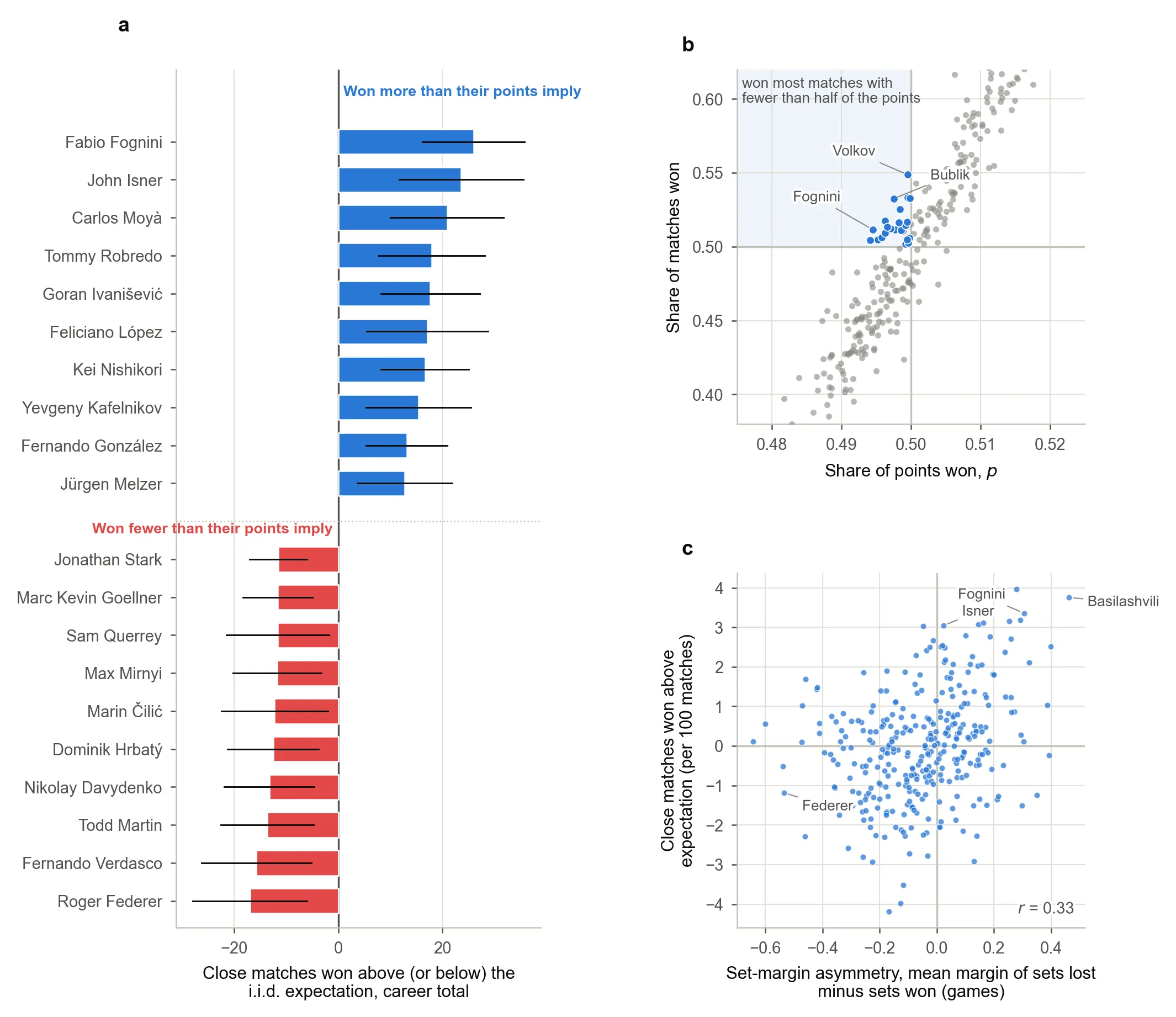
Close matches won above or below expectation: Fognini at the top, Federer at the bottom (left); the players who won most matches with fewer than half of the points (top right). — Figure 6, Martín, Martínez & Buldú (2026), arXiv:2611.03702.
The model is deliberately minimal: no serve, constant probabilities through a match, all crucial points of one level treated alike, and only men’s tennis in the data. Its last line borrows Federer’s words — “it is only a point” — and adds: “But not all points are equal.”