A DAYTIME FIREBALL TRACKED INTO THE SEA
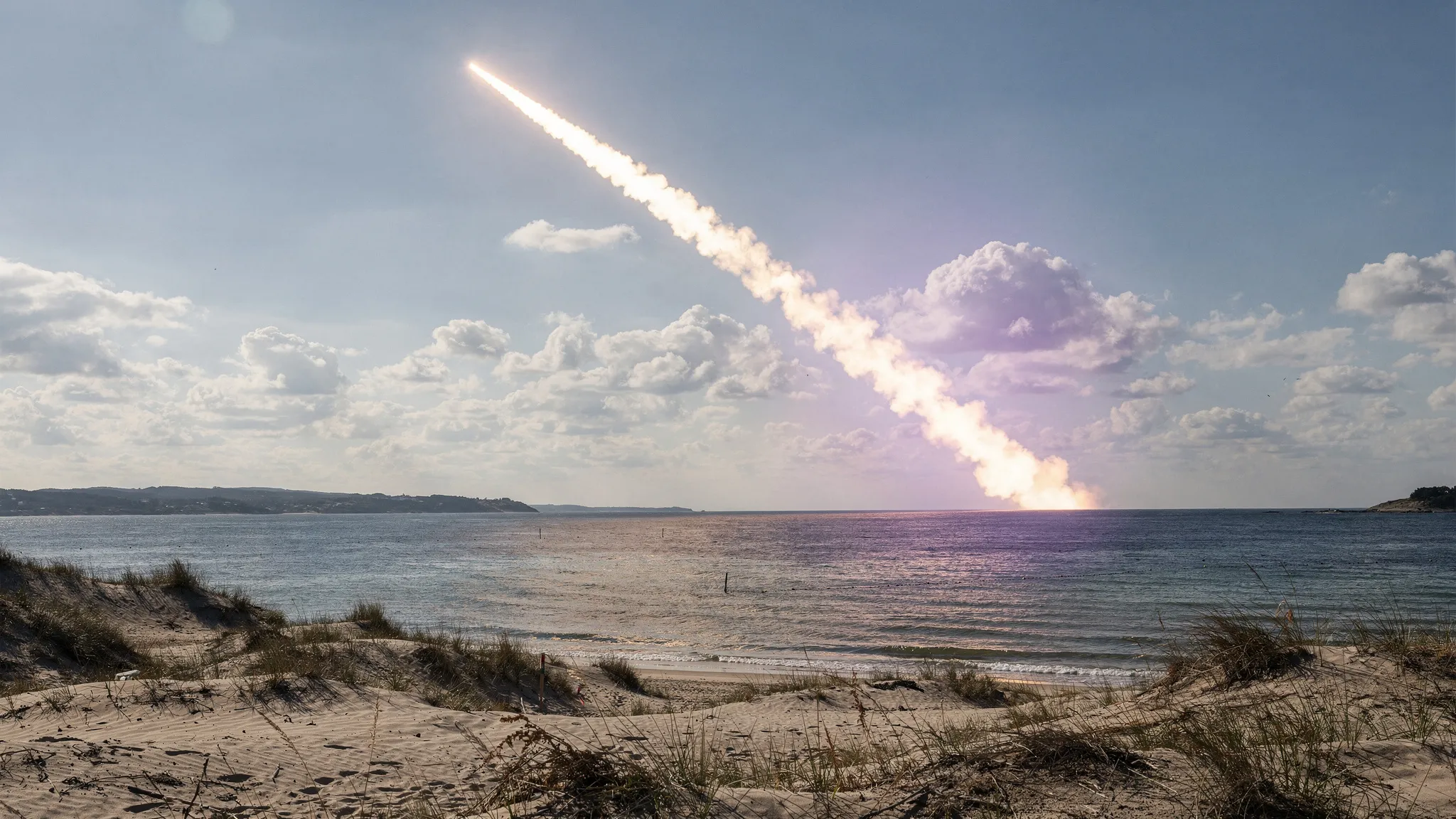
On 30 May 2026, shortly after 18:06 UTC, a bright fireball crossed the coast of Massachusetts in daylight and ended over Cape Cod Bay. People across the region heard a sonic boom. NASA’s Meteoroid Environment Office estimated the object at about 1.6 metres across and 5,600 kilograms.
A US government sensor reported by NASA/JPL’s CNEOS put its impact energy at 1.1 kilotons of TNT. According to the paper, only three events in the CNEOS catalogue for 2025 were more energetic, and this one is comparable to asteroid 2008 TC3, which fell over Sudan.
Metre-sized impactors are rare, and their orbits and make-up are seldom measured together, especially in daylight, when meteor cameras see little. This time, by luck, a whole set of instruments was watching.
Following the plasma
The SIMONe meteor radar of MIT’s Haystack Observatory transmits at 31.65 MHz and listens from five stations in New England. At that frequency it does not see the rock itself, but the plasma the rock creates as it tears through the air.
It caught the “head echo”, the plasma travelling with the meteoroid, from about 90 down to 71 kilometres. Below that, short-lived echoes from the turbulent wake continued down to 33.6 kilometres, an unusually low altitude. The team calls that point the radar terminus, where the body is expected to break up. CNEOS placed peak brightness at 32.0 km, just 1.6 km lower.
Combining all echoes gives a steep trajectory towards the south-east, at 26 kilometres per second at 100 km altitude.
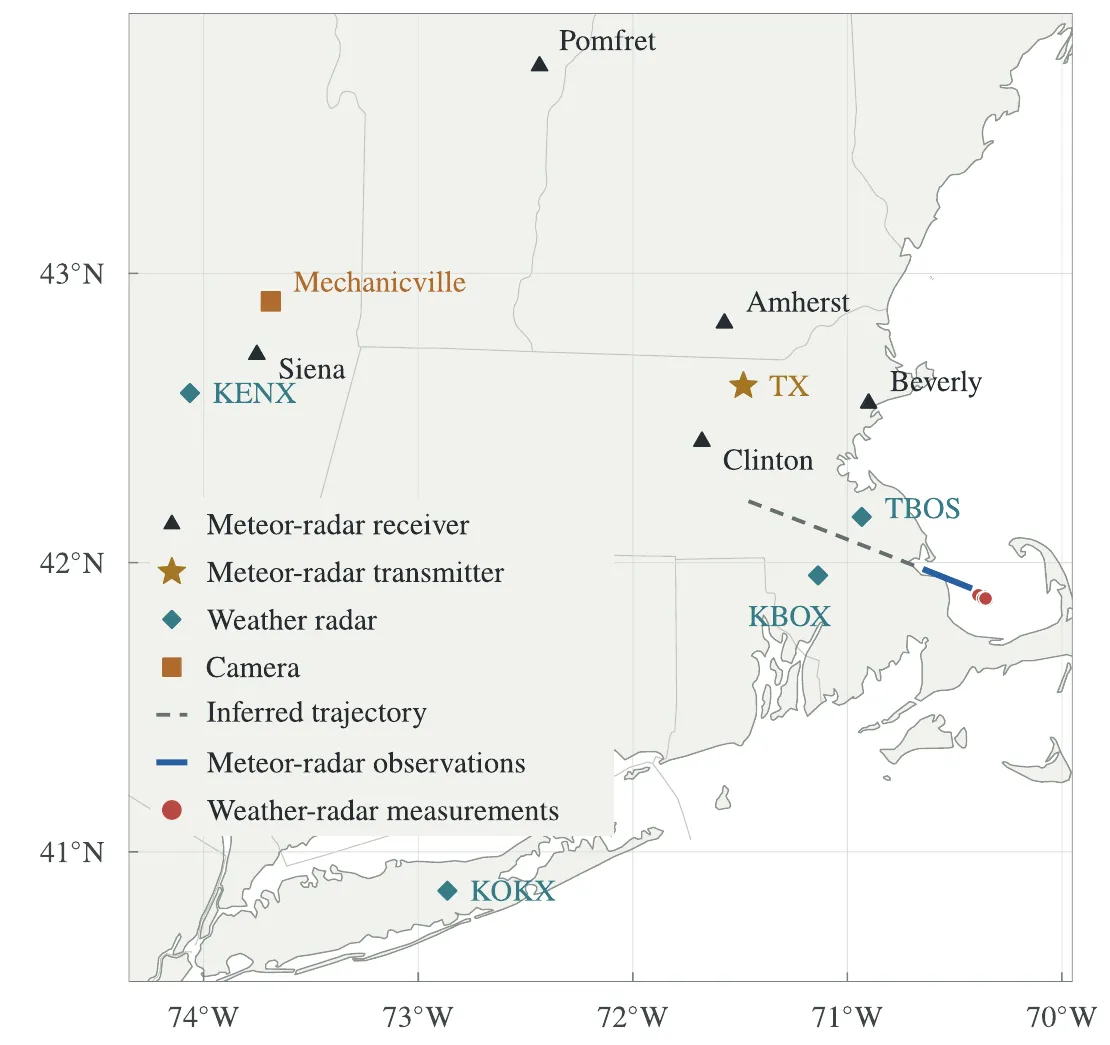
Observing geometry: meteor-radar receivers (triangles), transmitter (star), weather radars (diamonds); the blue segment is the path seen by the meteor radar, red dots the falling meteorites seen by weather radar. — Figure 2, Vierinen et al. (2026), arXiv:2610.24566, CC BY 4.0.
Meteorites in the weather radar
Once the fireball went out, the surviving fragments kept falling in “dark flight”. Ordinary weather radars picked them up: the Boston radar saw signatures from 13.6 down to 7.6 kilometres, well above the clouds, which topped out near 6.5 km. An airport radar saw others higher still.
A dark-flight model fed with these echoes and with measured winds places the fall zone in the bay, about 6 by 5 kilometres, in roughly 34 metres of water. The six modelled fragments weigh from 3.2 grams to 1.4 kilograms.
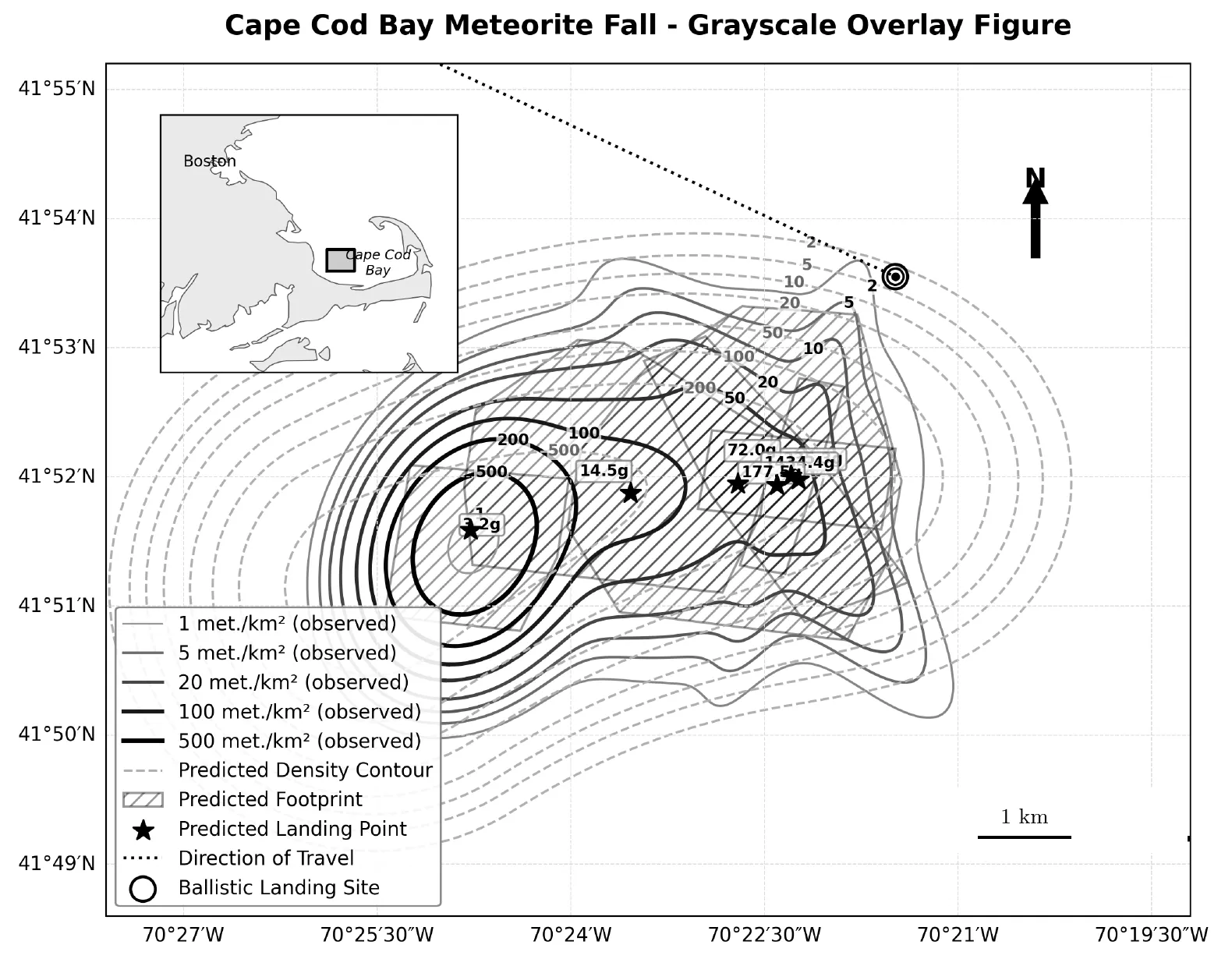
Predicted meteorite strewn field: solid lines, density of radar-observed meteorites; dashed lines, extended prediction for masses from 0.1 g to 10 kg. — Figure 8, Vierinen et al. (2026), arXiv:2610.24566, CC BY 4.0.
Hearing the shock
The team gathered pressure records from every open station within 2,000 km: 199 sensors, including citizen-run Raspberry Shake/Boom devices. Six of these cheap sensors, 65 to 101 km away, were inconclusive one by one. Analysed together as an “array of opportunity”, they pointed to the source within about one degree of the radar terminus.
From the period of the infrasound waves, the authors estimate an energy of about 0.5 kilotons, half the CNEOS figure but within the usual scatter of such methods.
A tough rock with no family
Several clues point to a dense, mechanically strong body, possibly rich in iron. The plasma appeared late, only below 90 km. The radar showed no sign of breakup during the head echo. The rock withstood a pressure of about 7 megapascals, above the typical breakup range of ordinary stony meteorites. And the fall is rich in large fragments: its mass distribution is the flattest measured to date.
Its orbit lies right on the border between comets and asteroids, and no parent body or meteor shower matches it. The composition, the authors stress, remains to be confirmed by recovered meteorites, which would have to be found on the floor of Cape Cod Bay.