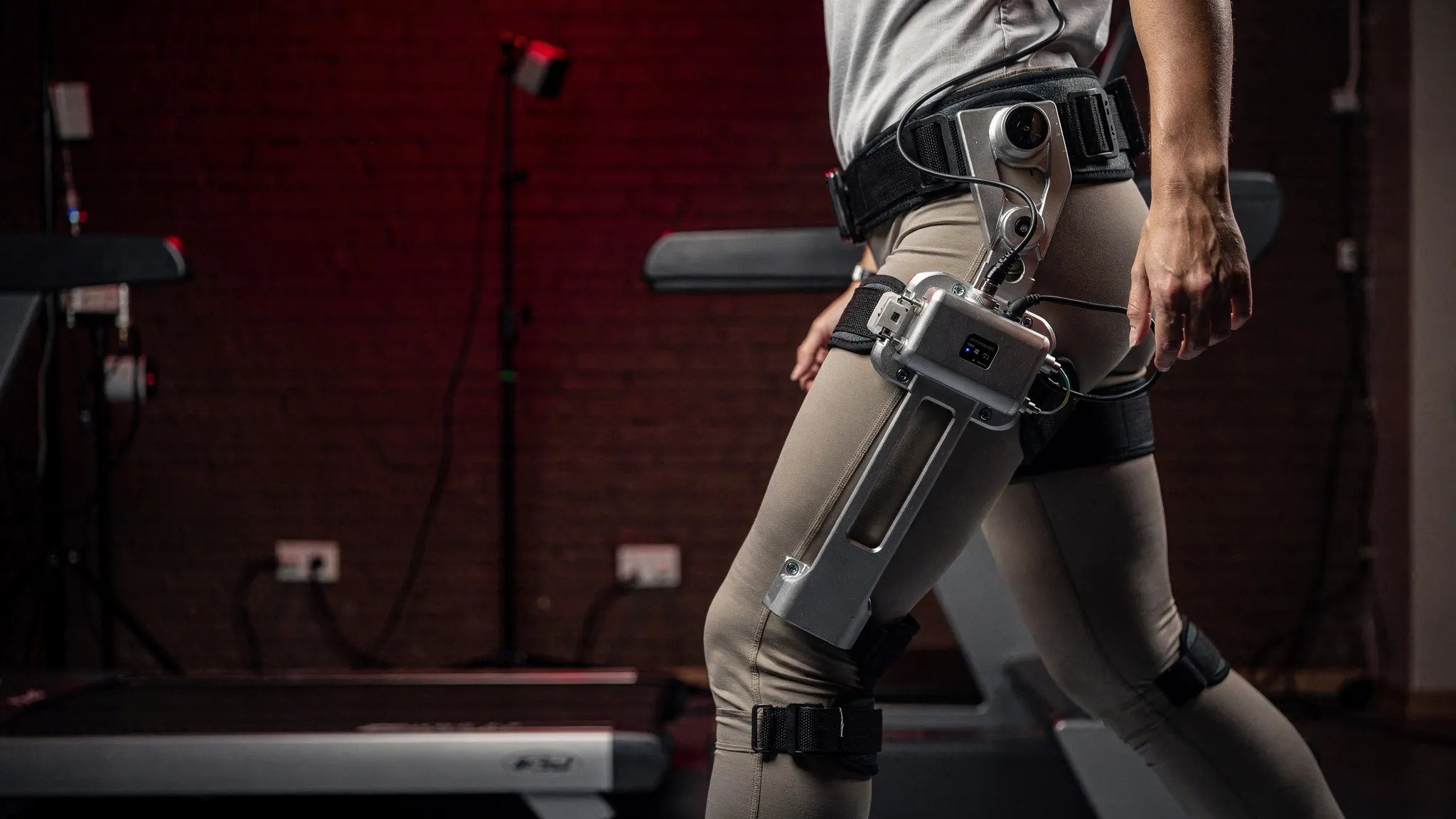
A HIP EXOSKELETON THAT LEARNED ON A VIRTUAL BODY
Powered exoskeletons for the legs are being developed both for rehabilitation and to help healthy people walk. Hip devices are especially attractive: the hip muscles supply a large share of the effort that pushes the body forward on level ground, so helping them relieves muscles that do much of the work of walking.
The difficulty is the wearer. As soon as a motor pushes on a joint, the gait changes and the muscles reorganise. The usual fix, “human-in-the-loop” optimisation, tunes the device directly on each person — long experiments that have to be repeated for every new user and every condition.
A virtual walker as training partner
Yifei Yuan, Xianlian Zhou and colleagues at the New Jersey Institute of Technology, with the Kessler Foundation, moved the training into a computer. Their virtual human has a full body driven by 304 muscle actuators. Its height, weight, muscle strength, stride and walking speed are drawn at random, from about 1.55 m and 54 kg up to 1.94 m and 97 kg, so the controller learns for a whole population rather than one person.
Two learning agents, programs that improve by trial and error guided by a score called a reward, share the same simulated world: one controls the body, the other the exoskeleton. First the body learns to walk alone; then the device is strapped on and both adapt to each other. The exoskeleton sees only the angles and speeds of the hips, and was trained to cope with readings that arrive 40 milliseconds late, which is why a small Raspberry Pi 5 computer and cheap motion sensors can run it.
Rewarding the right effort
What should the device aim for? Earlier controllers were rewarded for reducing muscle activation or mechanical work, stand-ins for effort. Here, the exoskeleton’s reward includes the metabolic power of the hip muscles, computed with a physiological model of muscle energy use.
The team trained two versions. One also rewarded the motors for delivering positive mechanical power. The other, without that extra term, did better in simulation: the energy used by the analysed leg muscles fell by 13.8% compared with walking without the device, against 8.8% for the version with the power term. The largest drop was at the hip muscles: almost 30%.
Eight walkers, no tuning
The better version was loaded, unchanged, onto a real hip exoskeleton weighing 5.94 kg. Eight healthy adults, aged 18 to 44, walked on a treadmill at 1.25 metres per second for about six minutes per condition while a portable analyser sampled their breath to measure the oxygen they used and the carbon dioxide they breathed out.
- Simply wearing the device switched off raised the energy cost of walking by 13.1%.
- With the controller running, the cost fell by 18.3% compared with the switched-off device — in every one of the eight participants, by 7.2% to 27.7%.
- Compared with walking without any device, the average saving was 7.4%, too variable across eight people to be statistically clear. Six of the eight walked more cheaply than without the device, up to 24.2%; two still spent slightly more.
In other words, the assistance removed about 0.63 watts per kilogram of body mass, roughly one and a half times the 0.41 that carrying the device added.
A wider swing at the hip
The wearers’ hip range of motion grew from 44 to 60 degrees, almost entirely in flexion, that is, in bringing the thigh forward, while their cadence barely changed. The help was well timed: 98.5% of the power the motors delivered pushed in the same direction as the hip was moving, although the deployed version was never directly rewarded for that. Its savings were close to those of the team’s earlier controller, tested in the same session at the same torque.
Lighter hardware next
The authors point to the hardware. Their device weighs about twice as much as two others trained in simulation (3.2 and 2.9 kg), and it was run at a torque (twisting force) of 12 newton-metres, below the 18 used in training, to keep it comfortable. A lighter frame with a better fit, larger groups of walkers, other speeds and slopes, and people with walking impairments are the next tests.