THE BOND IN H₂, PINNED DOWN TO 175 KILOHERTZ
The hydrogen molecule, H₂ — two protons, two electrons — is the simplest neutral molecule. For more than a century, two of its numbers have served as benchmarks for theory: its ionization energy, the energy needed to pull one electron away, and its dissociation energy, the energy needed to split it into two hydrogen atoms. Ioana Doran, Frédéric Merkt, Kjeld Eikema and 17 colleagues at ETH Zurich, VU Amsterdam and Université Paris-Saclay now give both with an uncertainty equivalent to 175 kilohertz.
Bohr’s figure, Langmuir’s figure
In 1913, Bohr calculated the dissociation energy by extending his model of the hydrogen atom. He found about 21,000 cm⁻¹ (a unit explained below), and trusted it enough to doubt Langmuir’s experimental value of about 46,000, obtained by an “indirect method”. The truth lay in between: a century ago, chemical measurements had converged near 36,750, uncertain by roughly 5 to 10%. Spectroscopy and calculation then took turns in the lead; by 1995, Wolniewicz had computed the first eight digits, 36,118.069.
Energies counted in hertz
Why kilohertz for an energy? Because the experimenters measure frequencies: that of the laser light or millimetre waves that makes the molecule jump from one energy level to another. Each energy gap matches one frequency, so the paper quotes energies as frequencies — an “ionization frequency” as readily as an ionization energy. The other unit, the wavenumber in cm⁻¹, is that frequency divided by the speed of light: the number of light waves per centimetre. Given side by side in the paper, the two units fix the exchange rate: 1 cm⁻¹ is about 29.98 gigahertz.
The dissociation energy of H₂ is 36,118.069 6646 cm⁻¹, or 1,082,792,488.30 megahertz — about a million billion hertz. On the ionization energy, 175 kHz amount to 5 parts in a hundred billion, the authors write; on the dissociation energy, to about 1.6 parts in ten billion — like measuring 1,000 kilometres to within 0.16 millimetre.
A detour through the ion
Measured head-on, the dissociation energy is elusive: where the molecule starts to break apart, the signal rises only slowly. Hence a detour. Pull an electron off H₂ (its ionization energy, Eᵢ), split the resulting ion H₂⁺ into a proton and a hydrogen atom, then give the electron back to the proton, which releases the ionization energy of the hydrogen atom. Both routes start and end at the same place, so their energies balance:
D₀(H₂) + Eᵢ(H) = Eᵢ(H₂) + D₀(H₂⁺)
where D₀ is a dissociation energy. The hydrogen atom and the H₂⁺ ion each have a single electron, and their energies are known to within 6 and 18 kHz. Everything therefore rests on the ionization energy of H₂: any precision gained there passes straight into D₀(H₂).
Three steps, two cities
In Amsterdam, two photons of deep-ultraviolet light, at 201.7 nanometres, lift the molecule from its ground state to an excited state called EF. The frequency of that jump was measured by Ramsey-comb spectroscopy: pairs of pulses from a frequency comb — a laser emitting an evenly spaced train of pulses — excite the molecule twice, and the two excitations interfere. Result: 2,972,885,517,077 kHz, within 31 kHz — over a hundred times more precise than before.
In Zurich, an ultraviolet laser carries the molecule from EF to Rydberg states, where one electron orbits far out, barely bound. Millimetre waves, from 110 to 430 GHz, then link these states to two reference Rydberg states whose binding energies (the energy still holding the electron), about 48 and 28 cm⁻¹, were known to within 21 and 30 kHz from earlier work: adding that last binding energy completes the climb to the ionization limit. Summed in eight combinations, the steps give the ionization energy five times more precisely than the previous value.
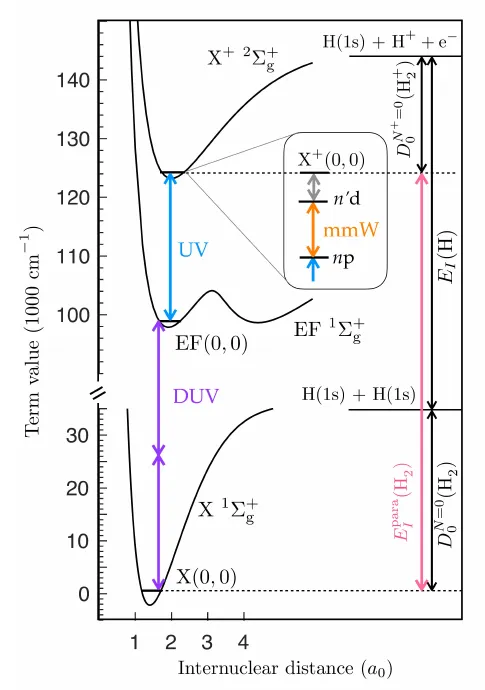
Energy levels of H₂ in its ground state (bottom curve) and its EF state (middle), and of the H₂⁺ ion (top), in thousands of cm⁻¹. The violet, blue and orange arrows are the three kinds of steps measured: deep ultraviolet, ultraviolet and millimetre waves. The pink arrow is the ionization energy; the cycle on the right turns it into the dissociation energy. — Figure 1, Doran et al. (2026), arXiv:2610.40359.
Why the rarer form of hydrogen
H₂ comes in two forms, depending on how the spins of its two protons combine: a total of 0 in para-hydrogen, 1 in ortho-hydrogen. The best earlier determination used ortho-hydrogen, whose EF state splits into closely spaced sub-levels — a hyperfine structure — that could not be resolved and cost more than 200 kHz of systematic error. Para-hydrogen has none, but it is the minority: 25% of the molecules in the cold beam, against 75% ortho. And its Rydberg states are disturbed by a neighbouring series, so the usual method — reading the ionization limit off the regular ladder of Rydberg levels that converge on it — is not precise enough. Hence the millimetre-wave link to two reference states whose distance to the limit was already known.
Sharper than the theory
The team then fitted together 45 energy intervals measured by the collaboration over the years. The ionization energy comes out at 124,417.491 1573 cm⁻¹; both energies are known within about 175 kHz. The best calculations carry an uncertainty of 780 kHz. The two agree, but both new values, para and ortho, sit close to the upper edge of the theory’s error bar.
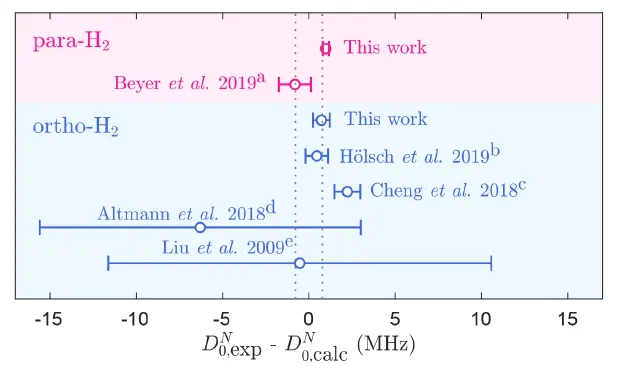
Measured dissociation energies of H₂ minus the best calculation, set at zero, in MHz: para-hydrogen in pink, ortho-hydrogen in blue, older measurements lower down. The dotted lines mark the calculation’s uncertainty. — Figure 12, Doran et al. (2026), arXiv:2610.40359.
The calculations add corrections from quantum electrodynamics, the quantum theory of light and charges, order by order in powers of the fine-structure constant α (about 1/137, which sets the strength of electric forces). Until now, orders up to α⁶ were enough to match experiment for H₂; the best calculations already include the leading α⁷ term, and the authors call a full calculation of the α⁷ correction to its dissociation energy “highly desirable”. In helium, the other two-electron system calculated this finely, theory and experiment disagree by 450 kHz on the ionization energy of a long-lived excited state — nine times their combined uncertainty — for reasons still unknown. At 175 kHz, H₂ could test, once the α⁷ correction is computed, whether the theory of two-electron systems is missing something.
A ceiling for new physics
The two forms offer one more test. The gap between their ionization energies, 60.253 146 cm⁻¹, should equal a difference of rotational energies that theory computes — ortho-hydrogen cannot stop rotating: it starts, and its ion ends, one rotational step above para: 60.253 137 6 cm⁻¹. They agree. Any contribution from beyond the Standard Model — physics outside the established theory of particles — that would set the two forms apart through their different nuclear spins must therefore stay below 540 kHz (at one standard deviation), a bound three times tighter than before.
Since the first studies of the 1910s, the authors count some nine orders of magnitude of improvement in this one number. The experiment is now ahead; the next comparison waits on a full α⁷ calculation.