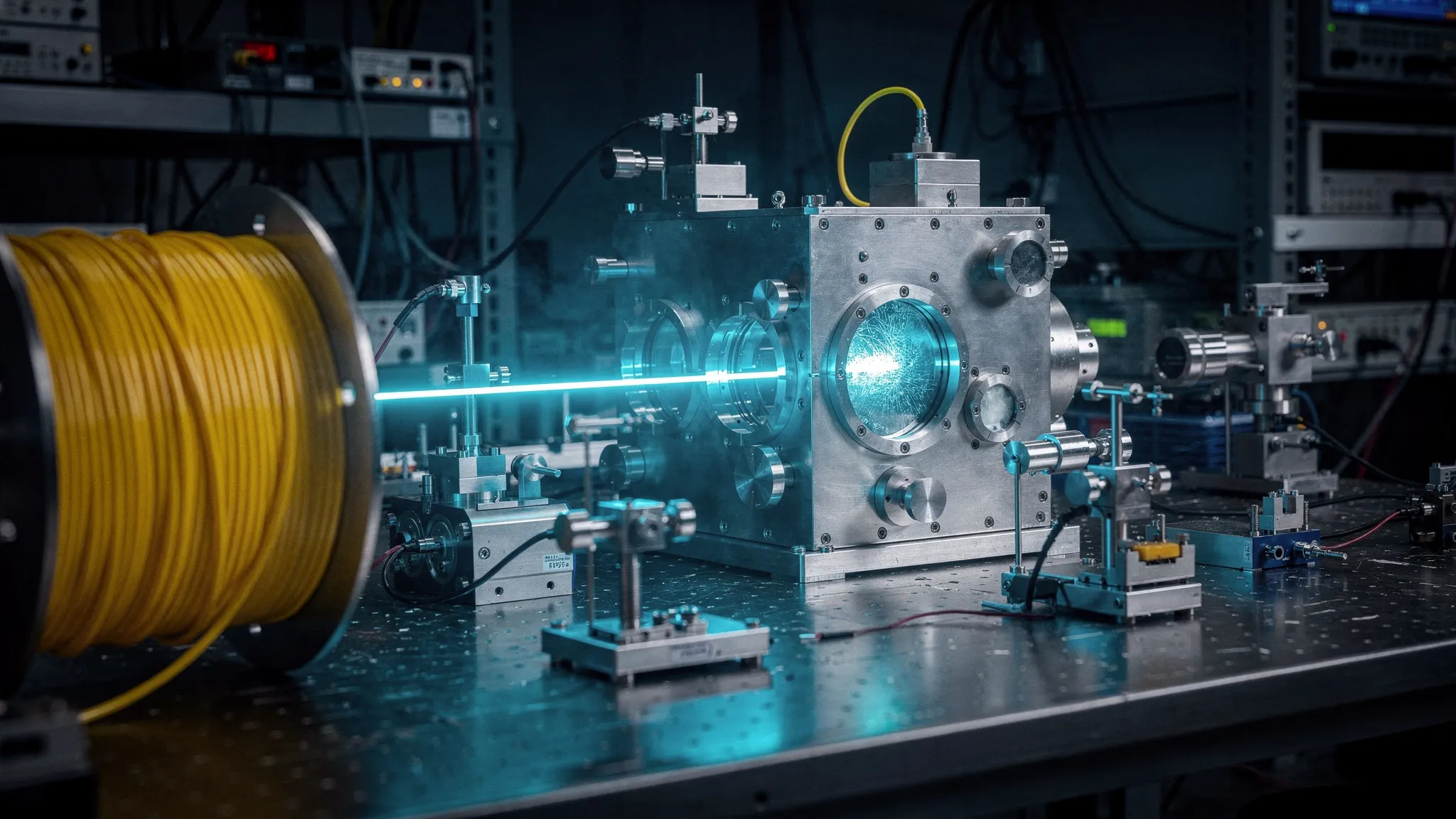
CLOCKS THAT FEEL THE TIDES IN TIME ITSELF
Gravity affects the passage of time, as general relativity describes. On Earth, the rate of a clock changes by about one part in 10¹⁶ for every metre of height. Comparing distant clocks can therefore directly measure differences in the Earth’s gravity potential (roughly, how deep a place sits in the Earth’s gravity, which mostly follows altitude) — a technique called chronometric levelling. Until now, experiments have used it for fixed differences, such as the height gap between two laboratories, reaching uncertainties of a few centimetres.
A signal everyone can predict
Gravity on Earth is not fixed, though. The pull of the Moon and the Sun changes over the day, the solid Earth deforms in response, and the ocean tides load the ground. Together, these shift a clock’s rate by up to 5 × 10⁻¹⁷ at any one place, with rhythms of about one and two cycles per day.
What two clocks compare is the difference between their sites. Stations separated in longitude feel the tide at different times; stations separated in latitude feel it with different strength. Across a continent, the gap swings by a few parts in 10¹⁸. To follow it, a clock comparison must be stable to about 1 × 10⁻¹⁸ within a few hours. Optical clocks had never resolved such a time-varying signal.
Clocks across Europe
A collaboration of 44 researchers, with Sören Dörscher of the Physikalisch-Technische Bundesanstalt (PTB) in Braunschweig, Germany, and Ian Hill of the National Physical Laboratory (NPL) in Teddington, UK, as corresponding authors, used optical lattice clocks, in which strontium or ytterbium atoms are held in a grid of laser light. They are linked through the European network of phase-stabilised optical fibres, with Paris as its hub.
Two pairs of clocks did the main work, each about 800 kilometres apart:
- Turin and Braunschweig (about 840 km), March 2025. Here, PTB sent its transportable clock PTB-Sr4 to Italy’s Istituto Nazionale di Ricerca Metrologica (INRiM) as a remote sensor, and compared it with its laboratory clock PTB-Sr3. The sites differ mainly in latitude (about 7°), so the tide reaches them with different strengths.
- Teddington and Braunschweig (about 740 km), March 2023, with NPL’s clock NPL-Sr1. At almost the same latitude but 11° apart in longitude, these sites feel the same tide at different times.
The tide model predicted differences between the sites of up to 5 × 10⁻¹⁸ from peak to peak — a few parts in a billion billion. Both pairs reached the stability needed, thanks to ultrastable laser cavities, including a 20-centimetre transportable one.
Watching time rise and fall
Averaged over three hours, the ratio of the two clocks’ ticking rates (their frequencies) in each pair rose and fell like the predicted tide. A spectral analysis made it sharper: both comparisons showed a strong twice-a-day rhythm, which all but vanished once the prediction was subtracted — showing that amplitude and timing both matched. The Teddington–Braunschweig pair also showed the once-a-day rhythm its geometry predicts; the Turin–Braunschweig pair, as expected, did not.
A tracking algorithm called a Kalman filter, which could run on live data, then measured how strong the observed signal was relative to the model, where 1 means a perfect match. Over about a week each, it found 1.42 ± 0.35 for Turin and 1.12 ± 0.24 for Teddington — both more than four standard deviations away from zero. Single days already agreed with the prediction: the tide was resolved in less than one day of measurement. Including other clock pairs in Paris, Turin and Teddington, the weighted average came to 1.00 ± 0.12.
As a check, the team ran the same analysis on two clocks sitting side by side in Turin, where the tidal difference is about 10⁻²², while telling the filter to look for the tide between two distant sites. It found values compatible with zero, as it should.
The authors put the effect at height changes of the order of 10 centimetres at each station, once or twice a day.
From tides to volcanoes
For metrologists, the lesson is practical: tides are a real, predictable bias in long-distance clock comparisons, and the average over a measurement campaign can differ from the long-term average. They must be modelled as clocks aim for 10⁻¹⁸ and beyond.
For Earth scientists, the transportable clock matters most. It performed as well as fixed laboratory clocks, so clocks could be sent to sites chosen for their geophysical interest, wherever a fibre reaches. Networks of clocks could then watch the slow redistribution of groundwater, ice, ocean and air, or a magma chamber filling beneath a volcano, and check satellite gravity missions, which sample monthly, with daily to weekly measurements on the ground.
The network keeps growing: a new link to Toruń in Poland has stretched the widest east–west spacing from 11° to about 19°, and links to Belgium and the Netherlands are planned. For stations at the same latitude, the twice-daily tide signal peaks at 90° of longitude apart — a spacing that only transoceanic links could reach. For now, the tides serve as the test: a change in gravity that everyone can calculate in advance, so that the clocks can later be trusted with less predictable ones.