AI VIDEOS COULD EMIT 75 TIMES MORE BY 2030
Type a sentence, get a video clip: text-to-video generation now runs at commercial scale. Its cost per clip is already known to be high. According to an earlier study by Delavande and colleagues, generating a short video from text uses roughly 90 watt-hours, nearly 30 times an image and 45,000 times a simple text-classification task. And the clips are not made on the user’s own device: each request runs on racks of AI chips in data centres.
But a cost per clip says little about the total. It does not tell how many clips are made, what hardware that requires, or how much water the cooling uses. And efficiency per clip can improve while the total footprint grows.
Tristan Coignion, at the University of Lille, with A. Bugeau and G. Guennebaud in Bordeaux and A.-L. Ligozat at Paris-Saclay, set out to estimate the whole footprint of AI video generation worldwide — for 2026 and up to 2030.
Counting the clips
Providers rarely say how many videos they generate, so the team measured what it could. It crawled the public feed of Sora, OpenAI’s video service, for 54 days between February and April 2026: 3.3 million public videos, or about 22 million a year. OpenAI shut Sora’s web and app experiences down shortly after. It also followed HeyGen’s live counter for 90 days: about 111 million videos a year, private ones included.
Six other providers publish their own counts. The largest by far is Grok Imagine, at about 3.8 billion a year. Added up, these give an observable total of about 6.2 billion videos a year. Since these counts are partial, the model lets the true 2026 volume range between 6.2 and 9.5 billion; its middle estimate is 7.16 billion.
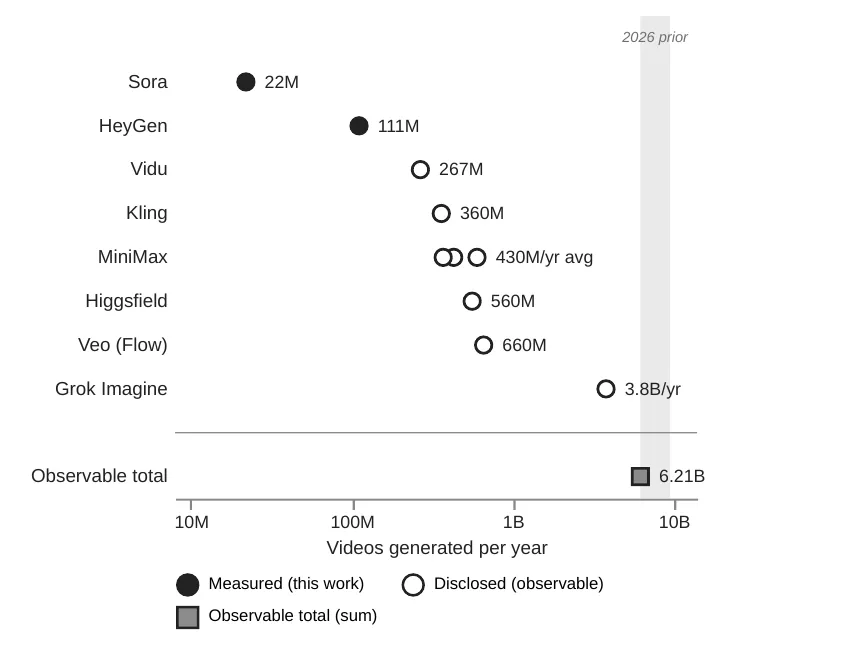
Yearly AI videos per service: filled dots measured by the team, open dots disclosed by providers; the shaded band is the model’s range for 2026. — Fig. 1, Coignion et al. (2026), arXiv:2611.17938.
The 2026 bill
From there, a bottom-up model sizes the fleet of AI chips needed, then derives electricity, water, greenhouse gases and the depletion of mineral resources, running 10,000 simulations to capture the uncertainty. Training and storage are included; sound, and the streaming of videos to viewers, are not.
For 2026, the median result is a fleet of 72,600 graphics processors, 724 gigawatt-hours of electricity and 124,300 tonnes of CO₂ equivalent. Take the greenhouse gases humanity can emit each year without crossing the planet’s climate limit and share them out equally per person: 124,300 tonnes is the yearly allowance of about 126,000 people.
Per video, the all-in cost comes to about 100 watt-hours — 4.1 times the 24.4 watt-hours the chip alone spends on one generation — an average over 2026’s mostly short, low-resolution clips, adjusted for the optimisations of commercial services. Idle time, building overheads, training and storage make the difference. Generating the videos accounts for about 69% of the emissions, training models for 31%, storage for almost nothing. And where the electricity comes from matters more than how much is used: for emissions, the carbon intensity of the grid weighs 12 times more than the number of videos.
Three futures
The model then runs to 2030 under three scenarios, all with the same steady technical progress: newer, more efficient chips and software about 10% more efficient each year.
- Reference: the number of videos doubles in 2027, 2028 and 2029, then grows 60% in 2030 — 12.8 times in all, a deliberately modest path. Emissions grow 74 times, reaching about 9.2 million tonnes in 2030: the budget of about 9.3 million people. Why faster than demand? Videos get longer and sharper, so the energy per video rises from 24.4 to 214 watt-hours.
- Usage stagnation: volume, resolution and duration stay at 2026 levels. Emissions fall by about two-fifths. It is the only scenario where they drop.
- Mass adoption: volume grows 60-fold. Emissions reach 42.9 million tonnes — the budget of about 44 million people.
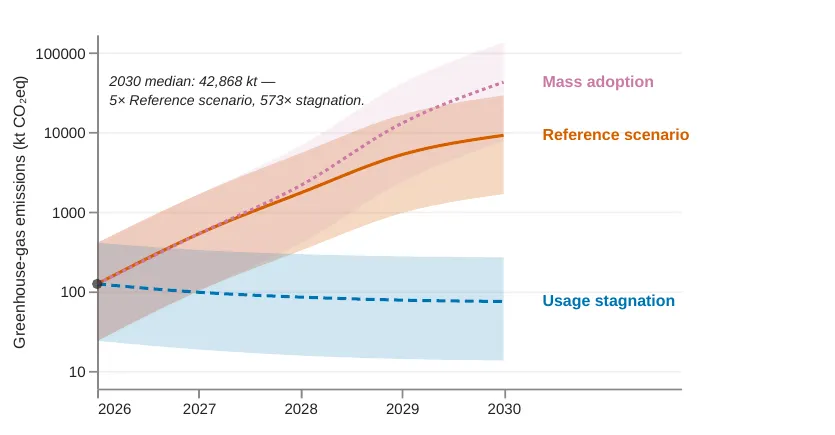
Emissions under the three scenarios, 2026–2030; lines are medians, bands the 5–95% range. — Fig. 6, Coignion et al. (2026), arXiv:2611.17938.
Efficiency will not catch up
The team also ran the model backwards. Under the reference path, even a 30% efficiency gain every year leaves 2030 emissions 27.5 times above 2026. Holding emissions flat would require an efficiency gain of about 75% a year — some seven times the 10% the model assumes, and beyond the best efficiency measured on any production model. The digital sector’s own target, aligned with the Paris Agreement, calls for a 45% cut in emissions between 2020 and 2030.
A floor, not a ceiling
The authors present all these figures as lower bounds. The generation model is held fixed until 2030, while real models will likely grow more demanding; streaming, sound and other AI uses are left out; training, the least documented part, is calibrated on a few small open models. Usage can also shrink fast, as the closure of Sora showed. But under the paper’s numbers, the footprint stops growing only if the number of videos, or their quality, stops growing too.