DRUG DOGS WALK RIGHT PAST THE DRUGS
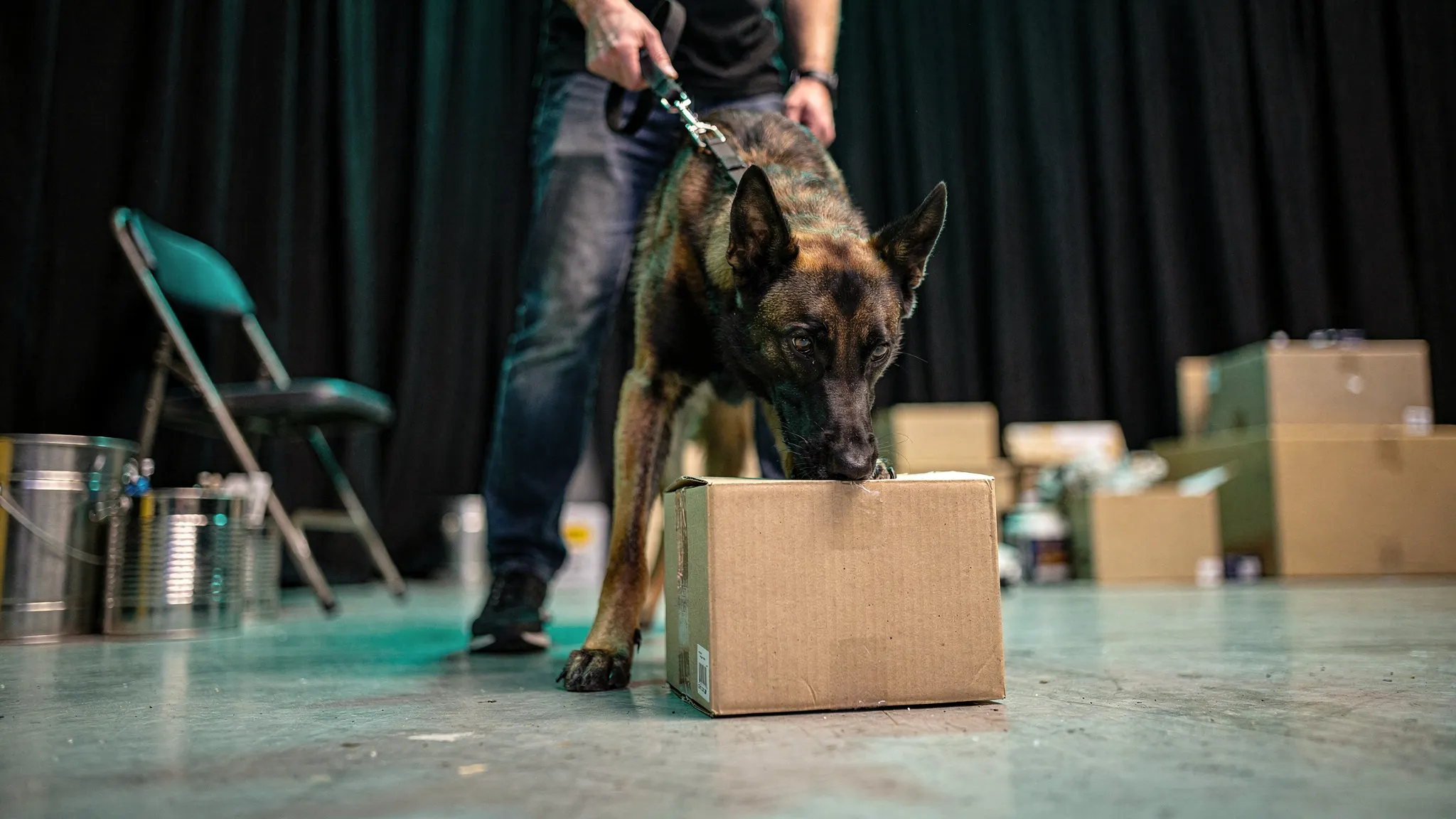
A detection dog and its handler work as a team of two species. The dog samples odours its partner cannot perceive. The handler decides where they go, how long they stay, and which of the dog’s reactions counts as a find — a “call”. Most research rates these teams by their results or by fixed traits such as breed or training. Few studies have watched what actually happens during a search.
In comfortable test conditions, certified teams often score above 90%. Under more realistic conditions, performance drops. And since Pfungst’s 1911 analysis of Clever Hans, unintentional cueing by humans has been the standard suspicion: handlers might be steering their dogs without knowing it.
109 searches under the cameras
Stephan Kaufhold, Federico Rossano and colleagues at the University of California San Diego organised two judged detection events on campus, in spring 2025 and spring 2026, with a professional dog-training company. Thirty-seven professional narcotics teams — from police, corrections and private security, mostly with Belgian Malinois — each searched three cluttered areas: an outdoor lot, a group of three vehicles and an indoor room, with two to four minutes per search.
Each area hid two real drugs (methamphetamine, cocaine or heroin) and several decoys: hot dogs, cheese, dog biscuits, pet food, and banknotes, both new and used — used notes often carry traces of drugs. Handlers did not know where anything was, only that there were exactly two targets. Fixed cameras and computer-vision software tracked the dog and the handler to within centimetres, and coders logged every gesture, command and dog reaction.
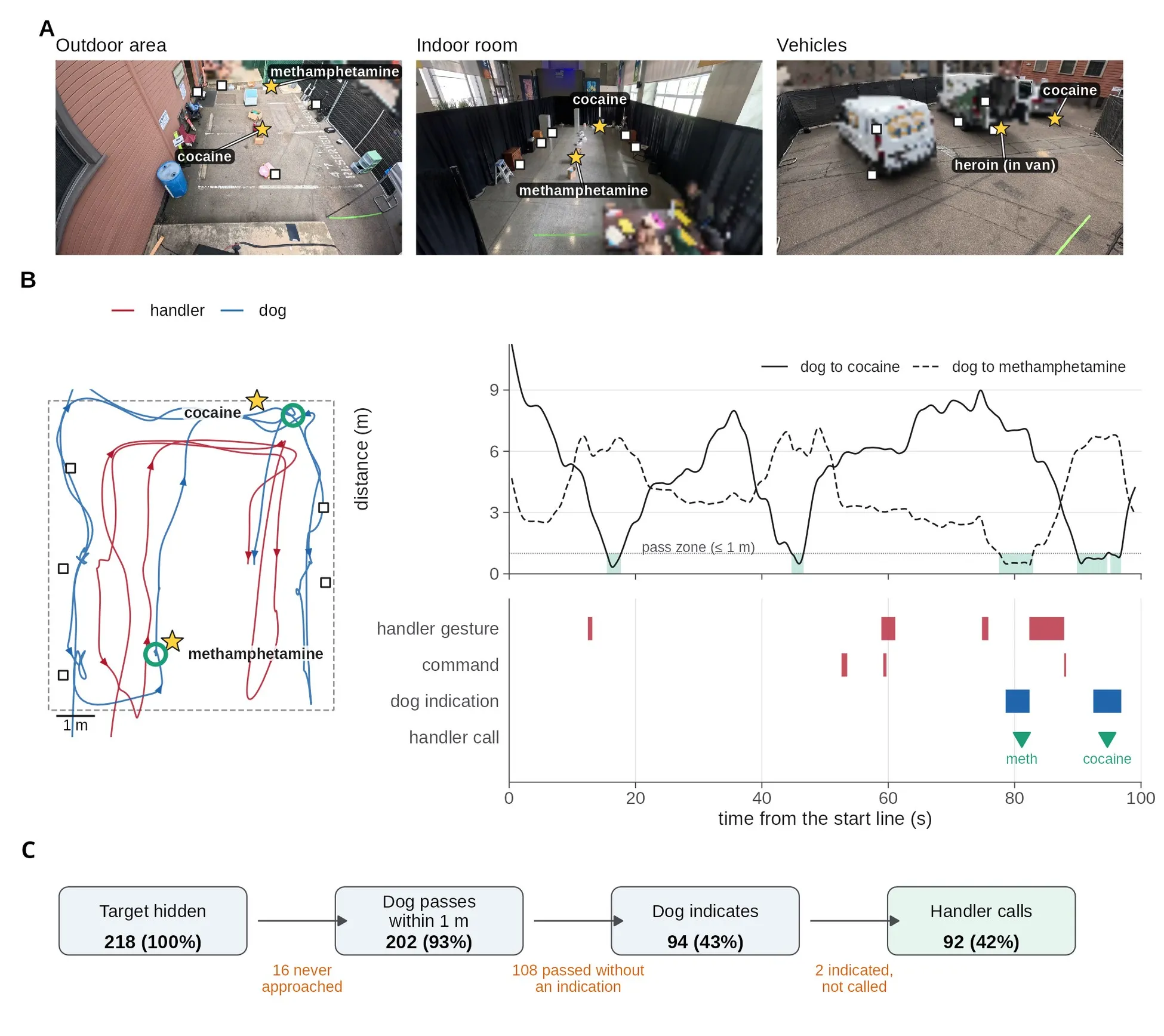
How a search was recorded: the three environments with targets (stars) and decoys (squares), the tracked paths of dog (blue) and handler (red) during one indoor search, and the chain from a hidden target to a call. — Figure 1, Kaufhold, Terwilliger, Kefer & Rossano (2026), arXiv:2610.07129.
Close, but no reaction
The results are sobering. Handlers made 157 calls, of which 41% were false. Teams found 92 of 218 targets, or 42%, and half the searches contained at least one false call. Performance varied hugely: five teams found none of their six targets, none found all six, and the best called its first target 7 seconds after crossing the start line.
The most striking finding is where the finds were lost. Coverage was not the problem: the dogs came within one metre of 92% of the targets. Missed targets had been passed a median of three times, for about 8 seconds in total — no less than the targets that were eventually found. Nor were handlers ignoring their dogs: they called 89 of the 91 targets their dog indicated.
The loss happened at the encounter. Treating each pass within a metre as a test, a dog reacted to a drug on 17% of passes — about one in six — and to a decoy on under 4%. So the dogs clearly told drugs from decoys; they just often walked by without responding. Only 4% of finds happened on the first pass.
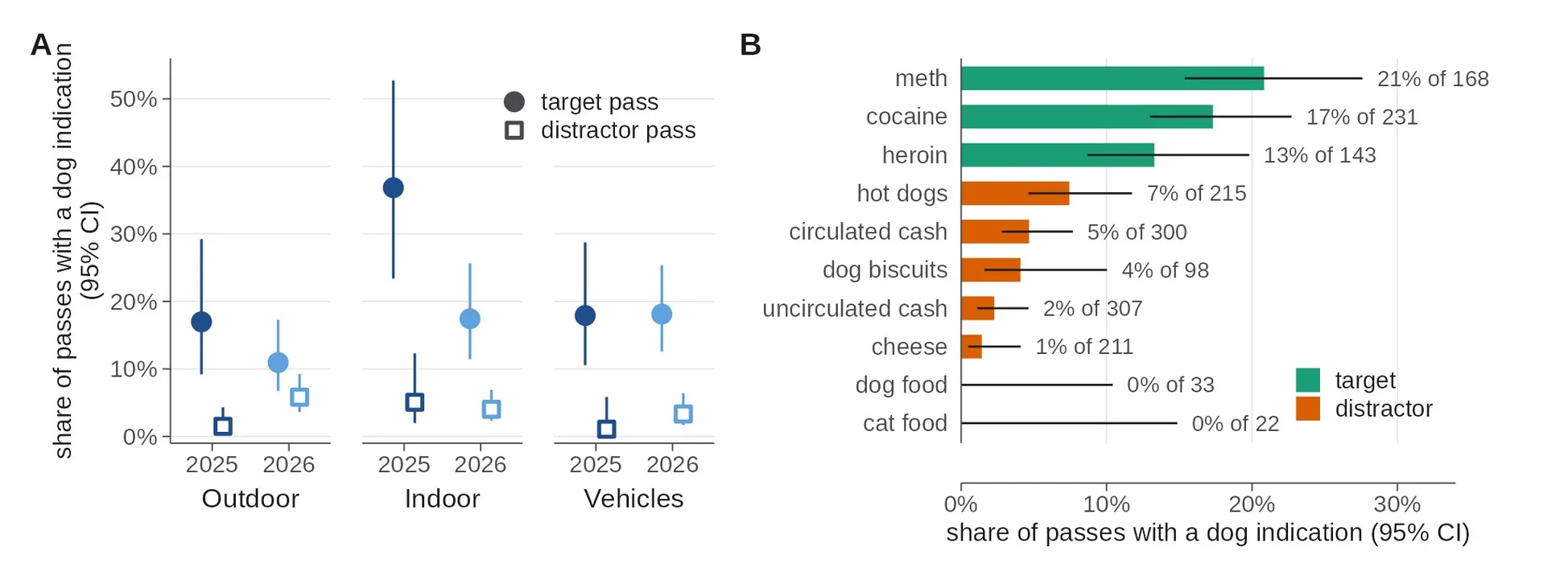
Dogs reacted far more often near drugs than near decoys, but still on only a minority of passes. — Figure 4, Kaufhold, Terwilliger, Kefer & Rossano (2026), arXiv:2610.07129.
No Clever Hans in sight
On the 1,590 passes without a reaction, handlers behaved the same near drugs as near decoys: pointing, gesturing, giving commands and walking at the same rates. They even gestured less before false calls than before correct ones. Here, nothing suggests that handlers steered their dogs — although the authors note that subtler signals, such as gaze or leash tension, were not measured, and that the judges watching the searches knew where the drugs were.
Something else did change behaviour: the clock. In the last 30 seconds, calls tripled, both right and wrong, and dogs reacted to decoys far more often.
Decoys, not teams
Finding targets was a moderately stable trait of a team. False calls were not: they depended on the search and on specific objects — hot dogs drew 19 false calls, used banknotes 17. The team’s pace was the only feature of the search linked to success, mostly within a team, which the authors present as a marker of how a search is going, not advice to walk faster. Malinois and dogs used to working off leash also did better; the handler’s experience and certifications did not predict success.
The authors stress that these numbers are not estimates of real-world accuracy, and that 37 teams is a small sample. Their reading: the dog decides whether to respond, the handler decides where, how long and how often it sniffs — and success belongs to the pair, not to either partner alone.