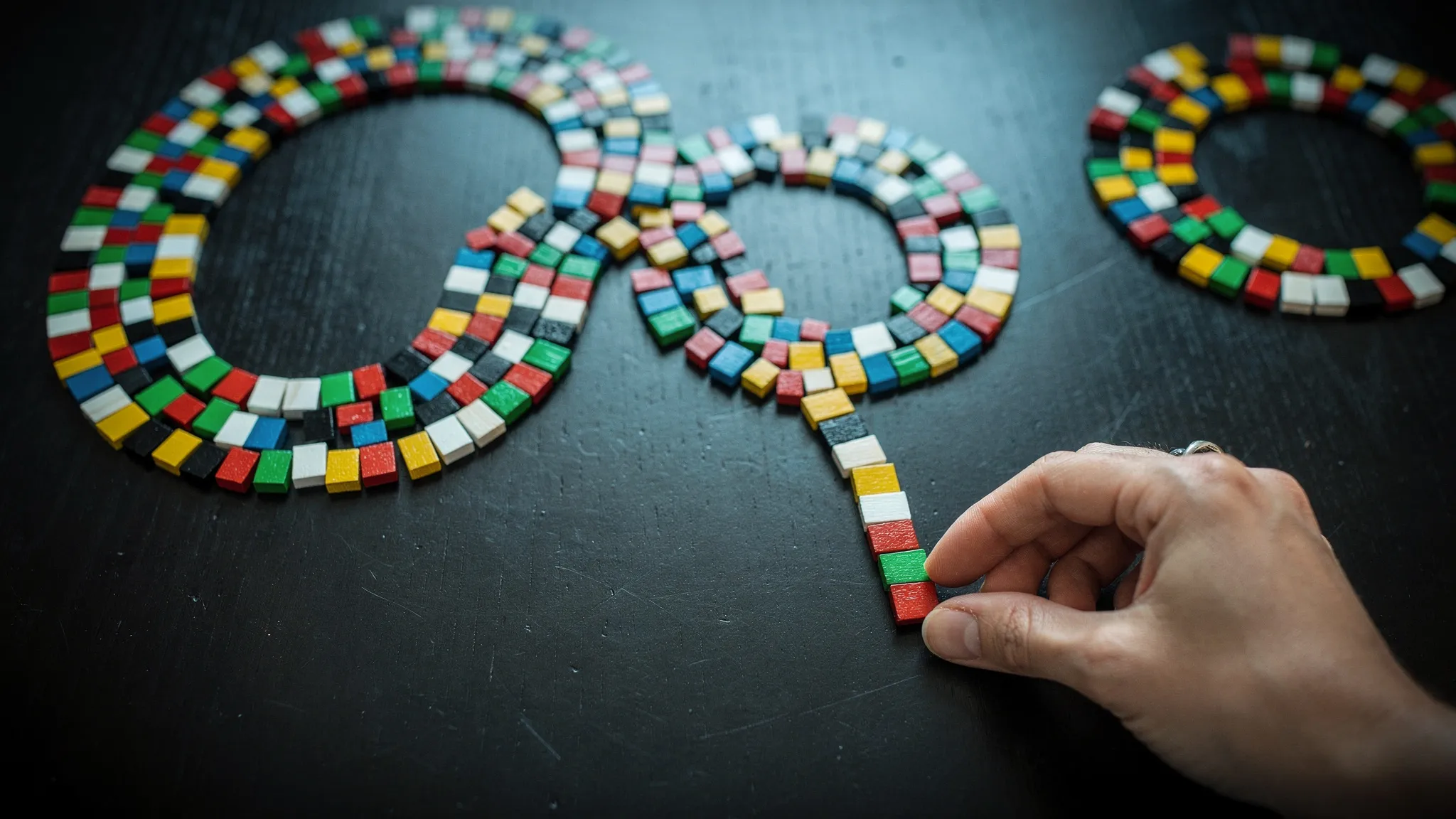
537 NUMBERS, SIX COLOURS, NO SUMS
Here is a puzzle a child can understand. Take the numbers 1, 2, 3, and so on. Give each one a colour. The only rule: within one colour, you may never find two numbers together with their sum. The two numbers may even be the same, so if 2 is red, then 4 cannot be red, because 2 + 2 = 4.
A set with no such triple is called sum-free. How far can you go before the rule forces you to stop? That limit, for k colours, is the Schur number S(k). The problem goes back to a 1916 paper by I. Schur, the first entry in the reference list.
A famously stubborn sequence
With one colour, you are stuck at once: 1 + 1 = 2, so the colour can hold only the number 1. The known values are:
- S(1) = 1
- S(2) = 4
- S(3) = 13
- S(4) = 44
- S(5) = 160, determined by M. J. H. Heule (in a paper published in 2018).
For six colours, nobody knows the answer. Since 2000, the best known construction, found by H. Fredricksen and M. M. Sweet through a search over symmetric colourings, reached 536. That number has been quoted as the best lower bound ever since — a floor: S(6) is at least that large, and its true value, still unknown, could be higher.
One more number
Zhiyang Chen and Fan Long, of the University of Toronto, and Ligeng Zhu, of NVIDIA Research, now push it to 537. Their proof is the kind mathematicians love for its bluntness: they print the answer. Six lists of numbers — 76, 76, 88, 70, 76 and 151 of them — that together contain every integer from 1 to 537 exactly once, with no colour holding x, y and x + y. Checking it means testing every sum within each list, a quick job for a computer.
The solution has a striking shape. It is symmetric: each number x has the same colour as 538 − x. The first four colours start at 1, 2, 3 and 4; the fifth only appears from 38 on, the sixth only from 151 on, and the sixth colour fills the whole middle stretch from 237 to 301. Even the first colour can be rebuilt from a seed of just 14 small numbers, using mirror images, a shift and one extra number, 95.
Ripples further up
Schur numbers feed into each other. Known recipes turn a good colouring with k colours into one with k + 2 or k + 5 colours: S(k + 2) is at least 10 S(k) + 2, and S(k + 5) at least 380 S(k) + 148. So the new 537 lifts other records:
- eight colours: from 5,362 to 5,372 — and the team built that colouring explicitly too;
- eleven colours: from 203,828 to 204,208;
- thirteen colours: from 2,038,282 to 2,042,082.
It also improves a Ramsey number, R₆(3): the smallest number of points, all linked in pairs, for which any colouring of the links with six colours must contain a triangle of a single colour. Number 538 points from 0 to 537 and colour the link between i and j by the colour of their difference |i − j|: the sum-free colouring leaves no single-colour triangle. So R₆(3) is at least 539, up from 538.
131 ways to do it
The search did not find one solution but 131 genuinely different ones, which the authors sort into five families and publish in full. Most stay very close to the first: those in families F1 to F4 agree with it on at least 462 of the 537 positions. One family breaks the mirror symmetry; another is built by mixing three scrambled copies of the original.
The paper does not explain how the search itself was run. The authors stress that their 131 colourings are not a complete catalogue of six-colour solutions, only fresh starting points for anyone who wants to try for 538.