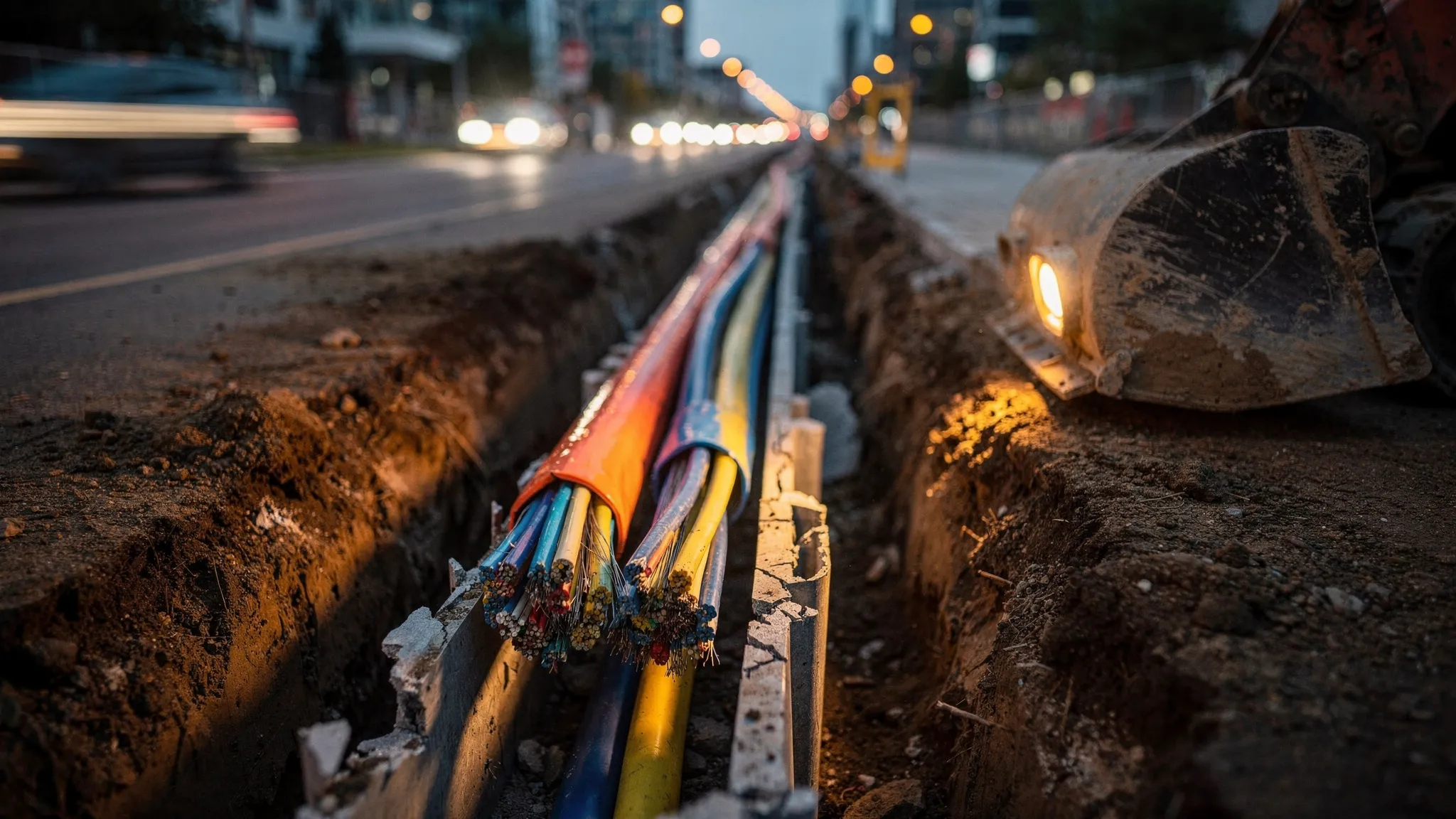
YOUR INTERNET BACKUP MAY SHARE THE SAME TRENCH
Companies that cannot afford to go offline buy a second internet connection from a different provider. The routes are checked on paper: the two paths cross no common network and no common link. As far as routing is concerned, they are independent.
Subhadeep Sahoo and Hrishikesh B Acharya open their paper with a scenario that shows the flaw. An excavator near Chicago severs a buried conduit, and a company 2,000 kilometres away loses both of its links to Seattle — the main one and the backup — because both providers leased fibre in that same conduit. The routing data could not see the shared trench. The authors call this gap “illusory resilience”.
What public data can reveal
The real maps of conduits, buildings and cable landings mostly belong to the carriers. So the authors asked a narrower question: how much of this hidden overlap can be spotted with public sources alone? They tested three signals, each against a control group, before trusting any of them.
- Simultaneous route losses. When a cable breaks, do the networks that depend on it drop their routes in the same minute? The authors replayed public routing archives around five documented physical incidents of 2024. The answer was no: zero same-minute hits among 12 monitored pairs, while reshuffling the network pairs at random made the same test find a coincidence 44.4% of the time. After a cut, losses spread over many minutes — in the hour after the Red Sea cut alone, networks announced 648,101 times that a route was no longer reachable. The authors dropped this signal rather than let it sway their conclusions.
- Shared buildings. Using PeeringDB, a public registry where networks list the sites where they interconnect, they compared 47 major operators in ten regions — 1,081 pairs.
- Shared shorelines. Using the public cable map of TeleGeography, they checked whether undersea cables serving the same route land within 25 kilometres of each other: 68 cable systems, 606 landing points, 12 routes between continents.
The same few buildings
Operators of the same region turned out to share far more interconnection sites than operators of different regions: an average overlap of 0.094 against 0.024 — the share of shared sites among all the sites the two operators declare, 0 meaning no site in common and 1 exactly the same ones, and a typical pair from two different regions shares none. A handful of buildings concentrate the risk. The Digital Realty campus in Marseille hosts 153 pairs of operators from the sample; sites in Hong Kong, Frankfurt and Singapore host 136 each. A fire, flood or power failure in one of them would hit many supposedly separate providers at once.
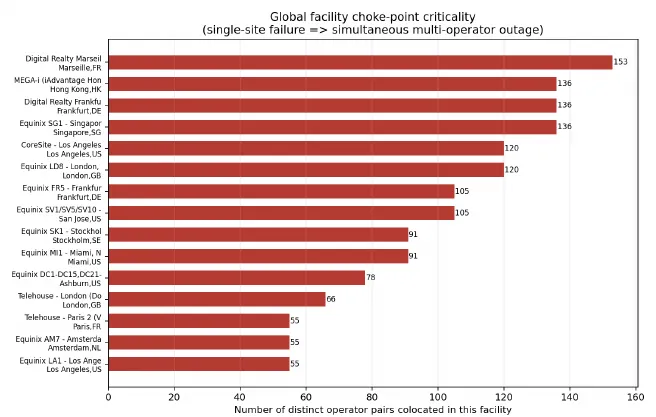
Number of operator pairs from the sample listed at the same facility: one failure there touches all of them. — Figure 4, Sahoo and Acharya (2026), arXiv:2610.27125.
Cables that land together
Undersea cables may take different paths across the ocean, but they have to come ashore somewhere — often at the same few points. Depending on the route, 31% to 100% of cable pairs land within 25 kilometres of each other. East Asia and India–Gulf are fully saturated, the Red Sea and Australia reach 81%, the transatlantic route sits lowest at 31%. Worldwide, Tuas in Singapore and Chikura in Japan each gather eleven cable systems inside one 25-kilometre zone.
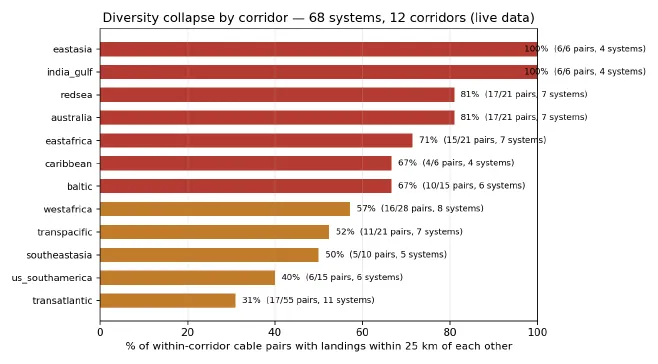
Share of cable pairs on each route that land within 25 km of each other: two routes reach 100%. — Figure 5, Sahoo and Acharya (2026), arXiv:2610.27125.
This crude rule matches reality. Of eleven cable pairs damaged together during 2024 — in the Red Sea, off Côte d’Ivoire, near Mtunzini in South Africa and in the Baltic — it flags ten. The one it misses is a Baltic pair whose landings lie 357 kilometres apart; they were damaged a day apart along a track crossing both routes, so a shoreline rule should indeed stay silent.
Disjoint in name only
The two signals can point to the same weakness. In East Africa, the cables SEACOM and EASSy land together at Mombasa, Djibouti and Mtunzini, and were damaged together on 12 May 2024. At the same time, the operators SEACOM and Liquid Intelligent Technologies — a member of the EASSy consortium — form the most overlapping pair of the whole sample, with 14 shared buildings. On paper, alternatives; in public data, disjoint in name only.
The authors are careful about what this proves. A shared building shows shared exposure, not that a given circuit runs through it, and silence in the data does not certify independence. Their audit does not replace the carriers’ own maps. It tells a customer where to ask for them — and that a backup should be judged by what it physically depends on, not only by the route it takes.