THE PICTURE YOU LOVE, YOU THINK A HUMAN MADE
Image generators now produce pictures that people can no longer reliably tell from human work. Most research on how we value such art asks what happens when people are told: label a painting as AI-made, and they like it less and find it less beautiful, profound and creative. Online, though, art rarely comes with a trustworthy label. People scroll past images and decide for themselves who made them. How does that private belief relate to what they like?
Fifty pictures, eleven thousand judges
In the autumn of 2024, the blog Astral Codex Ten posted an “AI Art Turing Test”: 50 pictures, in styles from Renaissance painting to digital art. Twenty-four were well-regarded human works, from fifteenth-century panel paintings to contemporary digital illustration. Twenty-six were made with image generators by people who make AI art, and screened to remove obvious defects such as garbled text or malformed hands. More than 11,000 people judged each picture: human or AI? The median respondent got 60% right — better than guessing, far from reliable.
Respondents also named their favourite picture, their main detection strategy, their familiarity with art and their opinion of AI art, on a scale from 1 (“loathe”) to 5 (“love”). The organiser published the anonymised answers. Zihan Chen and Di Zhu, of the Stevens Institute of Technology, and Lei Nico Zheng, of the University of Massachusetts Boston, analysed all 542,208 judgments.
Favourites look human
The analysis rests on the 9,152 respondents who named a favourite they had also judged. They called it human-made 76.6% of the time. Other respondents judged the very same pictures human only 54.6% of the time. The authors compared each favourite with what that person’s general habits and that picture’s general look would predict: the favourite was 22.1 percentage points more likely to be judged human.
The pull showed up picture by picture. It was positive for all 50, from 5.3 to 38.1 points. Ancient Gate, an AI picture that most people spotted, was called human by 22% of its fans against 9% of everyone else; Paris Scene, also AI-made, by 96% of its fans against 83%. Style does not explain it: comparing each favourite only with similar-looking pictures still leaves 19 to 20 points. Nor does recognising famous paintings: among the 4,704 people who had seen none of the pictures before, the gap was 22.6 points.
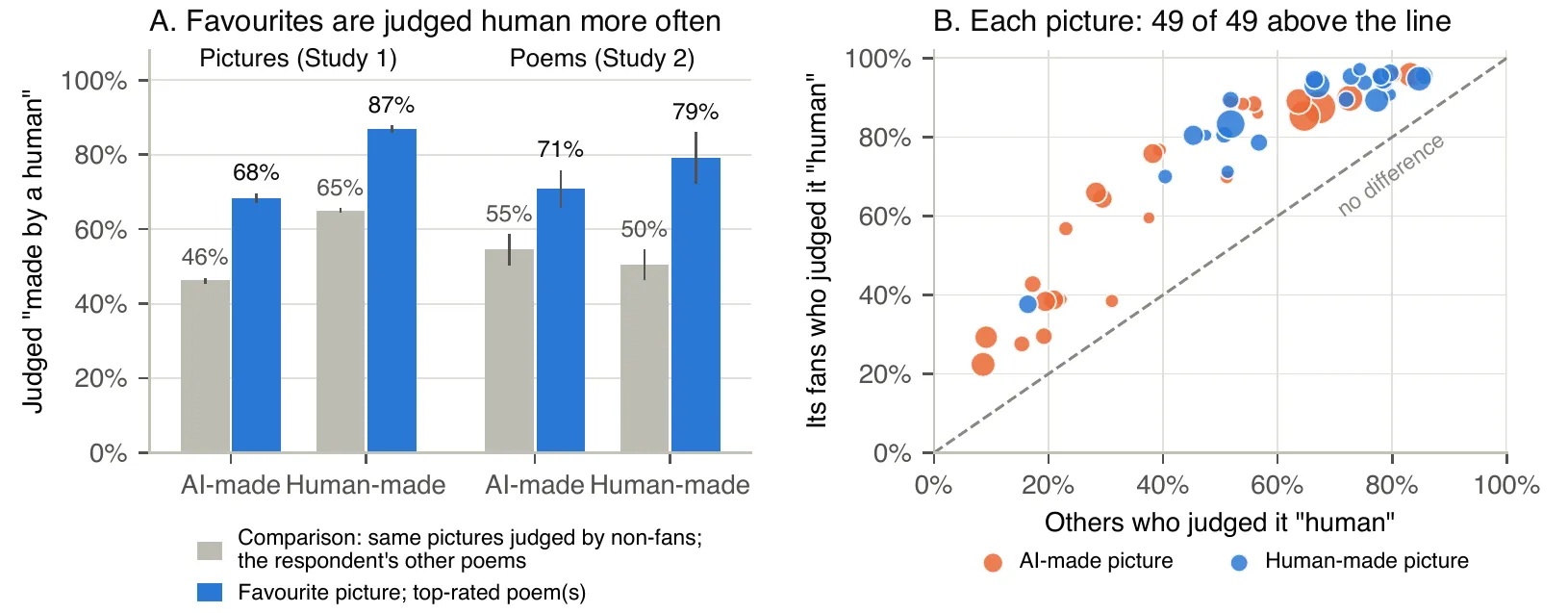
Favourites (blue) are judged human more often than the same pictures by non-fans (grey), whether AI-made or human-made (A). Each dot is one picture: its fans call it human more often than everyone else (B). — Figure 1, Chen, Zhu & Zheng (2026), arXiv:2610.38113.
Machines among the favourites
The effect was the same for AI-made favourites (+21.8 points) as for human-made ones (+22.4). So it is not just people correctly recognising human masterpieces they love. And in this test, liking a picture was no clue at all: AI images made up 55.6% of favourites, slightly more than their share of the test (26 of 50, 52%), and 6 of the 10 most popular favourites were AI-made. The most popular of all, the AI-made Riverside Cafe, had 642 fans. Of the pictures people were most sure a human had made, 30% were AI-made.
Even among those who loathe AI art
Opinions shaped choices, but less than one might think. Among those most negative about AI art, 47% chose an AI-made favourite, against 60% among the most positive. When their favourite was AI-made, 80% of the most negative believed a human had made it, against 56% of the most positive. They tended to pick AI pictures that looked human to everyone, and judged the same pictures human more often than others did.
The upshot: in every opinion group, a third to two fifths of respondents (33.5% to 40.8%) named an AI-made favourite they believed was human. The most negative group was actually the most accurate overall, at 63.9% — yet it identified its own AI-made favourites only 20% of the time.
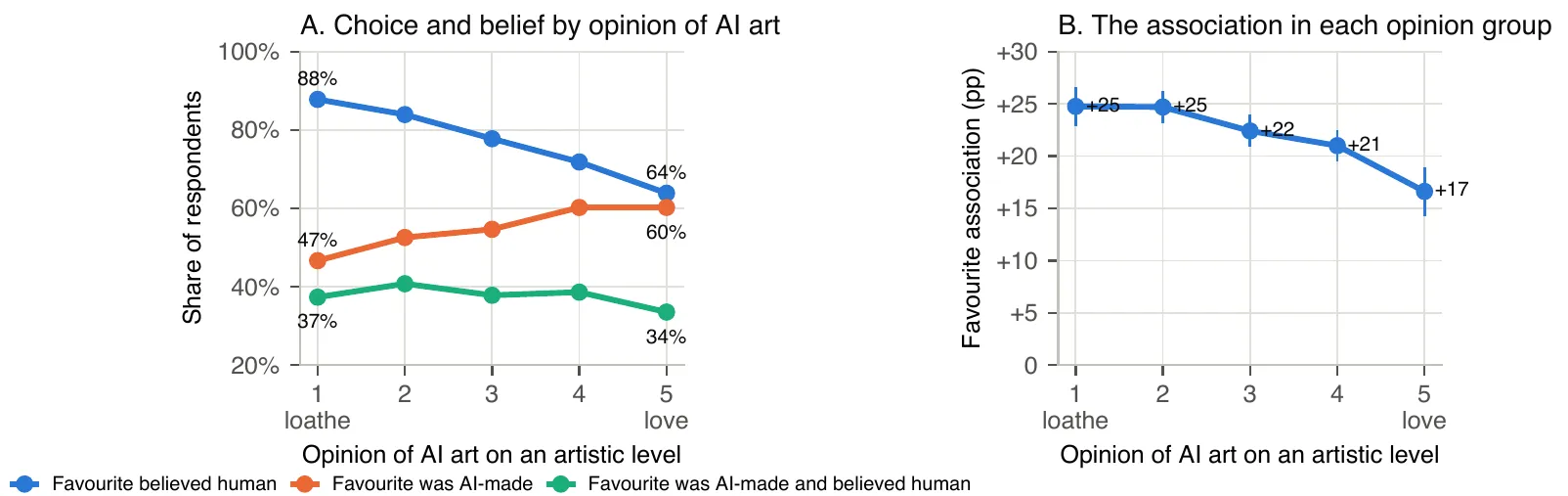
From “loathe” (1) to “love” (5): fewer AI favourites at the left, but more of them believed human (A); the favourite effect shrinks but never vanishes (B). — Figure 2, Chen, Zhu & Zheng (2026), arXiv:2610.38113.
Detection skills did not protect either. People whose main strategy was hunting for small errors, such as hands with the wrong number of fingers, showed a 23.4-point effect. Self-described art experts were the most accurate group, at 66.9%, but still showed 22.8 points. Only the 63 people who called AI art their job or greatest passion showed a much smaller effect, 7.4 points — a lead for a larger study.
Poems, rated first
In the picture test, favourites were named after all the guesses. A second dataset reverses the order. In a published poetry experiment, 230 people rated ten poems before guessing who wrote them: five by Chaucer, Shakespeare, Dickinson, Eliot and Lasky, five generated by ChatGPT 3.5 in the style of other poets. They rated the AI poems higher (5.30 against 4.18 out of 7) and guessed right only 47.3% of the time, below chance. Yet each extra point of rating went with an 11.5-point higher chance of a “human” verdict, for both kinds of poem. The rating gap between poems a person believed human and poems they believed AI-made, 0.89 points, matched the effect of simply telling readers the author, 0.81 points.
Liking as evidence
Some respondents said it outright: “This seems too good to be written by an artificial intelligence.” Explanations praising beauty, emotion or creativity came with a “human” verdict 80% of the time. The authors do not decide which way the link runs: believing a human made a work may raise its appeal, its appeal may be taken as evidence of a human maker, and the two may feed each other. The data are not causal, and the respondents were volunteer readers of one blog, likely keener on AI than most people.
Their conclusion looks ahead. As generated pictures, poems and music become indistinguishable from human work, what people believe about who made something will be bound up with how much they like it — a case, the authors argue, for reliable information on where a work comes from, rather than trusting our own delight as proof.