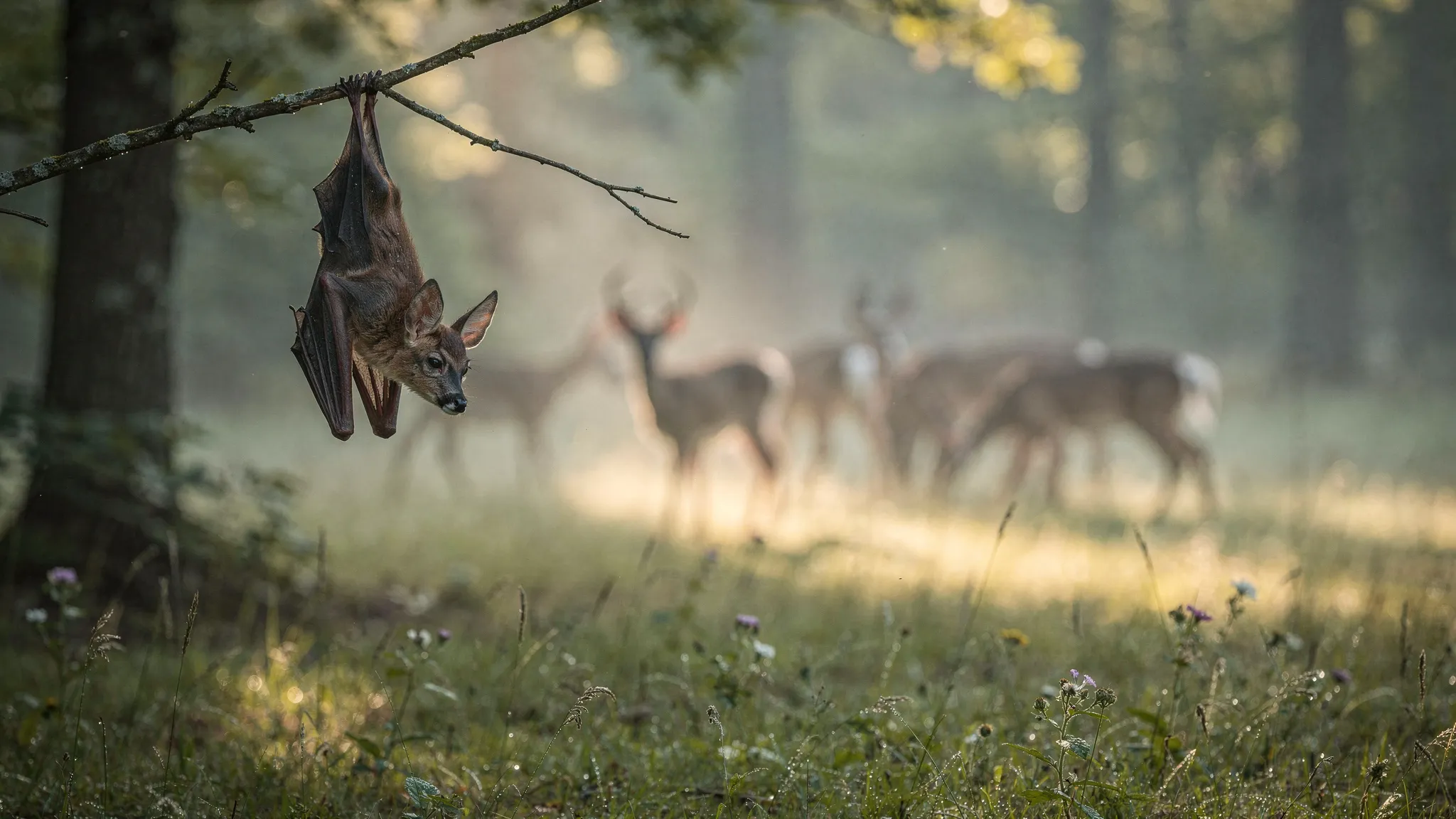
WILD MAMMALS ARE MORE UNEQUAL THAN HUMAN WEALTH
How unequal is nature? Ecologists have long known that large mammals live at lower population densities than small ones, and that the biggest herbivores are in steep decline. A recent global census of the biomass of wild land mammals — the total weight of every individual of a species — offers a way to put a single number on that imbalance.
Klaus M. Frahm and Dima L. Shepelyansky, at the Laboratory of Theoretical Physics in Toulouse, and José Lages, at the UTINAM Institute in Besançon, borrowed the tools that economists use to measure inequality of wealth.
Treating species like households
The census, published in 2023, covers 4,795 species with a combined biomass of 2.24 × 10¹³ grams, about 22 million tonnes. The authors treat each species as a “household” and its total biomass as its “wealth”. They then draw the Lorenz curve — the share of total wealth held by the poorest x% of households — and compute the Gini coefficient, which goes from 0 (perfect equality) to 1 (one household owns everything).
The extremes are striking:
- the white-tailed deer alone accounts for 12% of all wild land mammal biomass, followed by the wild boar (8.7%) and the African bush elephant (5.9%);
- at the other end, all the New Caledonian long-eared bats together weigh an estimated 14.4 grams, the Madeira pipistrelle 218.9 grams and the Sri Lankan rain forest shrew 466.1 grams.
Between the heaviest and the lightest species, total biomass varies by a factor of about 200 billion.
A Gini of 0.944
The Gini coefficient of wild mammal biomass comes out at 0.944. For comparison, the paper cites wealth Gini coefficients for countries in 2021 between 0.59 and 0.90, and 0.889 for the world as a whole. By this measure, the animal kingdom is more unequal than any human economy in that list.
The breakdown says the same thing:
- the lightest 50% of species hold only 0.23% of the biomass;
- the heaviest 10% hold 92%;
- the top 1% hold 63%, and the top 0.1% — a handful of species — hold 31%.
The paper sets this against the World Inequality Report 2022, which it quotes for human wealth: the poorer half of the world’s population owns 2%, the richest 10% own 75%.
A physicist’s model of inequality
The authors then test a model they previously proposed for human wealth, the wealth thermalization hypothesis. In it, values of wealth — here, biomass — behave like energy levels in a physical system that settles into a so-called Rayleigh–Jeans equilibrium. At low total energy, this system shows a “condensation”: most of the population crowds at the bottom, while a tiny “oligarchy” sits at the top.
An extended version of the model reproduces both the Lorenz curve and the related Pareto curve of real mammal biomass over four orders of magnitude. It drifts away only for the very lightest species, which the authors attribute to weak interactions — for instance for species confined to isolated places such as the Madeira pipistrelle. According to their earlier work, the same framework also describes national wealth, company valuations, bitcoin transactions, carbon emissions, election votes and even the popularity of first names.
Why would deer behave like money?
The authors offer an analogy: in a gas, almost any weak interaction between atoms leads to the same distribution of energies, whatever the details. In the same spirit, they suggest that the web of predation and competition between species could produce this distribution without any particular ecological mechanism being decisive. That is a hypothesis, not a demonstration — the paper fits curves; it does not trace how deer, boars and shrews actually exchange “biomass”.
The result fits known ecological rules linking body size and population density, the authors note, and the few species at the heavy end of the distribution are also those on which ecological and human pressures may weigh most. Marine mammals were left out: the census gives reliable figures only for the ten heaviest marine species.