GAUSS'S CIRCLE PROBLEM SLIPS BELOW 5/16
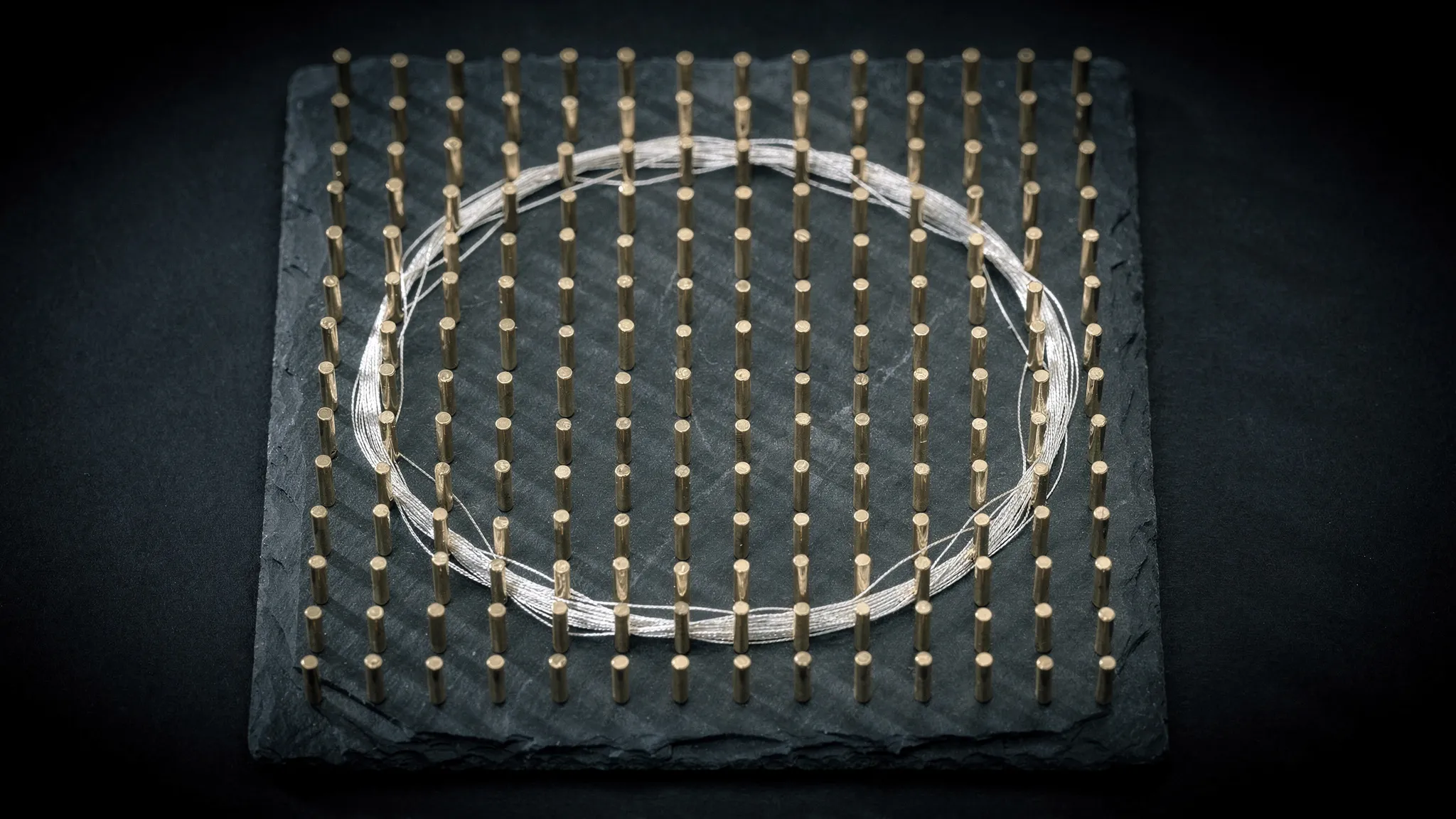
Take a circle centred on a grid point of an infinite sheet of squared paper and count the crossings that fall inside it. The answer is close to the circle’s area — but never equal to it, because the edge cuts through the grid in an irregular way. The Gauss circle problem asks how large that mismatch can get.
In the paper’s notation, the disc is a² + b² ≤ X, where X is the square of the radius, so its area is πX. The mismatch is
E(X) = #{(a, b) ∈ ℤ² : a² + b² ≤ X} − πX
— the number of grid points (a, b) inside, minus the area. All exponents below are powers of X, as in the paper.
From the perimeter to the conjecture
Gauss’s geometric argument gives E(X) = O(X^{1/2}): the error is at most of the order of the radius, roughly the size of the circle’s boundary. That is the easy bound.
At the other end, Hardy proved that the error keeps swinging, in both directions, to values of the order of X^{1/4} — so no bound with an exponent below 1/4 can hold. The expected answer, which the paper calls Hardy’s conjecture, is that 1/4 is essentially right: |E(X)| ≲ X^{1/4+ε} for every ε > 0, where the ε means a loss smaller than any fixed power.
Everything since has been a fight over the exponent between 1/2 and 1/4. The paper’s history table lists the steps: Sierpiński in 1906 with 1/3, van der Corput, Titchmarsh, Hua, Chen, Kolesnik, Iwaniec and Mozzochi with 7/22 in 1988, Huxley with 23/73 in 1993 and 131/416 (about 0.3149) in 2003, then Li and Yang, in a 2023 preprint, with 0.3144831759…
The threshold at 5/16
Much of that progress came from a technique built by Bombieri and Iwaniec and adapted to the circle by Iwaniec and Mozzochi. It turns the problem into estimates on exponential sums, which reduce to two “spacing” problems: counting how often certain rational approximations fall close together. Huxley pushed this method furthest, and in 1993 suggested 5/16 = 0.3125 as a possible limit of the Bombieri–Iwaniec method as it then stood. Li and Yang’s record, obtained by bringing in a recent tool from harmonic analysis — the “small cap decoupling” theorem of Guth and Maldague — still sat above it.
Xi Cen (China University of Mining and Technology-Beijing), Xitao Gao and Junyong Zhang (Beijing Institute of Technology) and Cheng Zhang (Yau Mathematical Sciences Center, Tsinghua University) now prove:
Theorem 1.1. For every ε > 0 and every real X ≥ 4, |E(X)| ≲ X^{209/670+ε}.
And they spell out exactly how far below the line this lands:
209/670 = 5/16 − 3/5360
That is about 0.31194 — a gain of 0.0025 over Li and Yang. Small in size, but on the other side of a value that had served as a marker for a whole approach.
Two refinements, two ranges
The proof splits the remaining parameters into two ranges, which meet exactly at the point where both give 209/670.
In the middle range, the authors expand a phase to sixth order and use Vinogradov’s mean value theorem to reduce everything to a count of pairs of points that agree in their fourth, fifth and sixth Taylor coefficients. The key step is to solve those constraints explicitly: the linear error cancels, leaving a quadratic error small enough to handle by Fourier expansion and the spacing estimates of Robert and Sargos. The pair count comes out as small as the trivial “diagonal” pairs, up to arbitrarily small losses.
In the larger range, the new ingredient is a distribution estimate for exponential sums whose frequencies lie on a cone, derived from an amplitude-dependent estimate of Guth and Maldague. It produces two terms, one with a fourth power and one with a sixth power. Keeping them separate through the double large sieve, rather than merging them into a single moment estimate first, is what pays off. According to the paper, this works without strengthening Watt’s second-spacing bound, the other main input.
Still a long way to 1/4
The new exponent, 0.3119, is still far from the conjectured 0.25. The paper also surveys the other side of the problem — how large the error is known to get — where results by Soundararajan, Lamzouri and others pin down its largest swings ever more precisely.
The work is a 34-page preprint. The authors state that they used ChatGPT and Codex to discuss proof strategies, help draft and check parts of the arguments and organise references, and that every statement and proof was written, reviewed and verified by them. For Gauss’s grid of points, the error is now known to grow no faster than about X^{0.312} — with room left, in principle, all the way down to X^{0.25}.