A SURGICAL ROBOT THAT WATCHES THE HEAT OF ITS OWN BLADE
Cancers of the mouth — tongue, lips, cheeks — strike about 377,000 people a year worldwide and cause 178,000 deaths, according to figures cited in the paper. When the tumour has not spread, surgery is often the most effective treatment. On the tongue, that usually means a partial glossectomy: removing the tumour with a 5-millimetre margin of healthy tissue around it. Too thin a margin risks leaving cancer cells behind; too wide removes healthy tongue and makes recovery harder.
Heat, the double-edged tool
The cut is usually made with electrosurgery: an instrument passes electric current into the tissue, heating it so that it parts easily and bleeds less. Speed is a balancing act. Move too slowly and heat spreads into healthy tissue, possibly harming the nerve that gives the tongue its sensation. Move too fast and the tissue is not softened enough: it snags on the tool, deforms, and the cut drifts from its planned path.
Experienced surgeons adjust their speed as they watch. Autonomous surgical robots, so far, do not: they cut at a speed chosen in advance. Earlier studies found that this kind of robotic cutting causes more cell damage than cutting by hand.
A camera on the scalpel
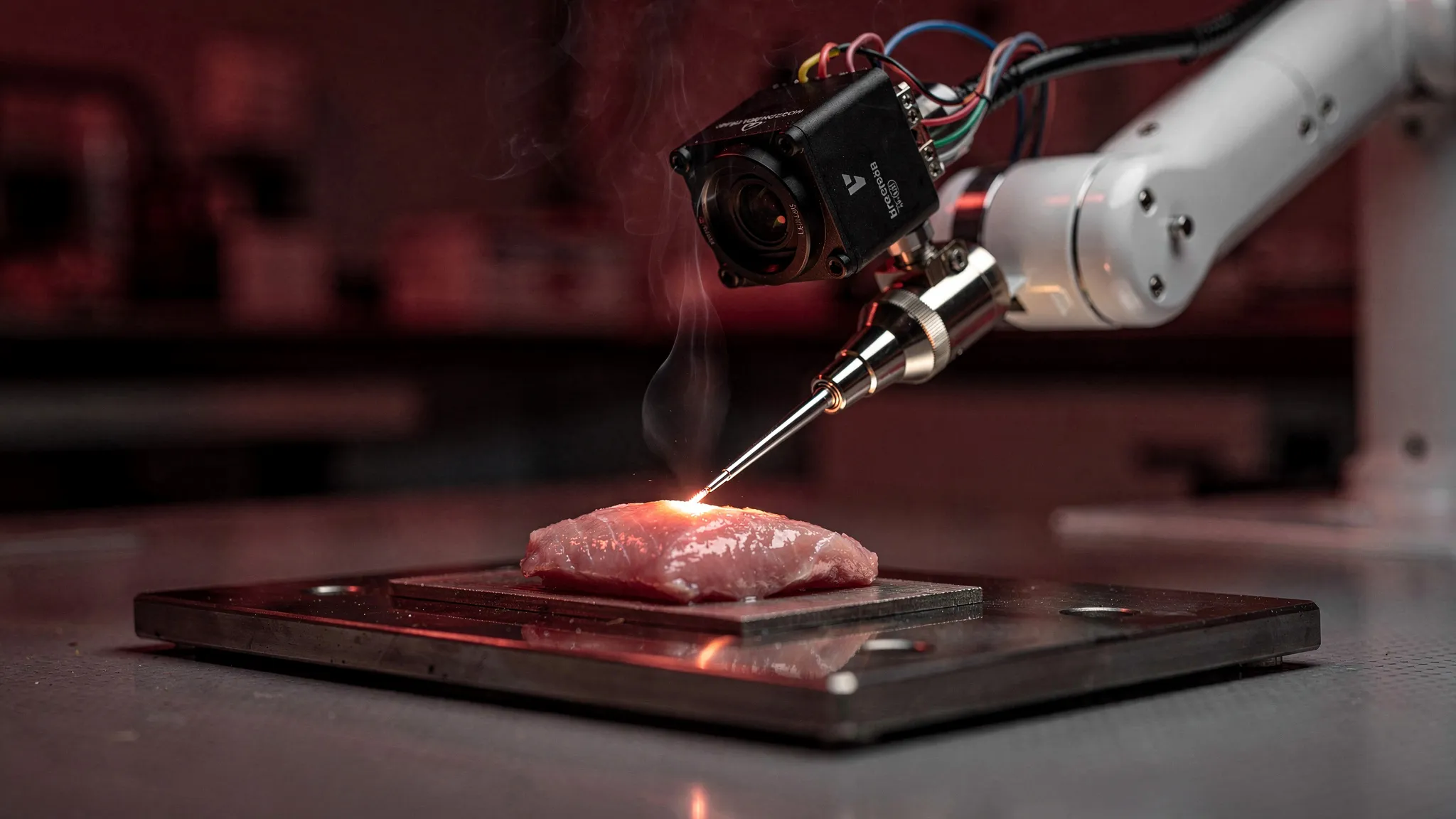
Naveed Riaziat, Jeremy Brown and colleagues at Johns Hopkins University built on their own algorithm, ThERMO, previously tested on gels. A small thermal camera rides on the robot arm behind the electric scalpel. In every frame, it measures how wide the zone heated above 60 °C — the temperature at which tissue proteins break down — has become, and how much the tool tip is being pushed aside. The robot continuously estimates the tissue’s properties and picks the speed that best balances the two risks: heat damage on one side, snagging on the other. It needs no training data and no trial-and-error tuning.
The team tested it on pig tongues, which the authors say resemble human tongues. A virtual tumour, drawn from the outline of a real patient’s tumour, was marked on each one, and the robot had to cut 5 millimetres around it. Three methods were compared, each on three tongues: a slow fixed speed of 2 mm/s, used until now by their robot; a fast fixed speed of 7 mm/s, measured on an expert surgeon; and ThERMO. A pathologist examined the tissue under the microscope without knowing which method had been used.
What the tongues showed
- Accuracy. The margin error — the gap between the width of healthy tissue actually left around the tumour and the 5 millimetres aimed for — averaged 0.69 mm for ThERMO, against 1.68 mm at the fast speed — a clear improvement. Against the slow speed (0.98 mm), the difference was not statistically significant.
- Heat damage. Damage extended about 247 micrometres from the cut with ThERMO, against 515 at the slow speed — about half. The fast speed (294) was not significantly different from ThERMO.
- Time. ThERMO took 22 seconds per cut, 20% longer than the fast speed but far quicker than the slow one (52 seconds).
- Depth. The cut also had to go 5 millimetres down into the thickness of the tongue, a target separate from the lateral margin; ThERMO came closest (4.1 mm). Deeper cuts caused slightly more heat damage.
The paper’s headline figures — up to 52% less heat damage, up to 59% better accuracy — therefore come from two different comparisons. No fixed speed did well on both counts; ThERMO did reasonably well on each.
A head-and-neck surgeon, also blinded, gave 4 out of 5 to both ThERMO and the slow speed, and 2 out of 5 to the fast speed for its poor margins. ThERMO’s cuts were judged quick and potentially less damaging, but with more jagged edges, perhaps from sharp changes of orientation in tight curves.
From pig tongue to patient
The authors are explicit about the distance to the clinic. The tongues were dead tissue at room temperature, with no blood flow and no inflammation; heat behaves differently in a living body. Only one type of tissue and three cuts per method were tested, and the robot was not compared with a human surgeon. Unlike a surgeon, it also never lifts the tool or backs up. Studies on cadavers, then on living tissue, would come next — along with smaller thermal cameras that could fit where real operations take place.