A LOADED DRONE SHOULD FLY FASTER
Multirotor drones photograph, inspect, survey and, increasingly, deliver parcels. Their weak point is endurance: their flight time is typically around 30 minutes. So every bit of energy saved in cruise flight extends their range.
The right measure is the energy spent per metre travelled. Fly too slowly, and the rotors spend their power just holding the drone up for a long time; fly too fast, and the drag of the airframe takes over. In between lies an energy-optimal speed. Earlier studies noticed that this best speed goes up when a drone carries more — but nobody had worked out the rule.
Three laws from one symmetry
Ayush Patnaik, Nicolas Michel and Xinfan Lin, at the University of California, Davis, with Leonard Bauersfeld and Davide Scaramuzza of the University of Zurich, modelled a drone in steady horizontal flight: the forces on its body, the airflow through each propeller, the power drawn by the rotors. They then changed only the mass — same frame, same shape, same rotors, as when a payload is added — and found three laws:
- the energy-optimal speed grows with the square root of the mass;
- the pitch angle at which the drone leans forward to fly at that speed does not change with mass;
- the minimum energy per metre is proportional to the mass.
All three come from one property. If the mass is multiplied by a factor k, every force must be multiplied by k. But every aerodynamic force — body drag, rotor thrust and the torque that resists the spinning of each rotor — grows with the square of speed. So multiplying every speed — the drone’s, the air’s through the propellers, the spinning of the blades — by √k does the job, while every angle stays the same. In the authors’ words, heavier vehicles fly through a geometrically similar flow, simply faster. Power, force times speed, then grows as the mass to the power 1.5; divide it by the speed, and the energy per metre grows exactly with the mass.
In the authors’ simulations, a drone of 8 kilograms has its best speed at 14.0 metres per second; at 12 kilograms, 17.2; at 16 kilograms, 19.8. Divide each by the square root of the mass, and the same number, 4.95, comes out each time. The optimal tilt stays at 15.4 degrees, and the energy per metre and per kilogram at 6.2 joules.
Tested in the field
The team flew two real machines at a model-aircraft field near Davis: an eight-rotor drone at 7, 8 and 9 kilograms (29% more mass), and a four-rotor drone at five masses from 3.58 to 5.17 kilograms (44% more). The added payload was mounted compactly so as not to change the drone’s shape. Each speed was flown back and forth along a straight line to average out the wind.
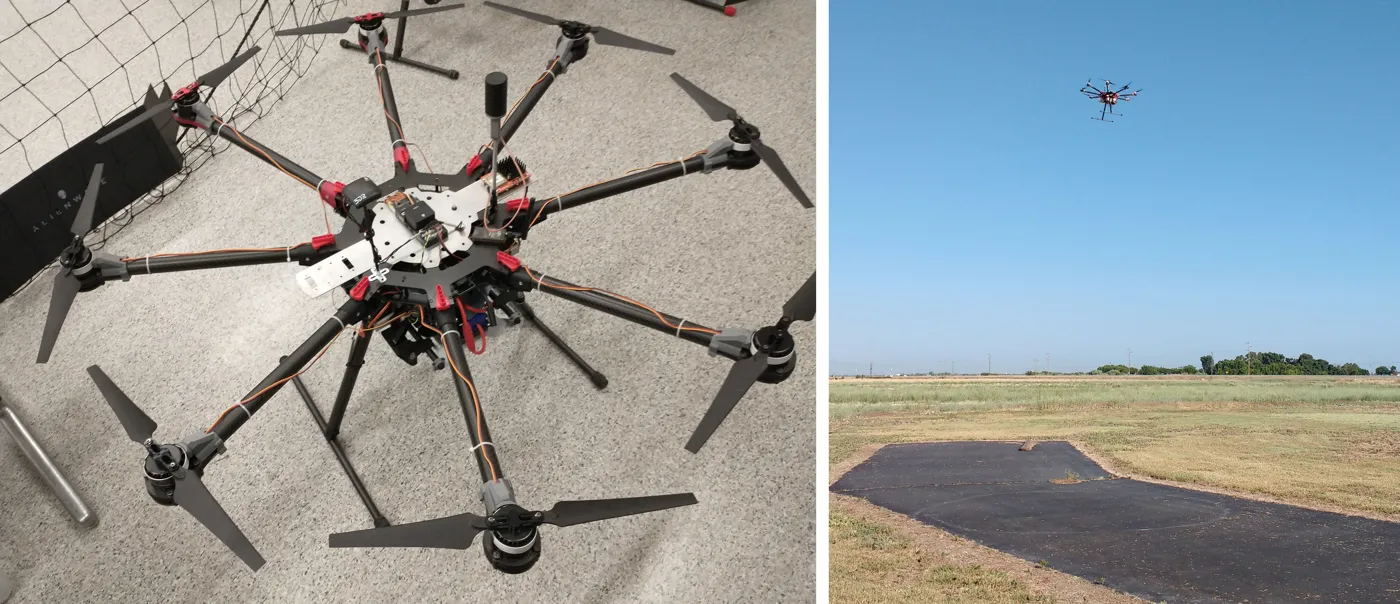
The eight-rotor test drone, on the ground and in steady horizontal flight. — Figure 1a, Patnaik et al. (2026), arXiv:2611.04748.
Once speed is divided by the square root of the mass, and power by the mass to the power 1.5, the measurements of all masses fall onto common curves, within a few per cent. For the eight-rotor drone, the optimal tilt varied by only 0.84 degree across the 29% mass change, and the best speed divided by the square root of the mass, like the minimum energy per metre and per kilogram, varied by less than 2% from one mass to the next. For the three heaviest loads of the four-rotor drone, the most economical speed lay beyond what the drone could fly, so the optimum was pinned down in five of the eight configurations.
From laws to delivery plans
The practical gain is immediate. Measure or compute the best speed once, at one mass; for any other mass, just multiply by the square root of the mass ratio. And at that best speed, the energy for a leg of a trip is a constant times the total mass times the distance — which turns the planning of a delivery round, who carries what and along which route, into a simple linear problem. The maximum range follows directly from the battery’s energy.
The authors add a warning: several energy models in use assume that energy per metre grows with mass at any speed. It does not. The simple proportionality holds only at the optimal speed.
The laws assume steady flight, a payload that changes the mass but not the shape or the balance of the drone, and motors and batteries whose efficiency stays roughly constant. Within those limits, a heavy drone should not slow down to save energy, but lean forward the same and speed up.