THE ROBOT UMPIRE THAT REWROTE THE STRIKE ZONE
Algorithms now take decisions about people in hiring, lending, bail and grading. Most studies ask whether the machine decides better than the human it replaces. Seung Jin Cho, of Dankook University, and Jun Yeong Lee, of Pusan National University, ask a different question: what does the switch do to the people being judged?
Baseball makes that measurable. Every pitch is tracked, and every call on a pitch the batter does not swing at — ball or strike — is recorded. In 2024, the Korea Baseball Organization (KBO) became the first top-tier professional league to hand that judgment entirely to an automated ball-strike system (ABS). A strike is called when any part of the ball crosses a box set by the batter’s registered height: in 2024, from 27.64% to 56.35% of that height, and 47.18 centimetres wide — the plate plus 2 centimetres on each side. The call reaches the umpire through an earpiece and cannot be challenged.
A million pitches
The authors gathered every regular-season pitch from 2021 to 2026, April to September: 1,203,755 pitches, of which 657,201 were taken and called. 2022–2023 serve as the human baseline, 2024–2026 as the machine years. Their reconstruction of the rule reproduces 98.6% of the machine’s calls — and only about 91% of the humans’, a first sign of how far the two zones differed.
They split the change in two. The machine removes discretion, the part of a human call that depends on context. And it imposes a new shape, the gap between the rule’s box and the zone humans actually called.
The favours that disappeared
On pitches near the edge of the zone, human umpires leaned on the context:
- they called 6.1 percentage points more strikes when the batter was ahead in the count, and 6.7 points fewer with two strikes. The count is the running tally of balls and strikes in the current duel, said balls first: 2-0, 3-0 or 3-1 means many balls and few strikes, so a batter in a strong position, since four balls send him to first base and three strikes put him out;
- they gave star batters about 1.5 points fewer called strikes on the same pitch;
- some catchers were reliably good at “framing” — catching borderline pitches so the umpire calls them strikes. A catcher’s skill measured on alternate games of a season showed up again in the others, with a correlation of 0.60 to 0.81 — meaning the ranking of catchers largely holds from one half of a season to the other, the mark of a real skill rather than luck.
Under the machine, the count no longer matters, the star advantage mostly vanishes, and framing turns into pure noise. Measured in runs — one called strike costs the batting team about 0.135 runs — these were small privileges: about 4.5 runs per catcher per season for framing, about 0.9 run per star batter per season. The star effect is the least robust of the three: its size depends on how finely the authors compare pitches by location.
A box that grows with the batter
The new shape mattered more. Human umpires judged height in absolute terms: the top of their zone sat around 102 centimetres above the ground for the shortest batters and 105 for the tallest. The machine scales with height and lifts it to 110 centimetres for the tallest group. As a result, a pitch in the upper third of the zone became 13.9 points more likely to be called a strike, and each centimetre of height added 0.75 points to the share of a batter’s high pitches called strikes.
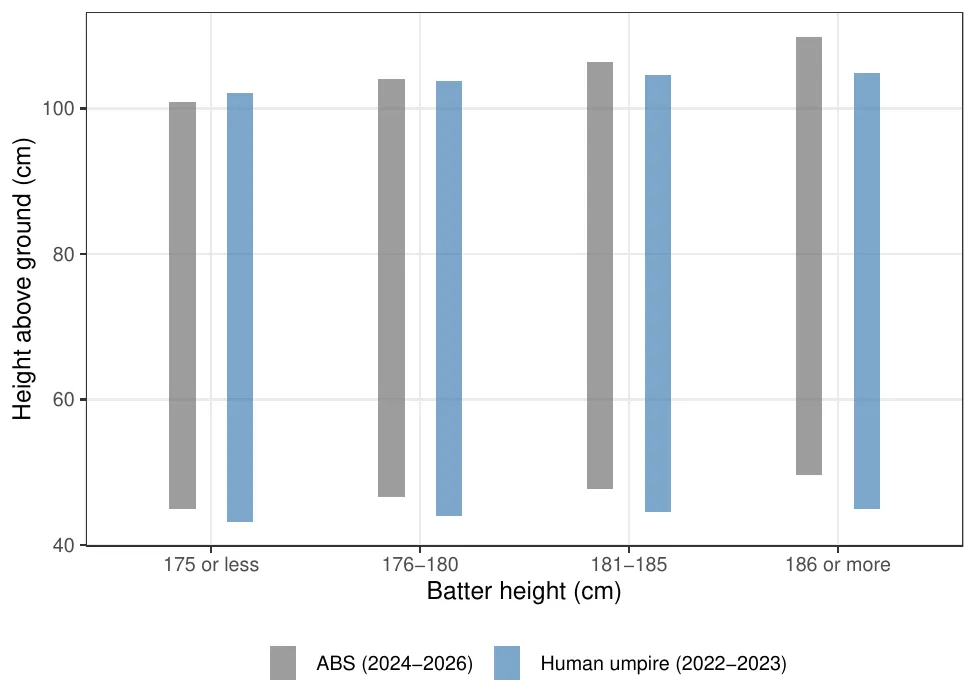
Where the strike zone really sat, by batter height: under the machine (grey) its top rises with the batter; under human umpires (blue) it barely moved. — Figure 1, Cho and Lee (2026), arXiv:2610.27576.
Human umpires also treated matchups unevenly. On the outer edge, a right-handed pitcher facing a right-handed batter got 50.4% strikes, against 42–45% for other pairings; on the inner edge, a left-hander facing a left-hander got only 21.5%. Under the machine, edge strike rates fall between 37% and 42% in every matchup.
Big changes, tiny consequences
Here is the twist. Few pitches land on those edges, and fewer still are left alone by the batter. The extra strikes amount to at most one every 23 plate appearances — a plate appearance being one complete duel between a batter and a pitcher — in the most exposed matchup, and 10 centimetres of extra height change by less than two percentage points the chance of reaching two strikes or three balls, the two counts where the duel is decided: one more strike puts the batter out, one more ball sends him to first base.
The two sides of the plate reacted differently. Pitchers quickly aimed higher, almost entirely by raising pitch height. Left-handers, who had not joined an earlier league-wide drift toward high pitches, caught up within a season. Batters, on the other hand, show no detectable change in when they swing — not even after the count stopped affecting calls. The authors’ explanation: a pitcher’s plan is set in advance and pays off against every batter, while a batter decides in a split second, for a small stake.
The lesson reaches beyond sport. Replacing a human judge with a rule removes the favours that judge handed out, including the value of skills built to sway them. It does not by itself make outcomes more equal. Where the box is drawn, and how many cases fall on its edge, decides who gains — and the authors note that one league over three seasons cannot yet say whether batters will eventually adapt.