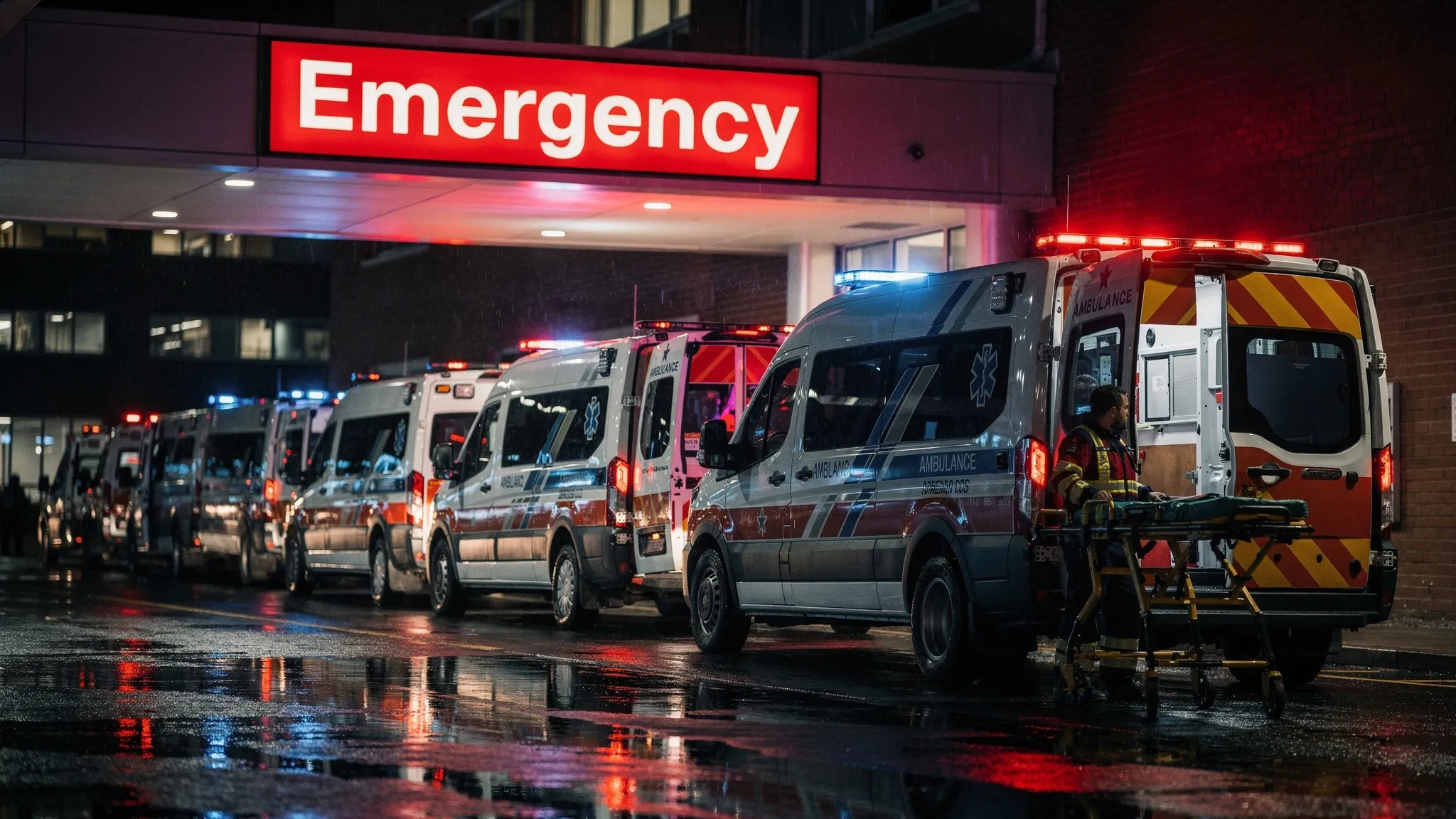
96 AMBULANCES STUCK AT THE DOOR, EVERY DAY
When an ambulance reaches a hospital and the emergency department cannot take the patient, the crew waits, patient still on the stretcher. Australian ambulance services call this ramping. The paper defines it as the time between the ambulance arriving at hospital and the patient being taken off the ambulance stretcher.
Ramping is a symptom of crowded emergency departments, but its effects spread outward: an ambulance held at a hospital door is not available for the next call. Earlier studies, the authors note, have linked such delays to slower responses for subsequent patients.
Four years, one whole state
Ayesha Tanveer, Khandakar Ahmed and Assefa Teshome of Victoria University in Melbourne, with Ziad Nehme and Oyetunde Gbadeyan of the research centre of Ambulance Victoria — the sole statutory ambulance provider in the state, serving more than 7 million people over 227,000 square kilometres — analysed 2,850,575 call-outs from January 2020 to March 2024. For handover delays they kept just over 2 million transports to the state’s 59 hospitals with an emergency department.
Ramping times are very uneven: the mean is 44 minutes, but the median is 31 minutes, and one transport in ten waits more than 91 minutes.
The hours add up
Summed over the period, ramping cost 1,491,127 ambulance hours — the equivalent of about 96 ambulances held at hospitals for a full 10-hour shift, every day for four and a quarter years. Metropolitan Melbourne carried 76.7% of the burden.
The losses are concentrated. The 10 hospitals with the most lost hours accounted for 57.8% of them while receiving 50.9% of transports. That excess fades beyond the top 25 to 30 hospitals. Two hospitals can reach the same total by different routes: one through long waits per patient, another simply through sheer volume.
Waiting regardless of urgency
Breaking down each trip into its stages shows where time goes. Travel from the scene to hospital takes about 19 to 21 minutes whatever the patient’s urgency. At the door, the most urgent patients (transport priority 1) are handed over faster, with a median ramping of 21.9 minutes. But for the three lower priorities — 33.0, 27.4 and 36.5 minutes — there is no ordering at all. Beyond fast-tracking the most critical cases, “how long a patient waits at the hospital door bears no relation to their assessed urgency,” the authors write. The least urgent transports have the longest tail: one in ten waits more than 116 minutes.
A 2022 peak
Yearly lost hours rose from 255,523 in 2020 to 401,981 in 2022 — up 57% — before easing slightly in 2023. Over the same period, the number of transports to emergency departments stayed broadly stable, and the average ramping per case rose from 32 to 52 minutes. The share of the most urgent transports also grew, from 10% to 13%.
The authors stress an important caveat: the data begin in January 2020, during the pandemic, with no earlier baseline. The 2021–2022 peaks likely reflect rebounding demand under pandemic infection-control rules, they write, rather than a broader decline in performance; and the lower delays of 2023–24 cannot be read as proof of improvement either.
Predictable congestion
Two patterns suggest the problem can be anticipated:
- Time of day. Demand peaks at noon; average ramping is lowest at 6 a.m. (30 minutes) and peaks between 6 and 8 p.m. (about 50 minutes). Hourly demand is moderately correlated with ramping three hours later (r = 0.365).
- Recent arrivals. When no other ambulance had arrived at the same hospital in the previous hour, the median wait was 23.6 minutes. After ten or more, it was 45.2 minutes, and one in ten waited more than two hours. The effect persists at every hour of the day and appears hospital by hospital, though some hospitals react much more sharply than others.
From description to dispatch
The study is observational: it draws on ambulance records only, with no data on hospital beds or staffing, and cannot show that redistributing ambulances would shorten waits in proportion. But the authors argue that a congestion that is concentrated, follows the clock and depends on the hospital’s current state is exactly what a dispatch system could use — the empirical basis, they write, for “hospital-state aware ambulance routing”.