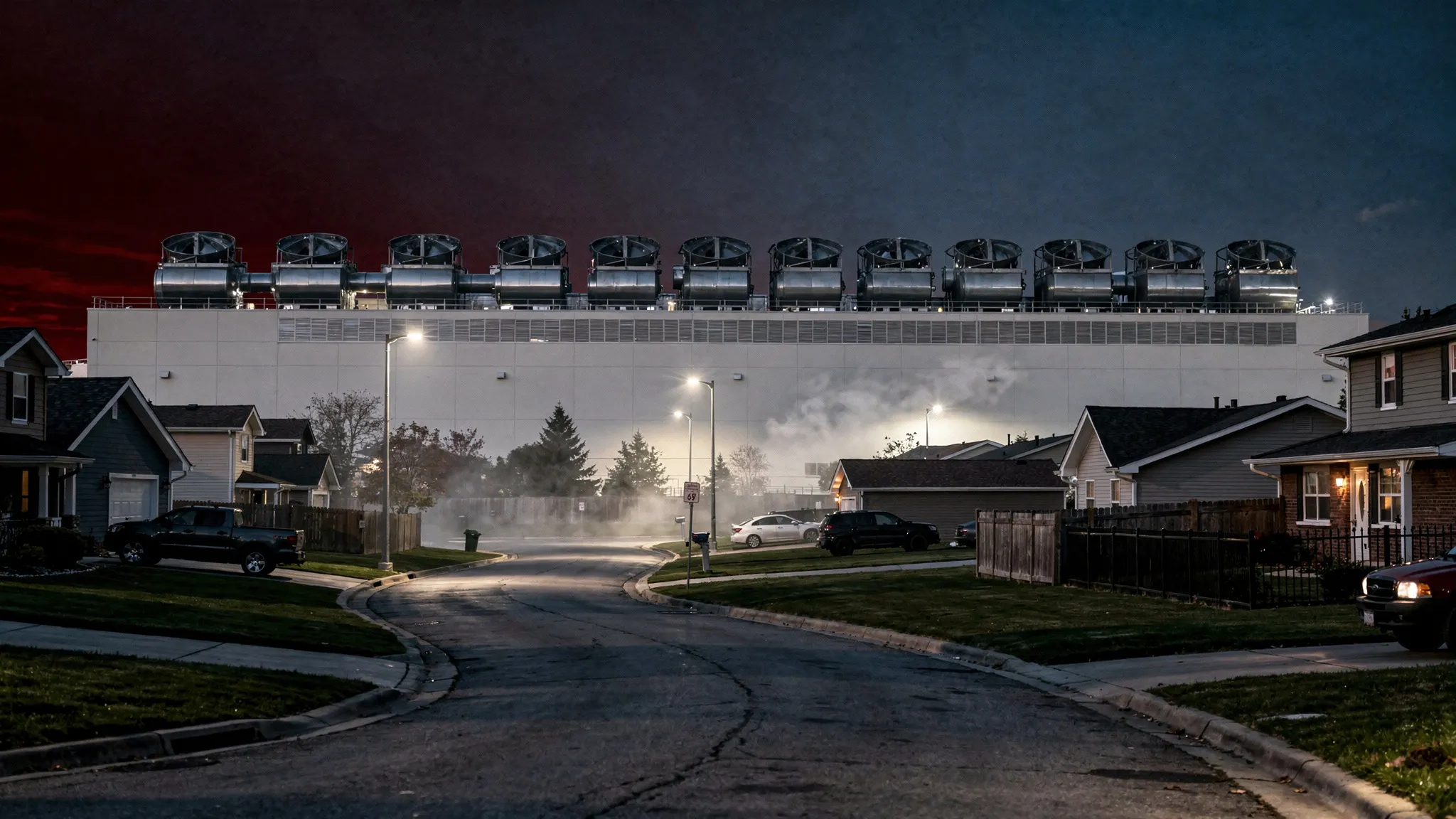
THE HUM NEXT DOOR TO AI DATA CENTERS
Across the United States, giant data centers built to train and run artificial intelligence are going up at a fast pace. The newest campuses draw hundreds of megawatts, sometimes more than a gigawatt, and because AI hardware runs close to full load day and night, their cooling never rests. Near several of them, residents describe a sound that never stops. Communities in Tennessee, Mississippi, Virginia, Arizona and North Dakota have organised, gone to court and pushed their towns to rewrite noise ordinances.
Before anyone can say whether this noise harms health, someone has to measure it properly. That is the gap Davide Bray and Francesca Dominici, biostatisticians at the Harvard T.H. Chan School of Public Health, set out to map.
Grading every number
Their review is narrative, not systematic. They searched the scientific databases up to July 2026, but almost nothing relevant is published there, so they also dug through municipal and regulatory records, court filings, company documents and newspaper archives. Each value they found was graded by where it comes from, on five levels — from a peer-reviewed study with calibrated instruments and published spectra (level 1) down to uncalibrated readings by residents (level 5).
No value reaches level 1. The best-documented American cases rest on residents’ consumer sound meters, readings taken by a mayor, and consultants’ models. The only calibrated, standards-based survey of an operating campus they found was carried out at a Microsoft facility near Sydney, in Australia — required by a planning condition, and outside the country where the disputes are sharpest.
From 39 to over 70 decibels
The reported levels span 39 to more than 70 decibels (A-weighted). Some examples from the review:
- Around xAI’s Colossus complex in Memphis and Southaven, a federal class action alleges more than 70 dB(A) at residential property lines near a turbine plant; readings by the mayor ranged from 39 to 70 dB(A), and news spot checks from 42 to 65.
- At Great Oak, in Prince William County, Virginia, next to Amazon data centers, residents reported up to 65 dB(A) at night. A fan retrofit, estimated by the community at about 30 million dollars, brought levels down by roughly 10 decibels.
- In North Dakota, acousticians found a dominant 118-hertz tone by analysing audio from a television broadcast — enough to deduce six-bladed fans spinning at about 1,180 revolutions per minute.
The authors insist these numbers cannot be compared or averaged: they mix positions near machines, at fences and at homes, calibrated and uncalibrated meters, measurements and models. And because sites enter the record mostly when neighbours complain, the record cannot tell “most facilities are quiet” from “most facilities are unmeasured.” Nor should it be read as a ranking of companies: Google, Meta and Oracle campuses are almost absent from it.
The tone, not the volume
What is consistent is the signature. Complaints point to a continuous tonal hum, low-pitched in every case with spectral detail but one — most often around 70 to 140 hertz. Two sources produce such tones like clockwork: transformers, which hum at twice the frequency of the power grid (120 hertz in North America), and fans, whose tone is set by the number of blades and their speed.
Here lies a trap. The standard decibel measure, the “A” weighting written dB(A), deliberately downplays low frequencies. A site can be compliant in dB(A) while producing exactly the penetrating hum residents describe. Low sounds also travel farther, bend around noise barriers, and pass through house walls more easily. The authors do not reject dB(A) — almost all the health evidence on noise is expressed in it — but say it must be complemented by low-frequency measures and a full spectrum.
Cooling as the key variable
If one design choice had to predict a site’s noise, the authors point to cooling. Fan-based air cooling moves enormous volumes of air, with most of the sound energy between 63 and 250 hertz. Liquid cooling removes or shrinks the big fan arrays. They estimate the gap at 15 to 30 decibels of sound power — but stress that this is an estimate at the level of equipment, not a measured difference between sites or at people’s homes. Sites powered by gas turbines running non-stop form a separate case, “more characteristic of a power plant than a server farm.”
Health: a hypothesis to test
For environmental noise in general, the World Health Organization links exposure to annoyance and disturbed sleep. For low-frequency noise, studies consistently find more annoyance, and suggestive but limited evidence on sleep. For data centers specifically, no study exists. The authors present the health link as a hypothesis, plausible because the hum is continuous, tonal, low and nocturnal. They add an environmental-justice concern: in documented cases, such as the turbines serving xAI in South Memphis and Southaven, facilities sit next to lower-income, historically industrial neighbourhoods.
Measure first
Their proposal: calibrated instruments, spectra fine to one hertz, weather and plant activity logged, at least 72 hours per station including nights and a weekend, a control station for background noise, and paired measurements outside and inside bedrooms, since sleep happens indoors. A first study would cover three to five named sites with different cooling systems. Their warning closes the review: health conclusions are already circulating outside peer-reviewed science, and an outcome literature built on poor exposure data would be hard to undo.