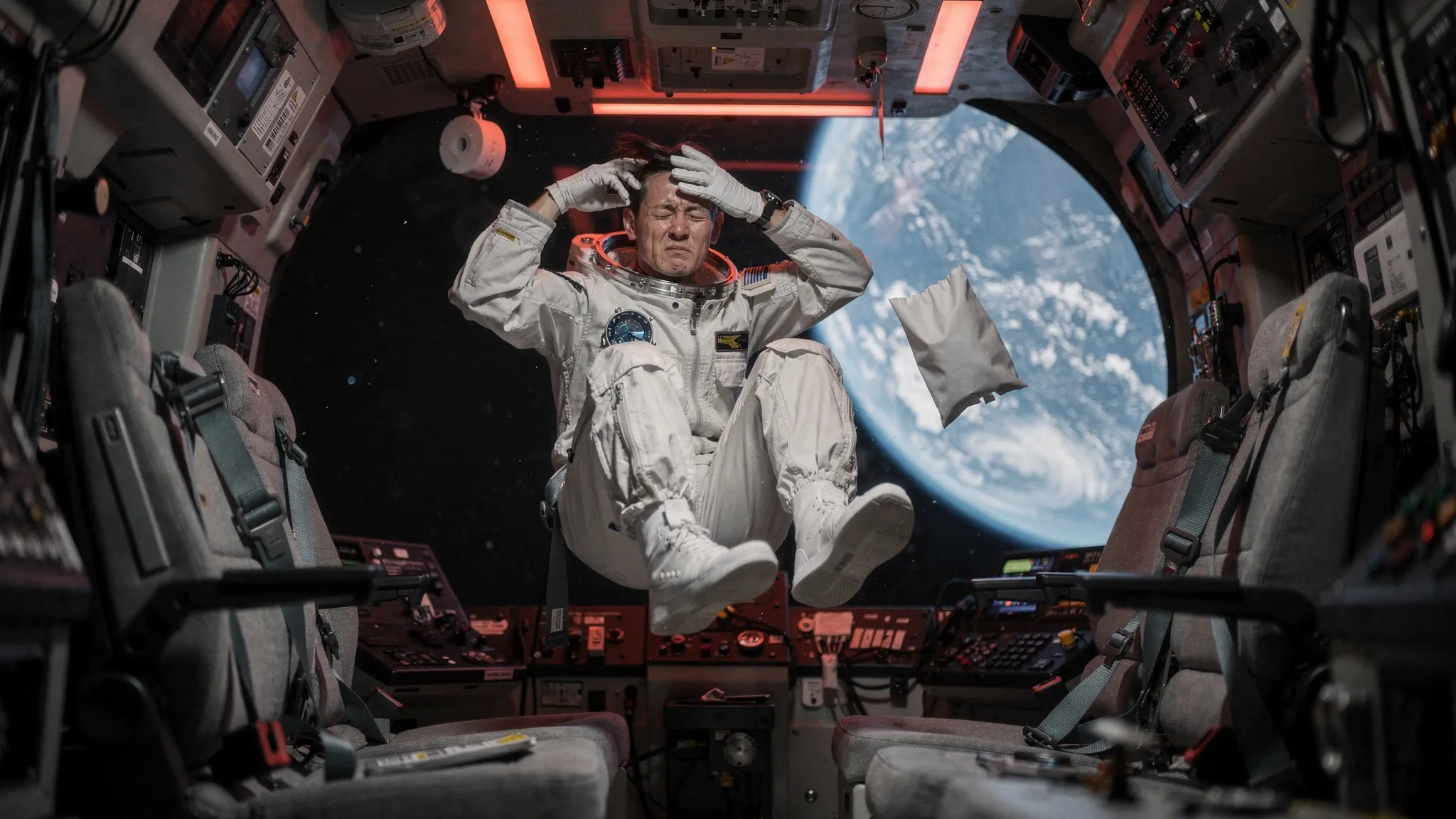
SEVEN PRIVATE ASTRONAUTS OUT OF EIGHT GOT SPACESICK
Arriving in weightlessness confuses the balance organs of the inner ear. In the first days, many astronauts suffer from space motion sickness: pallor, cold sweats, dizziness, nausea, sometimes vomiting. Back on Earth, the readjustment can bring a second bout, the readaptation sickness.
According to the paper, it is the most operationally limiting effect on the human body in the days after a change of gravity. NASA does not schedule spacewalks before 72 hours in orbit, because vomiting inside a spacesuit could lead to suffocation.
Old numbers, collected late
Spacesickness has been reported since 1961. The figures quoted in the paper vary a lot: none in the Mercury and Gemini programmes, 36% on Apollo, 56% on Skylab, 73% among 132 first-time Space Shuttle flyers.
The authors point to weaknesses in those numbers. Most were collected after landing, from memory, sometimes from astronauts who had future missions at stake. Head movements, which are known to trigger the sickness, were rarely controlled. Most subjects were men selected by space agencies. And no data had ever been published on commercial crews, now that private citizens fly to orbit.
Nod, tilt, rate
Torin K. Clark and colleagues followed the eight crew members of Polaris Dawn (4.9 days in orbit) and Fram2 (3.6 days), two missions aboard SpaceX’s Crew Dragon: four women and four men, aged 28 to 62, seven of them first-time flyers.
Before each report, every crew member performed the same sequence of head movements: ear to the left shoulder, ear to the right, back up, chin to the chest, head back, four times over. Then they rated their sickness on a tablet, from 0 (none at all) to 20 (vomiting or about to), in real time. Reports were planned about 30 minutes and 6 hours after reaching orbit, then daily, and again after splashdown.
What they felt
- In orbit: 7 of the 8 felt at least some sickness (87.5%), and 5 vomited (62.5%). Five reached the top of the scale. For half of them it lasted at least two days, for a quarter at least three. Vomiting stopped after the third day.
- Back on Earth: 4 of 8 felt sick again (50%), none vomited, and the worst ratings were much lower: 4.8 out of 20 on average, against 14.9 in orbit.
- Nobody felt sick after landing without having been sick in orbit.
Not everyone followed the textbook course. Four people had a “typical” sickness that peaked early and faded within a day or two. Two had a delayed onset after two or three days in space, one relapsed on day three, and one felt nothing at all. Anti-sickness drugs, taken by six crew members in flight, may explain the odd patterns, but the study cannot test them.
There was no difference between women and men, and no link with age or with how prone each person was to motion sickness on Earth.
Rough seas, rough return
All the post-landing sickness came from the Fram2 crew; nobody from Polaris Dawn reported any. The capsule sensors offer a clue: after splashdown, Fram2’s capsule rotated and swung about twice as much on the water. Its crew also climbed out of the capsule unaided, as part of a separate experiment.
A baseline for longer trips
The rates are higher than most agency figures, but close to those of NASA’s Spacelab-1 mission, the only earlier flight that also provoked head movements before real-time reports. The authors suggest some older figures may have underestimated the problem.
The cohort is small, the missions were short, and head movements between reports were not controlled. The authors expect readaptation sickness to rise as commercial flights get longer: among agency crews, it struck all 18 long-stay space station astronauts in one study cited in the paper.