
SCIENTIST MOTHERS IN CHILDCARE DESERTS GET TENURE LESS OFTEN
Childcare in the United States is scarce, expensive and uneven in quality, and the problem is decades old. In 2019, before the pandemic, 73% of childcare centres said they were turning families away or keeping a waiting list. Because the care of young children still falls mostly on women, such shortages can widen gaps in careers.
Science is a sharp case. After years of training, researchers enter the tenure track, an almost “up-or-out” climb towards tenure — the permanent position that brings job security and research freedom. Those years often coincide with the arrival of children. Jun Li, of the University of Michigan’s Ross School of Business, asked whether the childcare available near where scientists work makes a difference.
Mapping the deserts
National data on childcare are hard to assemble, because licences are held state by state. Li used instead a nationwide database of US business establishments going back to 1997. In each census tract — a small statistical district — Li compared the staff of childcare centres with the total number of people working there — converting childcare staff into places for children, and workers into the number of young children they are likely to have. A tract counts as a childcare desert when supply falls below one third of estimated demand, the threshold used by the Center for American Progress. The twist: deserts are measured around the workplace, not the home, since parents choose care along with their jobs and commutes.
From 1997 to 2019, on average 53.2% of census tracts were workplace childcare deserts.
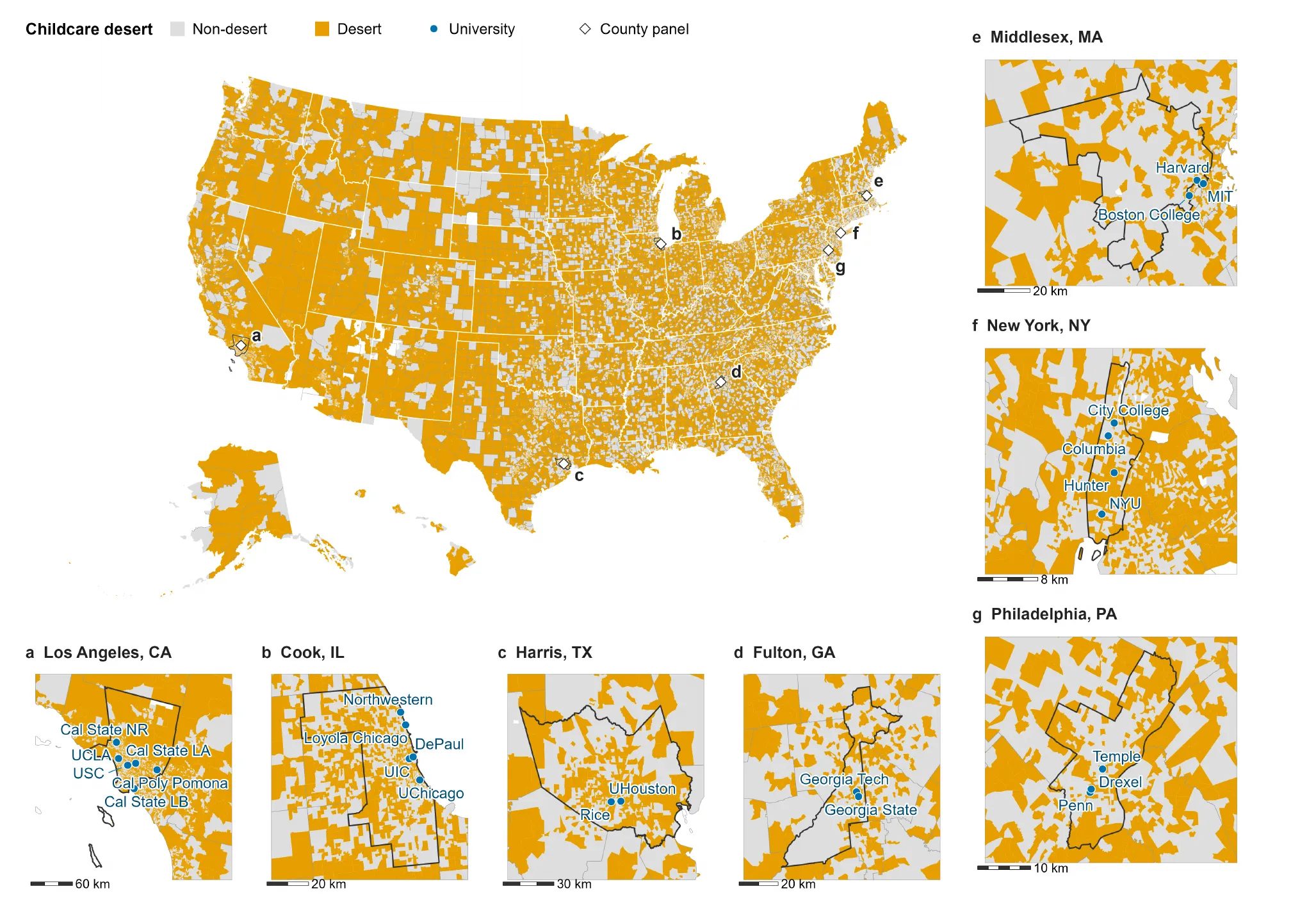
Workplace childcare deserts (orange) by census tract in 2019, with close-ups of seven counties that host universities (Los Angeles, Cook, Harris, Fulton, Middlesex, New York and Philadelphia). — Figure 1, Li (2026), arXiv:2610.40951.
Even the best-funded institutions are short. In 2024, Li collected waiting lists from the childcare centres of the 50 leading US research institutions. Of 157 centres, 46.5% reported average waits of one to two years and 27.4% of two to three years; the estimated mean was about 19 months.
Same deserts, different careers
The scientists come from a national survey of doctorate holders: 12,629 people who earned a PhD in science, engineering or health between 1997 and 2014, then worked at US universities or research institutions, followed every two or three years until 2023.
Men and women were exposed alike: 57.5% of men and 58.0% of women worked in a childcare desert. Tenure was not shared alike: 38.4% of men attained it during the period, against 32.6% of women. Women were also less often in a couple, less often parents of a young child in the six years after their PhD, and, when in a couple, far more often had a partner working full time (83.5% against 52.3%).
Where the gap opens
To compare like with like, Li used survival models that account for the timing of tenure and for many individual, institutional and regional factors. Among parents, working in a desert shows no link with fathers’ chances of tenure. For mothers, it does: working in a desert slows the pace at which they reach tenure, year after year, by 27.2% more than it does for fathers. Put as a probability, mothers’ chance of tenure relative to fathers’ is 6.9 percentage points lower inside deserts than outside them.
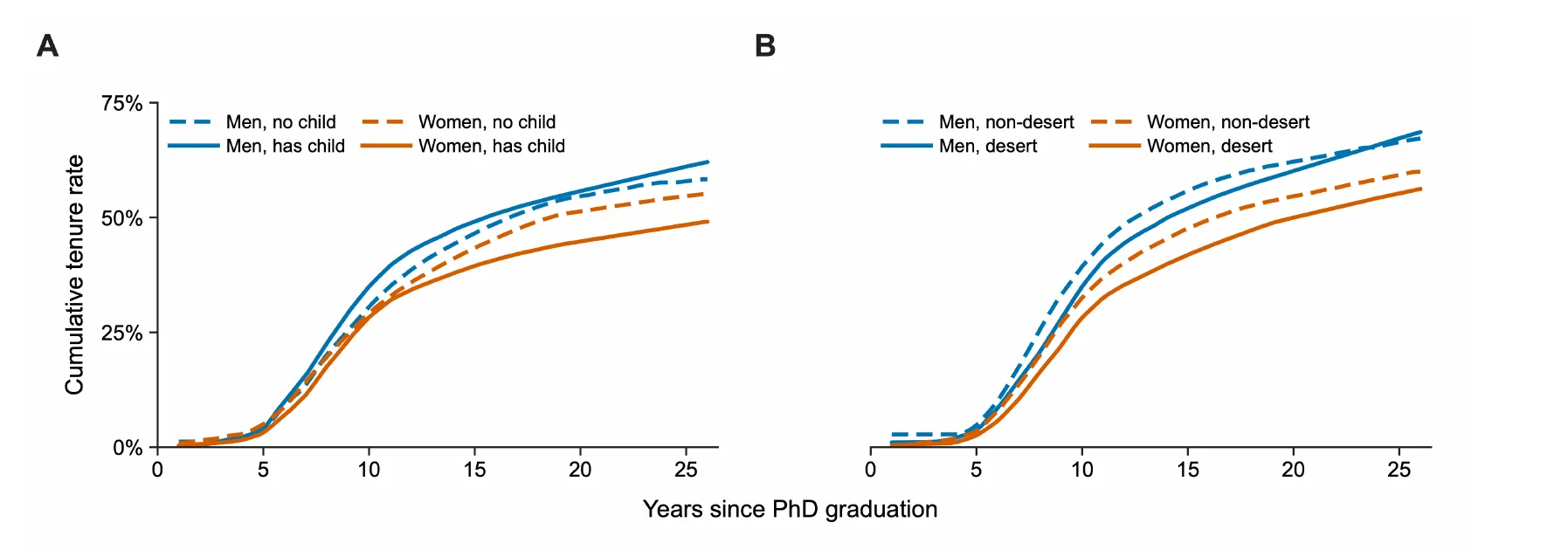
Share of scientists with tenure over the years since their PhD: (A) by gender and parenthood; (B) parents only, inside and outside childcare deserts. Mothers in deserts trail all other groups. — Figure 2, Li (2026), arXiv:2610.40951.
Two checks point to childcare itself rather than to some other feature of poorer local economies. Among scientists without children, deserts show no link with tenure. And the share of local workers employed in other services — health, retail, restaurants — shows no comparable pattern for women.
Leaving the track
Where do mothers go? In the next survey wave, working in a desert is linked, for women more than men, to 4.9 points more moves to industry and, less firmly, 5.1 points more part-time work, including 4.1 points more part-time work at universities. It is not linked to unemployment.
Hours, and what they do not explain
Scientists in the sample report working 48.7 hours a week on average. Having a young child cuts about 6.6 more weekly hours for women than for men. Working in a desert cuts another 2.4 hours for mothers, and none for fathers.
Lost time explains only part of the tenure gap: with working hours taken into account, mothers in deserts still reach tenure less often. Li suggests other routes — work shifted to awkward hours, lost sleep, interruptions, harder coordination with collaborators — but the survey cannot separate them.
A link, not yet a cause
The study is correlational: hidden differences between people or places may remain. It counts only centre-based and group care, more than 80% of licensed places, not childminders or family help. And availability is only one side of the problem; price and quality matter as well. Li points to policies already under way, from new facilities in Michigan to no-cost universal childcare in New Mexico, and to employers’ options such as on-site centres, backup care and subsidies. The paper’s own conclusion is specific: when universities design support for scientists, childcare near the workplace is worth counting.