A FOUR-DIGIT WINDOWS PIN, CRACKED IN 40 HOURS
Windows Hello is the main way to sign in on more than one billion Windows 11 devices, and it accepts PINs as short as four digits. That is only 10,000 possible codes. Such a short code is safe only because guessing is made painfully slow. The computer’s security chip, the TPM, locks itself after 32 failed attempts, then forgives one failure every ten minutes — at most one new try every ten minutes. On top of that, the Windows lock screen allows five tries before it forces a restart.
A counter kept outside the chip
On most recent PCs, the TPM is not a separate chip. It is a firmware TPM, a program running inside a security coprocessor of the main processor (at AMD, Intel, or Microsoft’s own Pluton). It has no memory of its own. So its state — including the count of failed attempts — is stored, encrypted, on the flash memory chip of the motherboard, next to the firmware, the built-in software that starts the computer.
Encryption stops an attacker from reading or editing that state. It does not stop them from copying it and writing an old version back later, which would reset the count of failures. Microsoft therefore requires protection against this “rollback”. On newer machines, the flash chip itself provides it, with replay-protected monotonic counters (RPMC): counters that can only go up, guarded by a secret key. But the flash chip talks to the processor over wires on the motherboard that can be reached physically.
Two flaws and a $5 board
Christian Werling, Jean-Pierre Seifert and their colleagues at the Technische Universität Berlin carried out what they describe as the first public security analysis of these counters in shipping PCs. Two flaws stand out:
- Winbond, the leading maker of this kind of memory with more than 25% of the market, leaks its secret session key when its supply voltage is briefly dropped at the right moment. With the best settings, the key comes out in about one second. With it, an attacker can forge any counter value.
- AMD processors tell the chip “add one to the counter” but never check that it did. A device in the middle can simply swallow the order and answer “done”.
Worse, on two AMD desktop computers whose flash chip has no such counters, rewriting an old copy of the memory with a simple memory-writing device (a “programmer”) was enough to reset the count. Intel machines without the counters resisted that naive trick.
To exploit the flaws, the team desoldered the flash chip and slipped a homemade board between it and the processor. A Raspberry Pi Pico 2W microcontroller, chosen for its price of around 5 dollars, watches the traffic and can take over the counter messages within a few dozen nanoseconds.
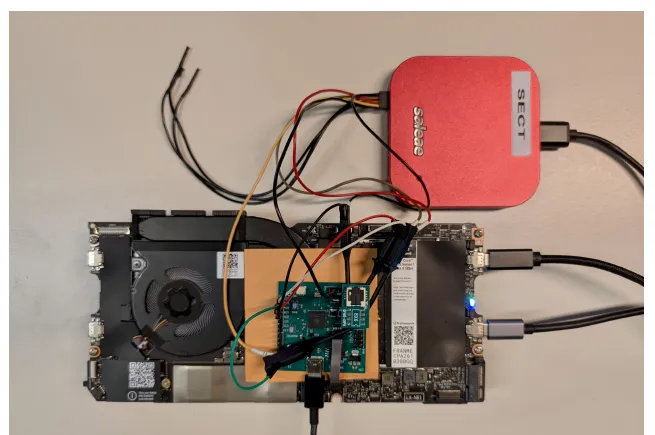
The attack setup on the motherboard of a Framework Laptop 13: the interposer board sits in place of the flash chip. — Figure 4, Werling et al. (2026), arXiv:2611.18126.
236 codes in 57 minutes
The demonstration ran on an HP OmniBook 3, a recent AMD laptop certified “Copilot+”, locked and with its disk encrypted. A KVM — a box that reads the screen and types on the keyboard — entered the codes, five per boot. At every restart, the board wrote the old state back into memory, and the computer accepted five new tries right away.
Starting from 1000, the setup reached the right PIN, 1235, after 236 tries in 57 minutes of net time: 4.14 tries per minute, against one per ten minutes. Trying all 10,000 four-digit codes would take 40 hours at worst, instead of 69 days — about 41 times faster.
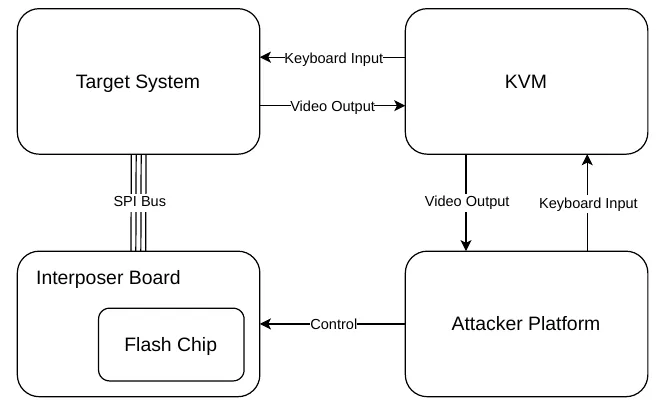
The brute-force loop: a KVM reads the screen and types codes, while the interposer board resets the memory at every restart. — Figure 6, Werling et al. (2026), arXiv:2611.18126.
The team also found that the real waiting time is longer than documented. On three of their machines, the TPM forgave one failure every two hours, not every ten minutes. Without the attack, a four-digit PIN would then hold for 833 days.
BitLocker: even faster guessing
The same trick works on BitLocker, Windows’ disk encryption, when it asks for a PIN before the computer starts. There, Windows adds no limit of its own: every restart gives the attacker the TPM’s full 32 tries. On a Framework Laptop 13 with an Intel processor and a Winbond chip, using the leaked key, the setup made 236 tries in 6 minutes 55 seconds — 34.1 tries per minute. A default six-digit PIN falls in 20 days at worst, instead of 19 years.
Screwdriver required
The attack is not remote: it needs the machine opened, a chip desoldered and a board wired in. The authors call their setup “rudimentary” and say it could go faster. This arXiv version slightly updates the paper published at the ACM CCS ’26 security conference: the BitLocker loop was sped up and the AMD desktop results were added.
The flaws were reported to the chip and processor makers and to Microsoft. None has committed to fixing the root causes. Microsoft rated the issue “moderate severity” and committed to raising the recommended minimum Windows Hello PIN to six digits. The authors note what two extra digits would buy: 168 days instead of 40 hours for Windows Hello, and six years instead of 20 days for an eight-digit BitLocker PIN.
The counters have one more side effect. During the research, the Framework laptop’s flash chip failed. Its secret key was unknown and the processor accepted no other: the machine became unusable, and the manufacturer could only offer to replace the whole board.