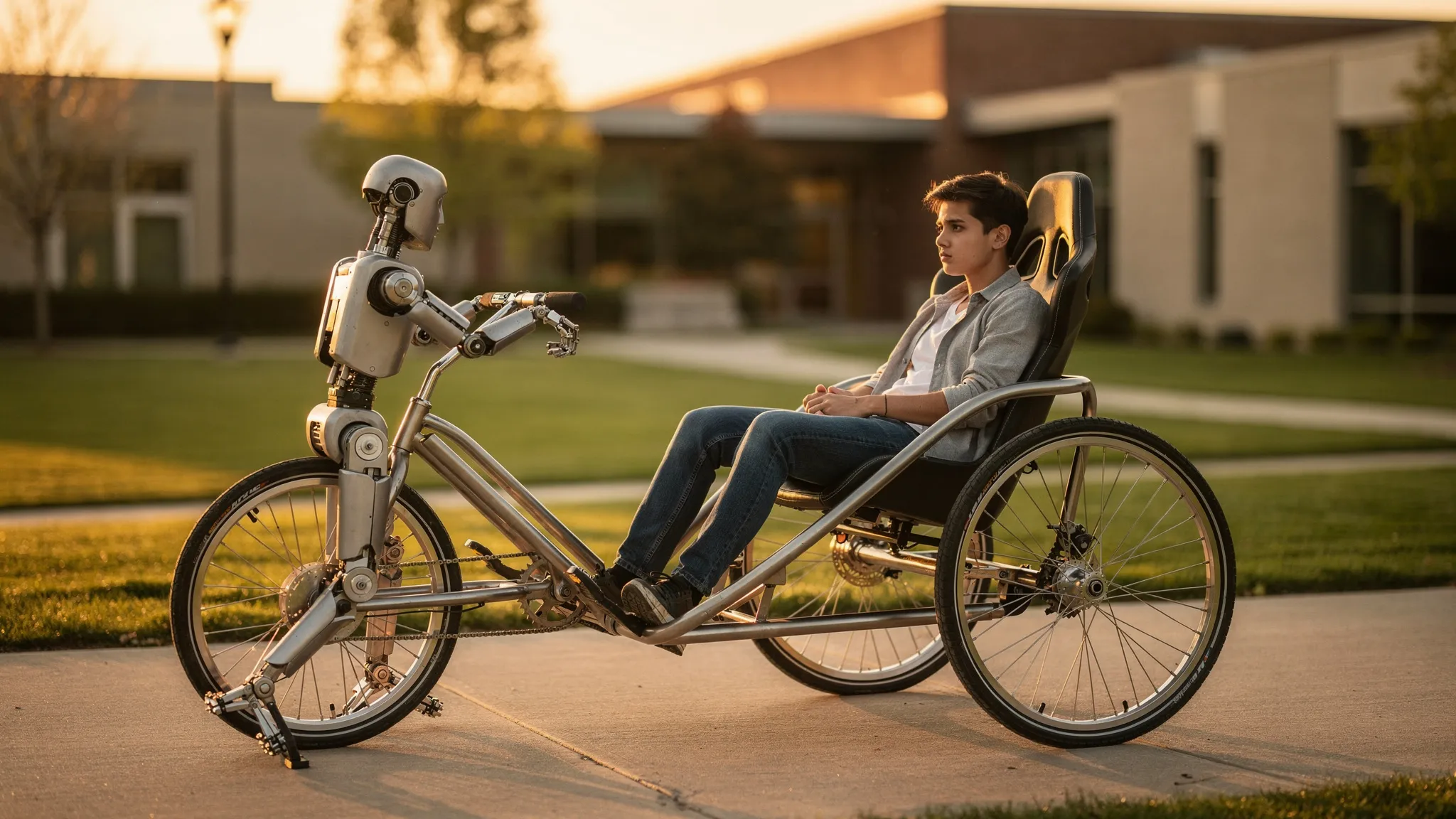
A HUMANOID ROBOT PULLS A RICKSHAW
Humanoid robots are expected to move people, tools and goods around places built for humans. Carrying a load in their arms is demanding: it strains the joints, the structure and the balance. There is another way, as old as the cart: pull it on wheels. The wheels bear most of the weight, and the robot only has to supply the push and the steering. In principle, a robot could then move loads far heavier than itself.
Yangzhi Yang, Xiaobin Xiong and colleagues at the Legged AI Lab of the Shanghai Innovation Institute chose a striking test case: a humanoid pulling a rickshaw.
A cart built to size
The robot is a Unitree G1, with 29 motorised joints in its legs, waist and arms, and two grippers fitted with custom aluminium tips. Commercial rickshaws were too big for it, so the team built one from bicycle wheels, a racing bucket seat and aluminium tubing. Empty, it weighs 22.8 kilograms.
The difficulty is that the forces travelling through the handles depend on everything at once: how heavy the load is and where it sits, how the wheels roll on the ground, how the robot stands relative to the cart. And the robot has to start, cruise, turn and stop without measuring any of this directly. It only knows what its own body feels — joint angles, joint speeds, the tilt of its torso.
A teacher who sees everything, a student who guesses
The controller was trained by reinforcement learning, in a physics simulator, in three stages:
- A “teacher” is trained with privileged access to everything the simulator knows: the cart’s mass and centre of gravity, rolling resistance, ground friction, slope, the forces on each gripper.
- A “student” sees only the history of the robot’s own sensors over the last 61 time steps. It learns to copy the teacher’s actions and to infer, from how its body has been reacting, the teacher’s compact summary of the situation.
- The student is then fine-tuned on its own.
Training ran 8,192 simulated robots in parallel on two graphics processors for about 11 hours, with cart mass, friction, slope and random shoves all varied.
What the student learned
In simulation, the student follows commanded speeds almost as well as the teacher. Memory matters: compared with a controller that only sees the present instant, using the history cuts speed errors by 23 percent. The arms matter too: freezing them makes speed errors 52 percent larger. And the controller keeps working with loads up to 120 kilograms, well beyond the 60-kilogram ceiling it was trained on.
Then the real test. One single controller, never retuned, pulled a second G1 robot sitting in the seat (60 kg in total), then a human passenger (90 kg), then a heavier one: 115 kilograms, about 3.15 times the robot’s own mass. At 1, 1.5 and 2 metres per second, the rickshaw started, held its speed and stopped every time. The paper also shows runs at 2.6 m/s with the 115-kg load, and at 3.8 m/s with a lighter 42-kg load after extra fine-tuning.
Lighter than walking
The most unexpected result concerns effort. The authors use an indicator based on how hard the joints have to twist. In most of the tested combinations of load and speed, pulling the rickshaw cost the robot less effort than walking with nothing — only at 120 kg and 1.6 to 2 m/s did it exceed walking. At 70 kg, the hips work 33 percent less and the ankles 61 percent less; the knees work 126 percent more, but the total still comes out lower. In simulation, quadrupling the load from 30 to 120 kg raises the mechanical cost of transport by only 16.5 percent.
Part of the explanation is that the cart pushes back helpfully. With every step, the sideways force from the handles opposes the robot’s sideways sway, and the cart’s twisting reaction opposes its rolling — like a shock absorber for its balance.
Next: grabbing the handles alone
These efficiency figures are indicators computed from joint torques, not measured electricity: the authors list real energy measurements among their next steps, along with teaching the robot to grab and regrab the handles by itself and to choose its path according to the terrain.