HOW LONG IS A GAME OF UNO?
Uno, writes Pragyaan Gaur, is one of the most widely played card games, and its rules are simple enough to analyse. Earlier work studied how hard it is to decide whether a hand can be played out. Gaur asks a more down-to-earth question: how many turns does a round take — at least, at most and on average — for N players who each start with M cards?
The deck has 108 cards: in each of four colours, one 0, two of each number from 1 to 9, and two each of Skip, Reverse and Draw Two; plus four Wilds and four Wild Draw Fours. Under the official rules, a Wild Draw Four may only be played by someone who holds no card of the current colour. That one rule turns out to shape the whole ending.
Shortest, longest, typical
- Shortest. With two players, a round lasts at least M turns: Skips, Reverses and Draw Twos all hand the turn straight back. With three or more players, at least 2M − 1. An exact computer search over random deals shows that real hands rarely allow it: with seven cards and two players, the 7-turn minimum was never reached in 4,000 deals.
- Longest. Under the official rules, a round has no maximum length, since players may always draw instead of playing, and the discard pile is reshuffled into a new stock.
- Typical. With players who always play a random legal card, 58 million simulated rounds all ended. With seven cards, a round lasts 46.7 turns on average for two players, 50.1 for four and 83.1 for ten. Seat order matters: with four players, the first player wins 26.0% of rounds and the last 24.3%.
A conservation law for giant hands
The main result concerns very large hands, using an idealised endless deck with the same card proportions. Every Draw Two or Wild Draw Four that is played sends extra cards into play, and those extra cards contain more draw cards, and so on. If every card a player ever holds is eventually played, this balance fixes the total:
T = (27/19) × N M turns
The constant 27/19 ≈ 1.421 depends only on the deck’s share of draw cards — 8 Draw Twos and 4 Wild Draw Fours out of 108. Simulations with the Wild Draw Four made legal at any time approach it, slowly.
The hoard
The official rule breaks this law. A large hand always holds some card of the current colour, so it can never legally play a Wild Draw Four. Every one it receives stays in the hand. By the end of the main phase, each player holds a hoard of about M/23 Wild Draw Fours. In one traced two-player game with 1,000-card hands, the eventual winner reached 41 cards, nearly all Wild Draw Fours, against the 43 predicted.
Then comes a dumping endgame. A player left with only Wild Draw Fours holds no card of any colour, so all of them become legal at once. Each one makes the next player draw four and miss a turn.
- With an even number of players, the dumping closes around the table: every other seat dumps, while the seats in between only collect cards and never get a turn. The round then lasts (53/46) × N M turns — about 1.152, shorter than without the rule. Simulations give 1.15192 ± 0.00034 for two players.
- With an odd number, the alternation cannot close. The seats settle into a pattern that Gaur computes numerically, without a closed formula.
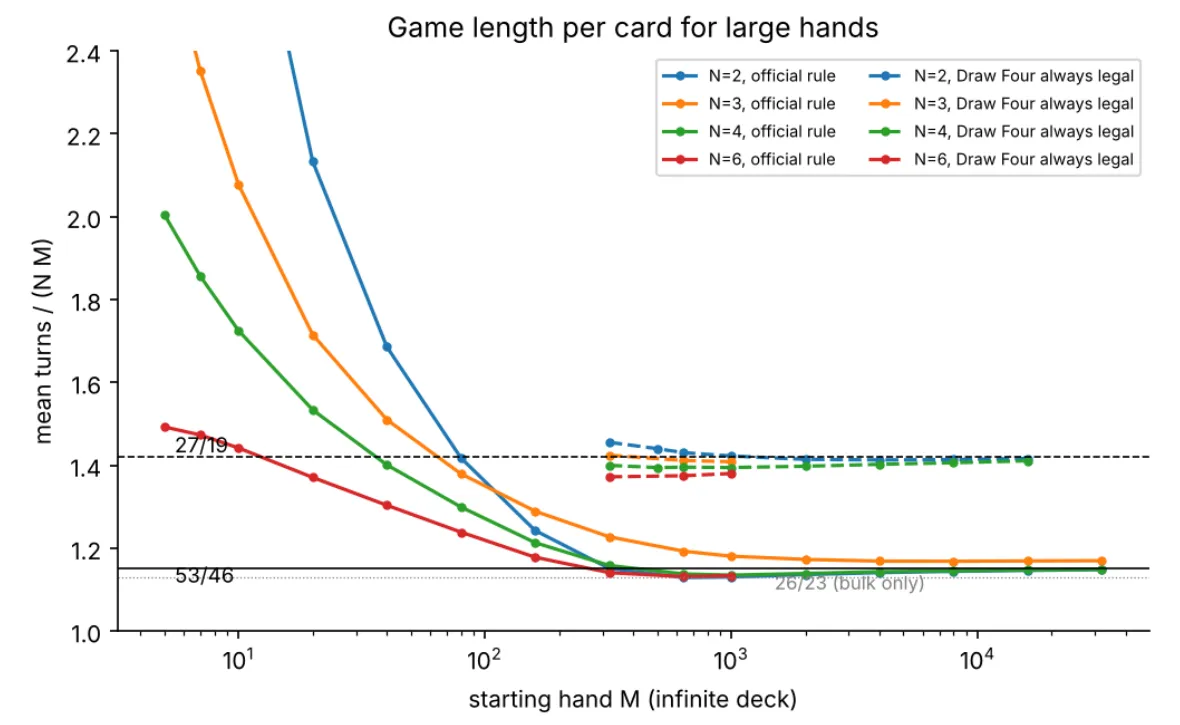
Game length per card for large hands. Dashed lines: Wild Draw Four always legal, near 27/19. Solid lines: the official rule, settling near 53/46 for an even number of players. — Figure 3, Gaur (2026), arXiv:2610.14076.
Winning, not just lasting
Gaur also pitted 48 strategies against each other. With two players, the equilibrium is a single strategy: hold your Wilds, play action cards first, name the colour you hold most, and attack with draw cards and Skips when the opponent is down to two cards or fewer. It wins 62.8% of rounds against random play. The colour choice matters most on its own, lifting the win rate from 51% to 58%.
The paper’s limits are clear: the large-hand results describe an idealised deck (on a real deck, all hands together cannot exceed 107 cards), simulated players never draw voluntarily, and the 48 strategies were built by hand. All code is public. The author says a large language model helped with the wording and the simulation code, and that the author checked every result.