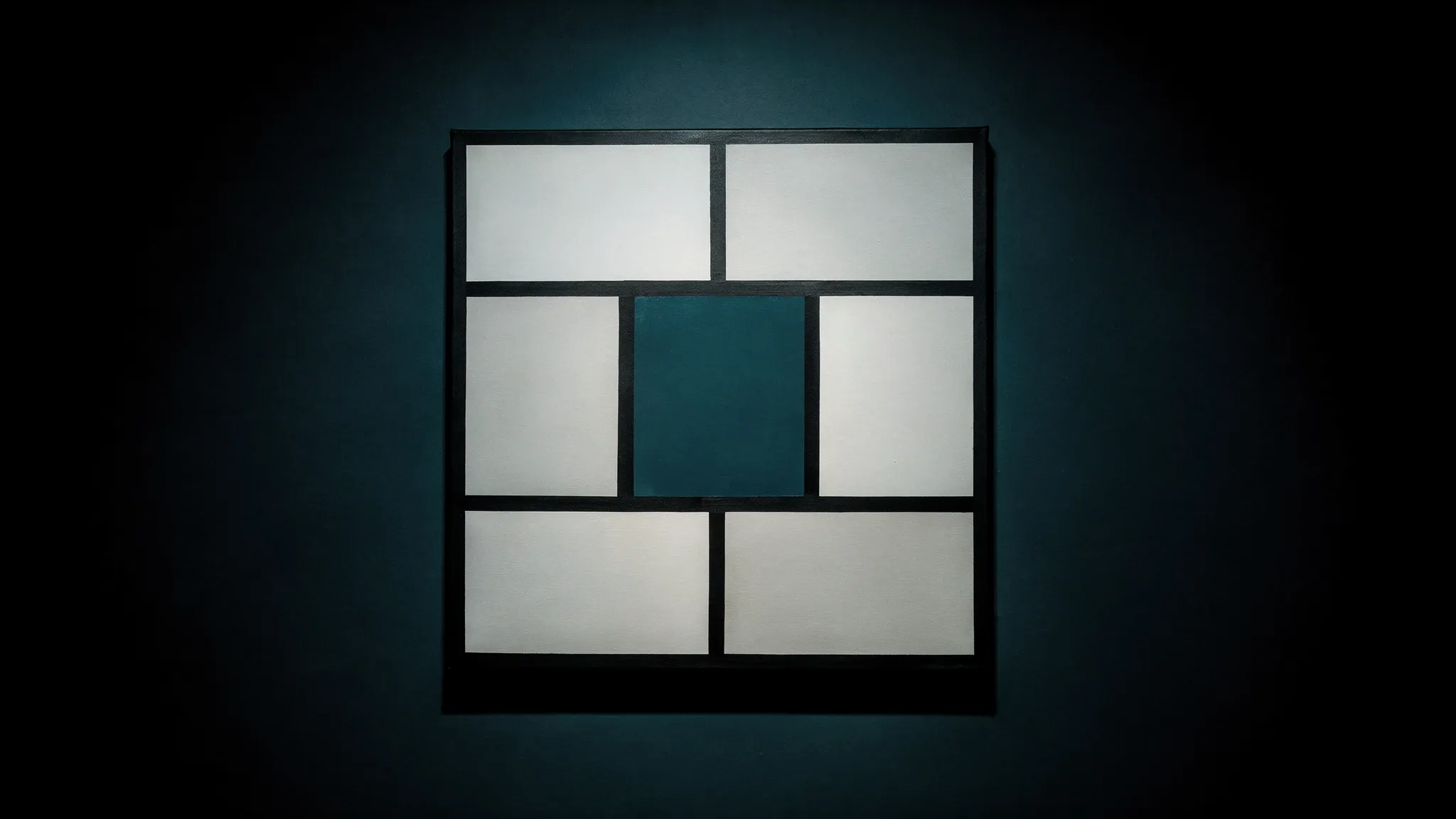
MONDRIAN'S PUZZLE: A GAP THAT STOPS GROWING
The Dutch painter Piet Mondrian is best known for his De Stijl works, made mostly of coloured rectangles. Mathematicians have borrowed them for a deceptively simple puzzle. Take a square canvas of side n. Cut it into rectangles with whole-number sides, all lined up with the edges. One rule: no two rectangles may be the same shape, even after turning one by a quarter — a 2 × 3 and a 3 × 2 cannot share the canvas.
Now compare their areas. The difference between the largest and the smallest is the defect. The question is how small it can be.
The perfect cut nobody has found
A cut with defect zero would be perfect: rectangles all different in shape, yet all exactly the same area. Equal areas are not enough on their own; the pieces must also fit together with no gap or overlap. Nobody knows whether a perfect cut exists for any square. It has been ruled out for every side up to 1,000, and the general belief is that there is none.
Behind that belief lay a broader one: that the smallest possible defect, written M(n), grows with the size of the square. The known examples, up to n = 900, seemed to say so. In a September 2026 preprint, another team reported the first non-trivial upper limit, M(n) ≤ 10 n^(5/6) — a gap that can still grow without end.
Seven rectangles and √19
Cooper O’Kuhn and Freeman Slaughter of the University of South Florida started from a known curiosity: a way of cutting a square into seven different rectangles of exactly equal area. Its catch is that the sides are not whole numbers; they involve √19, an irrational number.
Their idea is to replace √19 by fractions p/q that approximate it better and better. The right tool is a well-studied equation of number theory, Pell’s equation: here, p² − 19q² must stay fixed. With that choice, the sides become whole numbers, and the spread of areas depends only on that fixed value — not on how big the numbers get. They show the defect equals exactly 140 × |p² − 19q²|.
The square of 315
The smallest case uses p = 13 and q = 3, for which 13² − 19 × 3² = −2. It gives a square of side 315 cut into:
259 × 55, 56 × 255, 238 × 60, 77 × 185, 189 × 75, 70 × 200 and 112 × 125.
The largest area is 238 × 60 = 14,280; the smallest, 70 × 200 = 14,000. The defect is 280. The seven areas add up to 99,225, which is indeed 315 × 315.
Forever 280
Then the construction repeats. The side lengths follow a simple rule: 315, then 106,785, then each new side is 340 times the previous one minus the one before — 36,306,585, then 12,344,132,115, and so on without end. Every one of these squares can be cut into seven different rectangles with a defect of exactly 280.
So the minimal defect does not keep growing. In the authors’ words, there cannot even be a function that tends to infinity — linear, logarithmic or anything else — staying below M(n) for every large enough square. That overturns a conjecture they describe as open since the problem was first proposed. A variant of the same method gives, for any whole number k, infinitely many squares whose side is divisible by k, with a defect of at most 560.
Still no perfect square
The result says nothing about squares outside the family, and it does not rule out a perfect cut. The authors even prove that this kind of seven-rectangle cut can never go below 280: a defect of zero would have to come from a different idea entirely. They conjecture that 280 is the best these seven rectangles can do, propose that rectangular canvases might do better still, and expect “a quick flurry of progressive improvements”. Whether a perfect Mondrian square exists remains open — but the argument that it cannot, because the gap must grow, is gone.