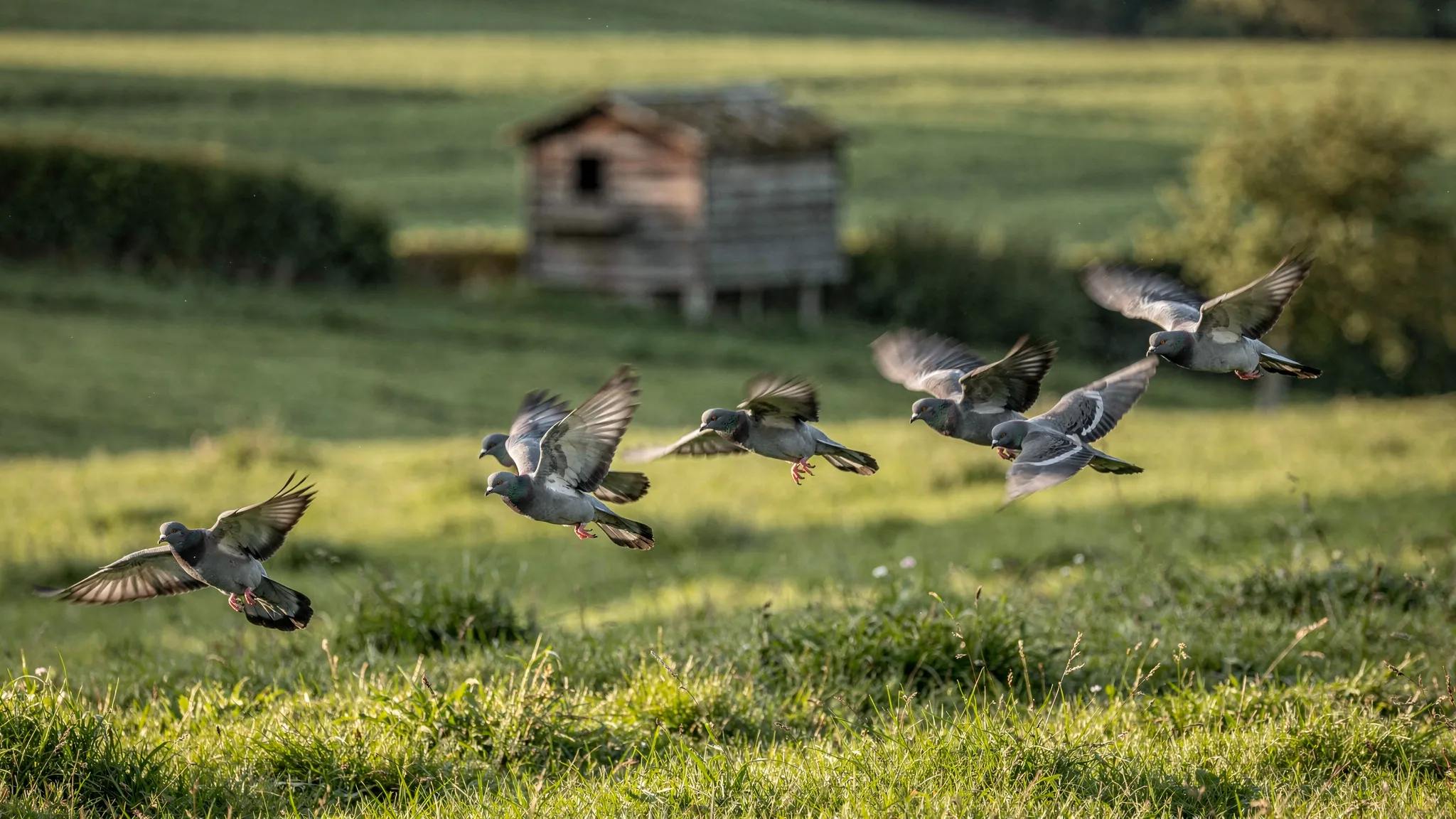
THE BIGGER THE FLOCK, THE WEAKER THE BOSS
When a group must agree on a direction, not everyone weighs the same. Leaders and followers appear, and influence flows mostly one way. Usually, this negotiation happens out of sight. But when animals fly home together, their decisions are written into their tracks, second by second.
Homing pigeons are the best-studied case. Alone, each bird has its favourite route. Released as a group, their preferences clash and must be settled in flight. Earlier GPS studies found clear leader–follower hierarchies in pigeon flocks, and showed that flying together makes homing more efficient. The classic explanation is the wisdom of crowds: average everyone’s errors, with equal weights, and the errors cancel out. But a previous study, by T. Sasaki and colleagues, found that this averaging idea, known as “many wrongs”, does not match the routes flocks actually take.
Reading decisions from tracks
Bibaswan Ghosh, Vipul Rai, Harsh Soni and Nitin Kumar, of the Indian Institute of Technology Bombay and IIT Mandi, built a way to measure hierarchy from trajectories alone. They treat a flying flock like an active particle: it moves at constant speed, its heading jitters at random, and it corrects course whenever the angle to home gets too large. That maximum angle, ϕm, measures how much navigational error the birds tolerate.
They applied it to Sasaki’s data: 30 pigeons, released 8.1 kilometres from their loft, in randomly mixed groups of 1, 2, 4 and 8. As the groups grew, the tracks became straighter. In the model, the randomness of the flight stayed the same; what changed was the tolerance — ϕm shrank as the flock grew. Bigger flocks fly better because they put up with less error.
Equal votes fail
Next, the team simulated pigeons that talk to each other. Each virtual bird corrects its own course when it strays more than 74 degrees (a separate trigger, wider than the 54° tolerance measured for a lone pigeon); each correction sends a signal to the others, which may then turn toward home too.
- If everyone always follows everyone — an egalitarian flock, equivalent to the wisdom of crowds — the simulated flocks become far too disciplined: their tolerance cone is much narrower than in real flocks.
- If influence is ranked — the lower a bird’s rank, the less often the others follow its corrections, at a rate set by a hierarchy index η (0 means every bird counts equally; the larger η, the more a single leader dominates) — the simulations match the real flocks. And the matching η drops as the flock grows: small groups are strongly hierarchical, larger ones increasingly egalitarian.
A quarter of a second
The model is coarse: corrections happen instantly. Real birds need time to react. So the team checked the hierarchy against something finer — who turns first. Comparing the headings of every pair of birds, each pigeon gets an average delay: positive if it tends to initiate turns, negative if it tends to follow.
Those delays stay between about plus and minus 0.25 seconds, remarkably close to the reaction times of pigeons measured in other studies. A simple formula linking delay to rank, using the η values from the simulation, fits the flocks of 2, 4 and 8. It also fits an independent dataset — a flock of 9 pigeons studied by M. Nagy and colleagues — with a hierarchy index smaller still, as the trend predicts: 0.05 or 0.11 depending on the fit, against 0.13 for eight birds.
The price of being followed
Why would hierarchy fade in larger groups? The authors turn to thermodynamics. When influence runs one way, the sequence of events looks different played backwards — like a film you can tell is reversed. Physicists measure that irreversibility as a rate of entropy production. Here it is an informational cost of one-way communication; it vanishes when everyone influences everyone equally.
Their calculation shows this cost, per bird, climbs very fast with flock size and hierarchy — in the simplest limit, as the cube of the number of birds. If each pigeon can only “spend” a fixed amount, the hierarchy has to weaken as the flock grows. Assuming a constant cost per bird, whose value they fit to the data, the team reproduces the decline of η inferred from the flights reasonably well.
The authors call it a plausible rationale, not a proof, and their model assumes every pair of birds can influence each other both ways, which may not hold in big flocks. They suggest it might also explain why each starling in a flock tracks only six or seven neighbours, and that programmable robots could put the idea to the test.