SIX DICE THAT BEAT EACH OTHER IN A LOOP
Roll two dice together; the higher number wins. Now let each face carry any value from 1 to 6, repeats allowed: a die might read 1, 1, 2, 5, 5, 5. Can six such dice be lined up so that each beats the next and the last beats the first, every win as narrow as possible? Terry Easlick, of the Université de Montréal, has shown with a computer that six is the smallest number of faces for which this works, and that there are exactly two ways to do it.
Nineteen duels out of thirty-six
A duel between two six-sided dice has 36 equally likely outcomes: each face of one against each face of the other. To have the edge, a die must come out higher in more than half of them, so at least 19: a probability of 19/36, about 52.8%. With n faces there are n × n pairings, and the slimmest win is the smallest whole number above half of them: 13 out of 25 for five faces, 51 out of 100 for ten.
Here is how the count works for the dice (1, 1, 2, 5, 5, 5) and (1, 3, 4, 4, 4, 4). The three 5s beat all six faces of the second die: 18 pairings. The 2 beats the second die’s only 1: one more, 19 in all. The two 1s tie with that 1, and the second die wins the other 15. The first die wins 19 duels out of 36: the narrowest victory there is.
Dice that beat one another in a loop are called non-transitive: every die in the loop is beaten by another, so none is the best. Easlick’s question: with values from 1 to n on n faces, for which n can n dice form such a loop, every duel won by exactly the slimmest margin, with no loop of more than n dice anywhere among the n-sided dice at that margin?
A map of every possible die
Here a die is simply a list of values, in no particular order. With six faces there are 462 of them, the ordinary die (1, 2, 3, 4, 5, 6) among them. Easlick draws each one as a point, then adds an arrow from one die to another whenever the first wins exactly 19 duels out of 36. For six faces, that makes 5,491 arrows.
A loop of dice is then a path of arrows that returns to its start. To find them, his program, written in the Julia language, splits the map into strongly connected components: the largest groups in which you can travel from any die to any other along the arrows, and back again. Every loop lies entirely inside one of these groups, so a group of a single die holds none. The split uses Tarjan’s algorithm, published in 1972. The author states that he used GPT-5.6 to help write the scripts, and that the mathematical ideas are entirely his own.
Nothing, nothing, nothing, then two
With three faces there are 10 possible dice and only 3 arrows; with four, 35 dice and 67 arrows; with five, 126 dice and 620 arrows. In all three cases every group holds a single die: at the slimmest margin, no loop exists at all.
With six faces, 448 of the 462 dice sit alone. The other 14 form two families of seven dice, each linked by 10 arrows. Inside each family, the program lists four loops: three of three dice and one of six. No loop can hold more than seven dice, and the full list of loops in each family shows none of seven, which the author notes can also be checked by hand. These two loops of six are the only ones. The first:
(1, 1, 2, 5, 5, 5) → (1, 3, 4, 4, 4, 4) → (2, 2, 2, 3, 6, 6) → (1, 1, 2, 5, 5, 6) → (1, 3, 3, 4, 4, 4) → (2, 2, 3, 3, 3, 6) → back to the first.
The second:
(1, 1, 4, 5, 5, 5) → (3, 3, 3, 3, 4, 6) → (2, 2, 2, 5, 6, 6) → (1, 4, 4, 4, 5, 5) → (3, 3, 3, 4, 4, 6) → (1, 2, 2, 5, 6, 6) → back to the first.
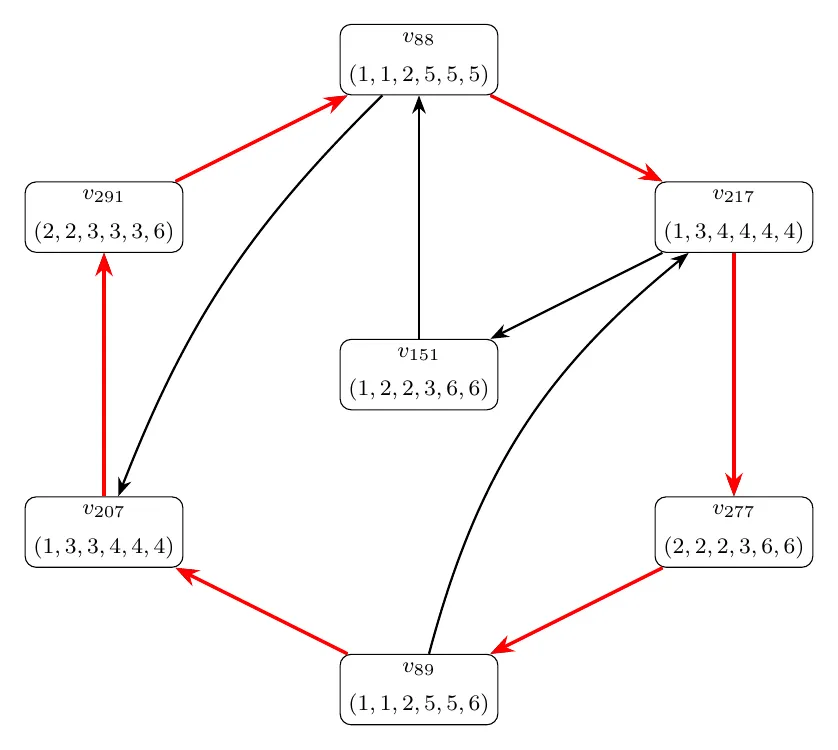
The first family of seven dice: each box is one die, with its number in the computer’s list and its six faces. An arrow means “wins exactly 19 duels out of 36”. In red, the loop of six. — Diagram of SCC 1, page 5, Easlick (2026), arXiv:2610.40321.
Two solutions, one reflection
The two loops are not independent. Replace every face value v by 7 − v: 1 becomes 6, 2 becomes 5, 3 becomes 4, and the other way round. A face that was higher is now lower, so every arrow flips direction. Easlick proves that this swap turns the first family into the second: the first loop, read backwards, becomes the second. Apply the swap twice and every die returns to itself.
Beyond six, the loops outgrow the dice
From seven to ten faces, the opposite happens: plenty of loops, but too long. With seven faces, 1,081 of the 1,716 possible dice form one giant family, and the first long loop the search returns links 14 dice. With eight faces, a family of 4,321 dice holds a loop of 29; with nine, 20,451 dice and a loop of 10. With ten faces, 92,378 dice and 157,244,770 arrows, a family of 81,791 dice holds a loop of 110. These are the first loops longer than the number of faces that the search found, not the longest ones.
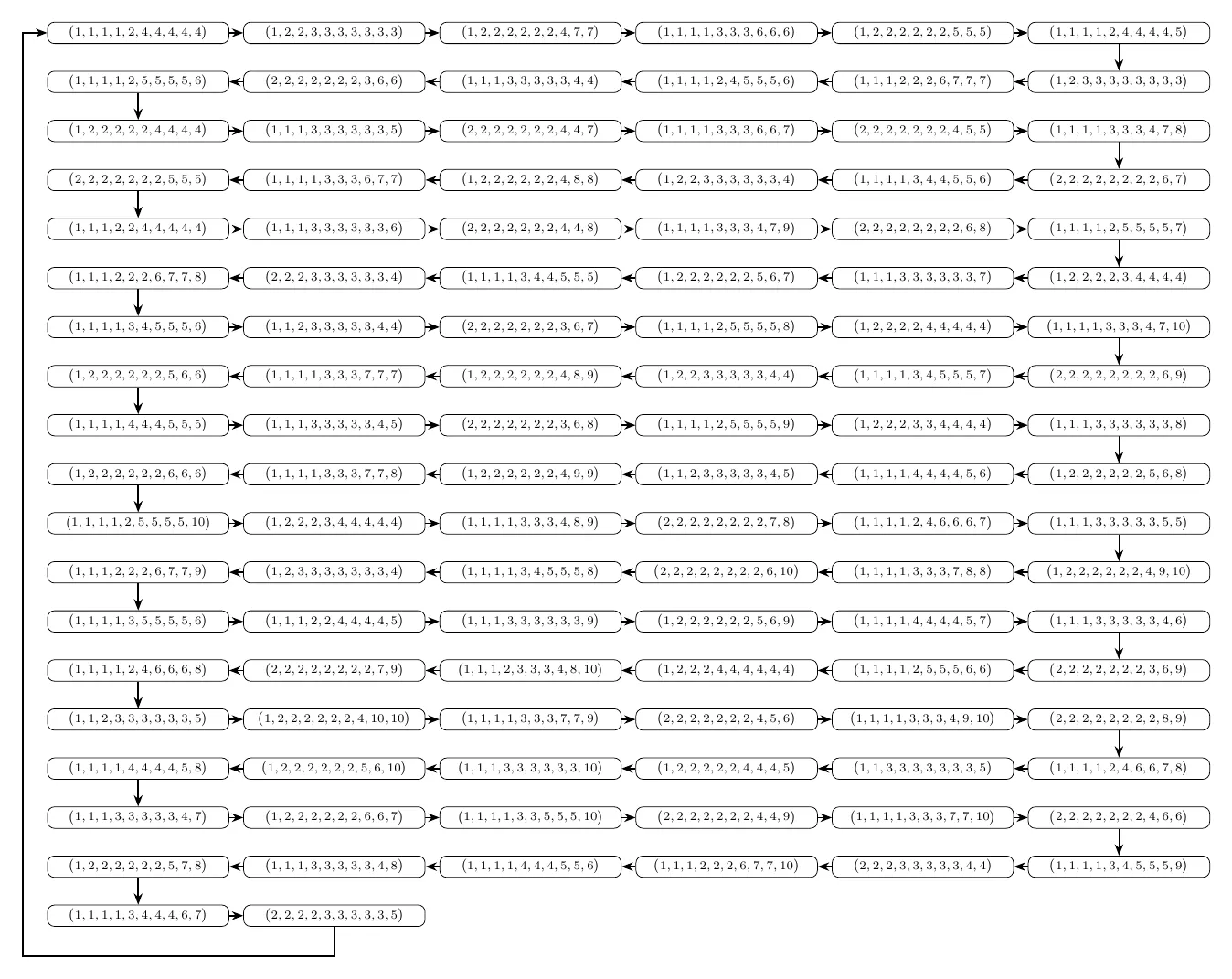
A loop of 110 ten-sided dice, each beating the next in exactly 51 duels out of 100. Follow the arrows row by row; the line on the left closes the loop. — Diagram of the case n = 10, page 10, Easlick (2026), arXiv:2610.40321.
Such loops break the second condition: no loop may hold more dice than there are faces. Easlick conjectures that six is not only the smallest number of faces with this property, but also the largest.
Eleven faces, still out of reach
That conjecture remains open. With eleven faces there are 352,716 possible dice; with twelve, 1,352,078. Both cases would take far longer to compute; the paper reports no computation for them, and the author only surmises that they, too, hide loops of at least 12 and 13 dice. The paper closes on where the question came from: the many games of dice the author played with his mom.