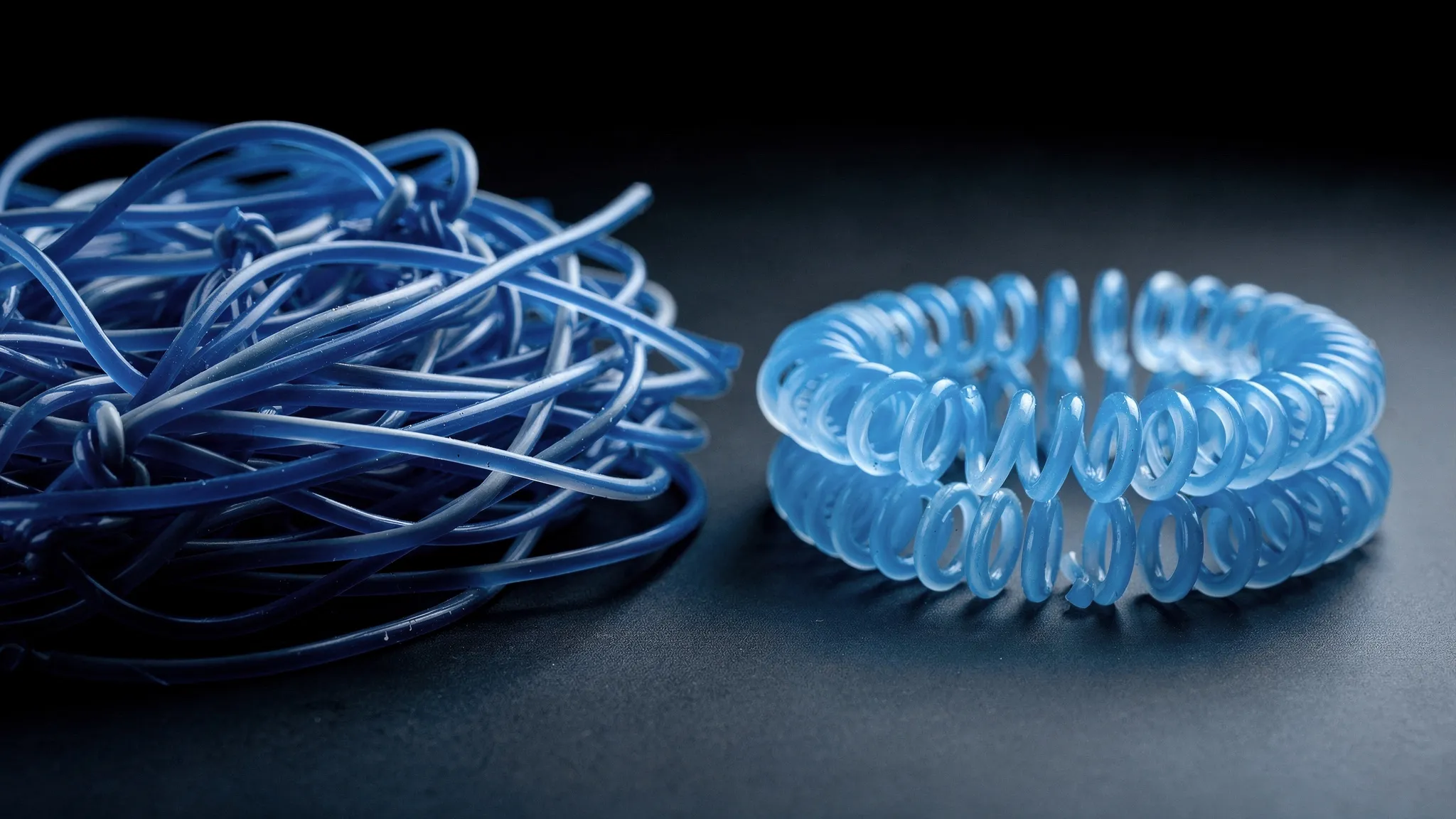
WHY CURLY CORDS TIE FEWER KNOTS
Everyone has pulled a tangled cable out of a pocket. The same problem runs through ropes and fabrics, through the long molecules of plastics, and through DNA packed in a cell nucleus. Mathematicians and physicists have studied it for a long time, and experiments with strings shaken in rotating boxes have shown that longer strings tangle more.
Those experiments almost always used straight filaments. Yet many natural ones are curved even at rest: plant tendrils, curly hair, collagen fibres. Fani Derveni, of Cornell University and the École polytechnique fédérale de Lausanne (EPFL), with Javier Sabater and Pedro M. Reis at EPFL, asked what that built-in curl does to tangling.
Rods in a tumbler
The team cast soft silicone rods 3.2 millimetres thick and 0.6 to 4.5 metres long. Some were straight. Others were moulded around cylinders to give them a natural helical curl, with curvatures from 0.02 to 0.145 per millimetre. Curvature is one over the radius of the curl: 0.02 per millimetre means coils 10 centimetres across, and 0.145 per millimetre coils under 1.5 centimetres. The higher the number, the tighter the curl. Coated with talc to reduce friction, each rod was tumbled for 20 minutes inside a cylinder 99 millimetres wide, rotating around two axes at once. Every condition was repeated 15 times.
They then measured two different kinds of entanglement:
- Knotting: the rod tumbled with both ends free, then both ends were pulled apart. If a tangle survived the pull, it counted as a knot.
- Locking: the rod tumbled with both ends fixed, then a motor pulled one end against an acrylic stopper plate. The tangle tightens against that stopper; if the rod resisted extraction instead of sliding free, it counted as locked, knot or not.
The curl that unties
For straight rods, the chance of knotting rose steadily with length and reached 100% beyond 3.5 metres, as in earlier experiments with strings.
Tightly curled rods, with a curvature of 0.11 per millimetre — coils about 1.8 centimetres across — knotted less at every length — up to 73% less. They even knotted less around 3.7 metres than at shorter lengths, perhaps because the helix jams inside the cylinder.
The effect of the curl is not simple. For rods of 0.6 and 1.2 metres, a slight curl, around 0.05 per millimetre, first made knots more likely. Then, at a critical curvature of about 0.11 per millimetre, knots disappeared altogether: no knotting at all in the trials. The authors say the origin of this rise-then-fall is not yet understood.
X-ray scans, made on a few selected tangles rather than on every trial, showed the difference. Straight rods formed large, complicated, disordered tangles. Curled rods produced simpler ones, mostly resembling an overhand knot or a figure-eight knot.
Locking does not care
Locking told another story. Its probability grew with the rod’s length and barely depended on its curl. For 2.3-metre rods, about 60% locked whatever their curvature; rods of 0.6 metres never locked in 15 tries. The scans revealed three types of lock: loops wrapped around the rod itself, tight compact knots, and messy clusters in the longest rods.
Two tangles, two causes
The authors draw a clear distinction. Knotting depends on the rod’s overall shape: a curl shrinks the space the rod spans and limits the crossings of its ends. Locking depends on local contacts and loops forced by the confinement. In principle, the two could be tuned separately by design.
They stress that these results belong to one system — one rod thickness, one material, one container, one tumbling speed — and that no theory yet explains them. They also speculate, without claiming it, that similar geometric rules might shape how naturally curved filaments in biology, such as helical proteins and supercoiled DNA, become entangled. Testing that will need models, not just a tumbler.