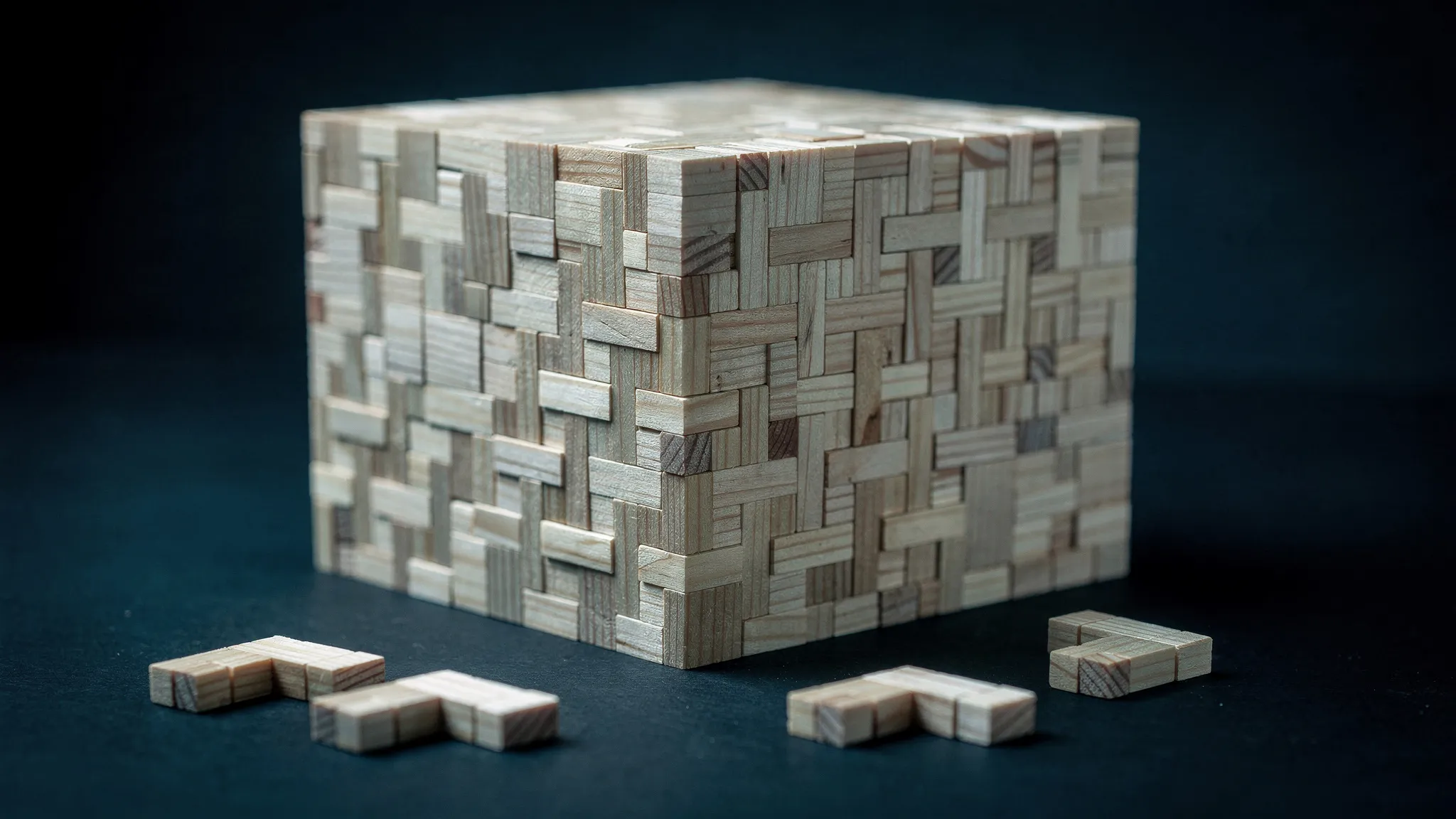
SHAPES THAT ALMOST FILL SPACE
Squares and hexagons tile the floor perfectly. Many other shapes do not. But a shape that cannot tile everything may still be surrounded by copies of itself, snugly, with no gap and no overlap. Such a ring of copies is called a corona. Sometimes a second corona fits around the first, then a third. The largest number of coronas you can build is the shape’s Heesch number, after Heinrich Heesch.
A shape that tiles the plane has an infinite Heesch number, and the converse is also true. So the number measures how close a non-tiling shape comes to tiling.
Stuck at six
Heesch’s problem asks whether finite Heesch numbers have a ceiling. In the plane, progress has been slow, according to the paper: figures with Heesch number 2, then 3, then 5 were found over the years, and 6 in 2021, still the planar record. That figure was found by the author of the new paper himself. Large computer searches through shapes made of squares, hexagons or triangles never found anything above 4.
The question matters beyond puzzles. If Heesch numbers had a ceiling for a reasonable family of shapes, one could decide whether a shape tiles the plane: just try to build one more corona than the ceiling allows. Whether that can be decided for a single shape in the plane is still unknown.
No ceiling in three dimensions
Bojan Bašić (University of Novi Sad, Serbia) settles the question in space. For every whole number h, he builds a solid whose Heesch number is finite and at least h. Since a 3D construction can be extended into higher dimensions, the same holds in every dimension from 3 up. The plane remains open.
The construction is explicit and elementary. The shape is made of 48h + 64 unit cubes, decorated with small bumps and matching nicks.
Four numbers on a line
Everything starts with four integers:
Fₙ = {0, 2n − 1, 2n + 1, 4n}
Shifted copies of this set can never cover all the integers without overlap: the paper gives a short proof. Yet they can fill, without gaps, a run of 4n² − 10n − 2 consecutive integers, even though the set itself spans only 4n. A near-miss that long is exactly what a large Heesch number needs.
From points to cubes
The author places the four points along a diagonal direction of a grid of cubes, and attaches to each one the same bent path: 2n cubes along one axis, then one level up and 2n cubes along another. The four paths join into a single connected block of 16n cubes. It inherits both properties of the four numbers: it cannot fill space, but copies of it fill a whole cube of edge 4n² − 12n − 1.
Small bumps on the faces, each fitting only its own nick, prevent copies from being rotated or flipped, so neighbours are forced to line up exactly. Then, starting from a copy at the centre of that big filled cube, ring after ring of copies can be peeled off as coronas. Choosing n = 3h + 4 guarantees at least h of them.
Space before the plane
The paper notes that this is not the first tiling question answered in space before the plane. A space-filling solid of a special kind, asked about by Hilbert, was found in 1928, seven years before its flat counterpart. And a three-dimensional aperiodic solid was built in 1988, some three and a half decades before aperiodic shapes were discovered in the plane. Whether the planar record of 6 can be beaten without limit is the part of Heesch’s question still waiting.