WHY SOCIETIES FEED ELDERS WHO TEACH OTHER PEOPLE'S CHILDREN
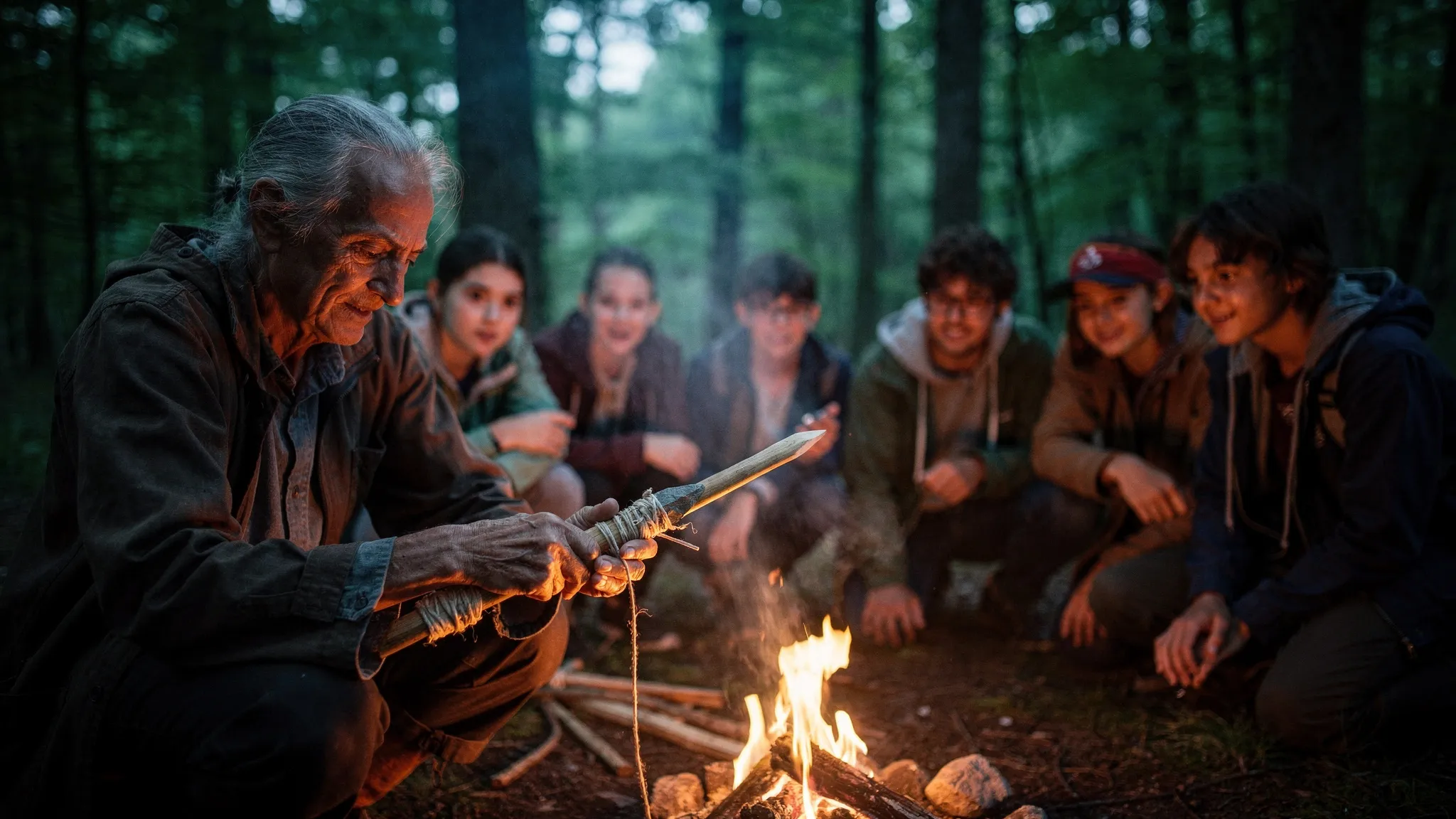
Humans live a long time after they stop having children. Among hunter-gatherers who survive childhood, a substantial part of adult life comes after reproduction ends. Elders keep contributing through what they know. Among the Tsimane, forager-horticulturalists, the skills an adult needs come largely from older members of the parents’ generation, not from parents alone. Among the Ache, hunting returns keep rising for two decades after physical strength has peaked.
That raises a puzzle. A teacher consumes what others hunt and produces no offspring. Why would natural selection establish a stage of life devoted to instruction, and why would a society feed the people in it?
Grandmothers, and everyone else
One classic answer is the grandmother hypothesis: a grandmother who helps her grandchildren passes on her genes indirectly. Natalie and Joseph Henrich extended it into an “information grandmother hypothesis”: once culture is transmitted faithfully, elders can invest in the young with knowledge rather than food. Their example: Fijian food taboos during pregnancy and breastfeeding single out precisely the marine species that carry dangerous toxins. That hypothesis had never been given a mathematical model.
And human teaching is not limited to family. Knowledge passes vertically (parents to children), horizontally (within a generation) and obliquely — from the parents’ generation to unrelated children, the way schools work. Formal models find that adding oblique teaching makes teaching harder to evolve, because the benefit goes to people who do not carry the teacher’s genes. Oblique teaching, common as it is, “remains a theoretical mystery”.
A model of retirement
Hirotaka Goto, of Meiji University in Tokyo and the University of Pennsylvania, and Joshua Plotkin, of the University of Pennsylvania, built a model of a population with two stages of life. Everyone is born a hunter — standing for any skilled work that benefits the group, from fishing to farming to toolmaking — and has children. At a certain rate — a fixed chance each year — hunters retire for good and become teachers: they no longer hunt or reproduce, but they turn amateur hunters into experts. The more teachers there are, the faster amateurs learn. Everything hunted is shared inside the group, teachers included, and the birth rate follows the food per person.
The retirement rate here is a social norm, not biology: it stands in for the age at which a society expects people to stop working — the higher the rate, the earlier people retire on average —, teach the young and be fed by others. The authors stress that this is not a model of menopause, and it does not distinguish between sexes. Groups with different norms compete for the same environment; nobody is related to anyone.
Teaching needs a crowd
The share of teachers settles at r/(r + d_T), where r is the retirement rate and d_T the death rate of teachers. It also equals the fraction of a lifetime each person spends retired. The winning norm is the one that gives each member the highest expected food from hunting over a lifetime.
The main results:
- Teaching can evolve without any kinship.
- But only in groups larger than a critical size. That threshold is bigger than the size at which teaching merely becomes useful, by a factor of 1 + d_T/d_H (teachers’ death rate over hunters’), because retiring someone costs not only their current catch but all their future hunting.
- One early retiree gains nothing: the gain from teaching goes to the hunters who share that norm, and at the start there are none. A norm that differs only slightly cannot invade from a minority. Teaching spreads when a group large enough adopts a clearly different norm at once — something cultures can do and genes cannot, since a mutation appears in one individual.
- Evolution often settles on fewer teachers than would maximise the food per person and the birth rate, because selection favours the norm under which each person hunts the most over their whole life, and retiring early shortens that hunting life — even when more teachers would feed the group better.
- When teachers live almost as long as hunters — for instance thanks to norms of elder care — and it is expertise rather than food that limits the group, the best number of teachers for the group becomes the one evolution settles on too — no other norm can displace it.
- Groups that share their food with each other can keep different retirement norms side by side.
Beyond kinship
The authors see their model as a theory for the information grandmother hypothesis, extended beyond kinship and beyond women: knowledge does not need to go to one’s descendants, as long as the returns of expertise are shared among those who share a norm of teaching and elder care. They note a parallel with sterile body cells in many-celled organisms, which also pay off only above a critical size.
The model is deliberately simple: no ages (people retire at a constant rate), no relatedness, a single skill, and fixed death rates. Its aim is to show which factors matter, not to describe any real society. The authors speculate that culturally evolved retirement may have helped select for long post-reproductive lives in humans — a link their model does not test.